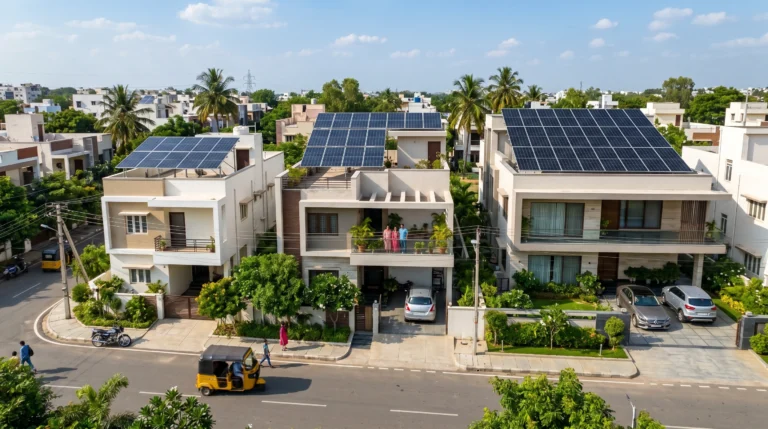
Choosing the right solar system size is one of the most important decisions before installing rooftop solar. A 3kW, 5kW, or 10kW solar system can significantly reduce your electricity bills, but the right capacity depends on your monthly electricity consumption, number of appliances, AC usage, available roof space, and future power requirements.
For homeowners in Hyderabad, selecting the correct system size is especially important because installing a system that is too small may not meet your household’s energy needs, while choosing an unnecessarily large system can increase the initial investment. This guide provides a clear 3kW vs 5kW vs 10kW solar system comparison, covering electricity generation, roof space, suitable household size, appliance usage, investment considerations, savings potential, and subsidy eligibility.
Whether you are dealing with a high electricity bill, planning to run multiple ACs, building a new home, or considering an EV in the future, this comparison will help you understand which solar capacity is better suited to your requirements.
The best solar system is not simply the largest one—it is the system capacity that matches your actual electricity consumption, available roof space, and future energy requirements.
The ideal solar system size depends on:
The goal is to install a system that matches your consumption pattern while maximizing long-term savings.
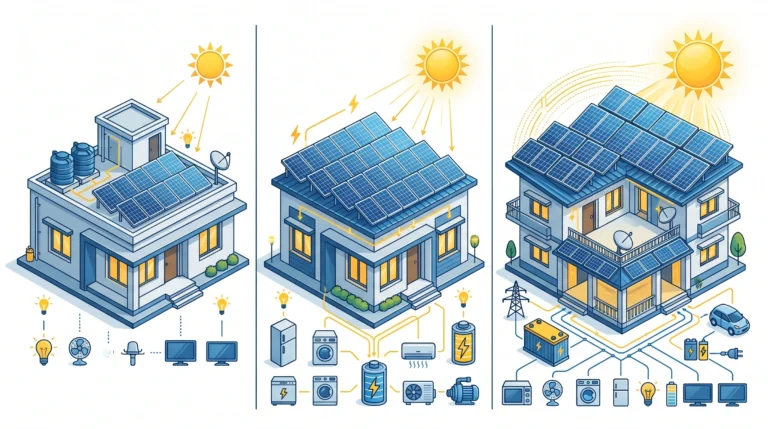
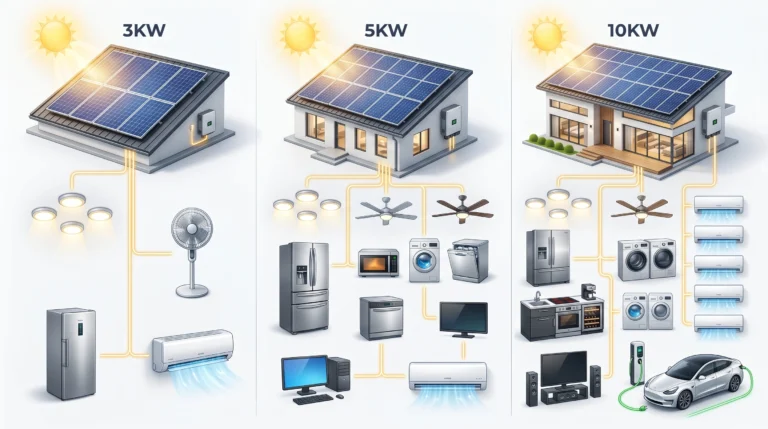
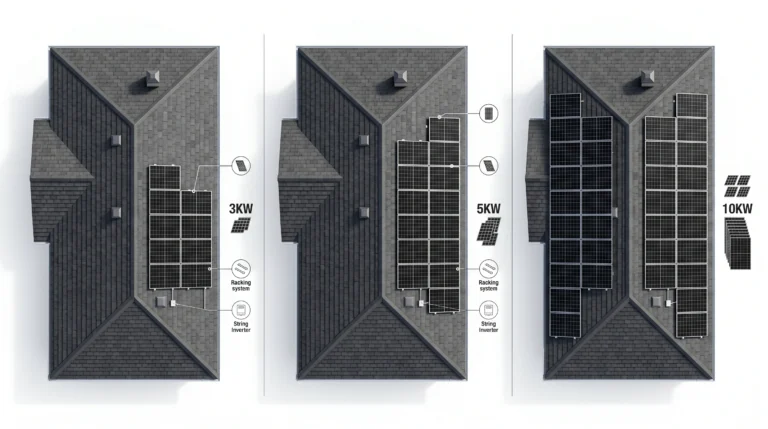
Choosing the right solar system depends on your electricity consumption, appliance usage, available roof space and future energy requirements. Compare the key differences between 3kW, 5kW and 10kW solar systems below.
| Feature | 3kW Solar System | 5kW Solar System | 10kW Solar System |
|---|---|---|---|
| System Capacity | 3,000 Watts (3kW) | 5,000 Watts (5kW) | 10,000 Watts (10kW) |
| Average Daily Generation | 12–15 Units | 20–25 Units | 40–50 Units |
| Average Monthly Generation | 360–450 Units | 600–750 Units | 1,200–1,500 Units |
| Roof Space Required | 180–250 sq. ft. | 300–450 sq. ft. | 600–900 sq. ft. |
| Ideal Home Type | 1–2 BHK / Small Homes | 3–4 BHK / Medium–Large Homes | Villas / Large Homes |
| Typical AC Usage | Up to 1 AC | Around 2–3 ACs | Multiple ACs |
| Typical Electricity Consumption | Moderate | High | Very High |
| Typical Monthly Bill Offset | ₹2,000–₹4,500 | ₹4,000–₹8,000 | ₹8,000–₹15,000+ |
| Best Suited For | Small households with moderate consumption | Families with higher consumption and multiple appliances | Large homes, villas and high-energy households |
| Future Expansion Potential | Suitable for basic requirements | Good balance of capacity and flexibility | Better for high loads and future energy needs |
| Typical Payback Period | 3–6 Years | 3–6 Years | 4–7 Years |
Which solar system should you choose? A 3kW system can be suitable for smaller households with moderate electricity consumption, while a 5kW system offers a practical balance for homes with higher usage and multiple appliances. A 10kW system is better suited to large homes, villas and households with high electricity consumption. The right system size should be based on your actual electricity consumption—not simply the size of your home.
The right solar system size depends on your average electricity consumption, monthly electricity bill, appliance usage, available roof space and future energy requirements. A larger system is not automatically better. The ideal capacity is the one that matches your actual electricity needs and available rooftop area.
Best for small households with moderate electricity consumption.
Best for homes with higher electricity consumption and multiple appliances.
Best for large homes, villas and high-energy households.
One of the easiest ways to estimate the solar capacity you may need is to start with your average monthly electricity consumption. Check your recent electricity bills and calculate your average monthly units.
As a general planning range, a 1kW rooftop solar system may generate approximately 120–150 units per month under suitable conditions. Actual generation can vary depending on location, sunlight, shading, roof orientation, panel technology, system efficiency and weather.
Suppose your household consumes approximately 600 units per month.
| Calculation | Estimated Result |
|---|---|
| Monthly electricity consumption | 600 units |
| Expected generation per 1kW | 120–150 units/month |
| Estimated requirement | Approximately 4–5kW |
| Practical system options | 4kW or 5kW, subject to site assessment |
Important: This calculation provides an initial estimate and should not be treated as a final system-sizing recommendation. Solar capacity should also consider your sanctioned load, electricity tariff, roof area, shading, panel orientation, inverter configuration, net-metering requirements and future electricity consumption.
Share your average monthly electricity bill, location and major appliance requirements with our solar team. A professional assessment can help determine a suitable system capacity for your home.
Get a Solar ConsultationWho Should Choose a 3KW Solar System?
A 3KW solar system is ideal for:
Typical Monthly Consumption
250–450 Units
Appliances Supported
A 3KW system can comfortably support:
Lower Initial Investment
A 3KW system requires less upfront investment compared to larger systems.
Faster ROI
Because of the lower investment cost, many homeowners achieve a faster return on investment.
Ideal for Moderate Usage
Perfect for households that do not heavily rely on air conditioners.
A 3KW system may not be suitable if:
Who Should Choose a 5KW Solar System?
A 5KW solar system is one of the most popular choices among Indian homeowners.
It is suitable for:
Typical Monthly Consumption
500–700 Units
Appliances Supported
A 5KW solar system can easily handle:
Excellent Balance Between Cost and Savings
Many homeowners find that 5KW delivers the best overall value.
Significant Bill Reduction
Can reduce electricity bills by 70–100% depending on usage patterns.
Future-Proofing
Provides additional capacity for growing electricity needs.
A 5KW system may be oversized for homes consuming less than 300 units per month.
Who Should Choose a 10KW Solar System?
A 10KW solar system is designed for:
Typical Monthly Consumption
1,000+ Units
Appliances Supported
A 10KW solar system can power:
Maximum Savings
A 10KW system can dramatically reduce high electricity bills.
Ideal for Luxury Homes
Perfect for homes with significant daily electricity consumption.
Supports Future Energy Expansion
Ideal for households planning:
If your monthly consumption is below 600 units, a 10KW system may not be the most cost-effective choice.
Before choosing a solar system, ensure your roof has adequate space.
3KW Solar System
Required Roof Space:
180–250 sq.ft.
Suitable For:
5KW Solar System
Required Roof Space:
300–450 sq.ft.
Suitable For:
10KW Solar System
Required Roof Space:
600–900 sq.ft.
Suitable For:
3KW Solar System
Monthly Savings:
₹2,000–₹4,500
Annual Savings:
₹24,000–₹54,000
5KW Solar System
Monthly Savings:
₹4,000–₹8,000
Annual Savings:
₹48,000–₹96,000
10KW Solar System
Monthly Savings:
₹8,000–₹15,000+
Annual Savings:
₹1,00,000–₹1,80,000+
Choose 3KW If:
✔ Monthly consumption is below 450 units
✔ You live in a 2 BHK home
✔ Electricity bills are between ₹2,000–₹4,000
✔ Limited roof space is available
Choose 5KW If:
✔ Monthly consumption is 500–700 units
✔ You own a 3 BHK home
✔ You use 1–2 ACs regularly
✔ Electricity bills are ₹4,000–₹8,000
Choose 10KW If:
✔ Monthly consumption exceeds 1,000 units
✔ You own a villa or large independent house
✔ Multiple ACs operate daily
✔ You plan to install an EV charger
Choosing Based Only on Budget
The cheapest system is not always the most economical long-term solution.
Ignoring Future Consumption
Future additions such as:
can increase energy demand.
Not Reviewing Electricity Bills
Your past 12 months of electricity bills provide valuable insights into actual energy consumption.
Ignoring Roof Constraints
Roof size and shading must be evaluated before finalizing system capacity.
Homeowners in:
are increasingly opting for 5KW and 10KW systems due to:
Is a 3KW solar system enough for a home?
Yes, for small households consuming up to 450 units per month.
How many ACs can a 5KW solar system support?
A 5KW system can comfortably support 1–2 air conditioners along with regular household appliances.
Is a 10KW solar system worth it?
Yes, for households with high electricity consumption and long-term energy needs.
Can I upgrade my solar system later?
Yes. Most systems can be expanded, subject to inverter compatibility and available roof space.
Which solar system provides the best ROI?
For many Indian households, a 5KW solar system offers the best balance of investment, savings, and future readiness.
At Roof Rays Solar, we help homeowners choose the right solar system size based on:
Our Services
✅ Residential Solar Installation
✅ Commercial Solar Solutions
✅ On-Grid Solar Systems
✅ Hybrid Solar Systems
✅ Subsidy Assistance
✅ Net Metering Support
✅ End-to-End Installation
📍 HUDA Complex, Tellapur, Hyderabad
Contact our solar experts today for a free consultation and personalized solar savings estimate.
The right solar system size depends on your electricity consumption, roof space, budget, and future energy needs.
A professional solar assessment ensures you invest in the right system today while maximizing savings for the next 25 years.
© 2025 Roof Rays Solar Solutions. All Rights Reserved. | Designed by MANI
Check whether your property qualifies for rooftop solar subsidy support.