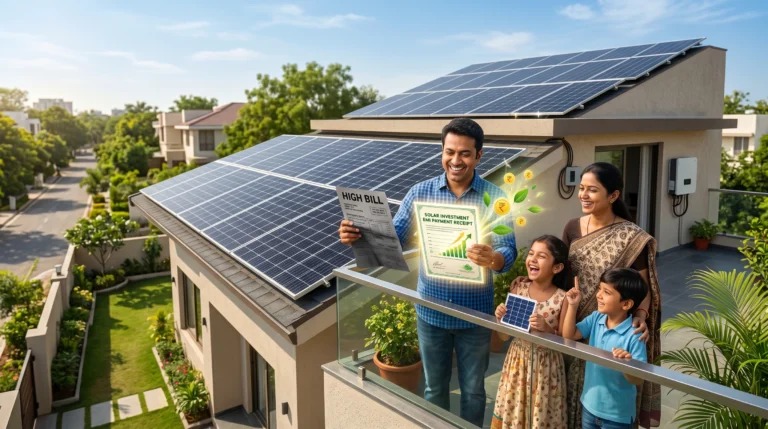
Many homeowners want to switch to solar but often hesitate because of one concern:
“Should I continue paying my monthly electricity bill or invest in solar through EMI?”
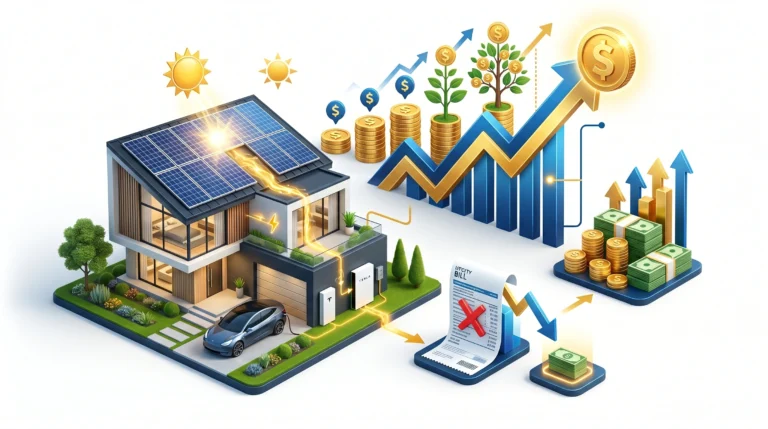
At first glance, paying an electricity bill may seem easier because it doesn’t require an upfront investment. However, when you compare the long-term costs, a solar system financed through EMI can often cost less per month than your electricity bill while helping you build an asset that generates free electricity for decades.
With electricity tariffs rising every year and attractive financing options now available, many homeowners are discovering that a solar EMI can be lower than their monthly power bill.
In this guide, we’ll compare Solar EMI vs Electricity Bill, analyze costs, savings, return on investment, and help you determine which option makes more financial sense for your home.
Before comparing costs, let’s understand what you’re paying for in each scenario.
When you pay your electricity bill:
Essentially, you’re paying for energy consumption indefinitely.
When you choose solar financing:
In simple terms, you’re investing in an energy-producing asset.
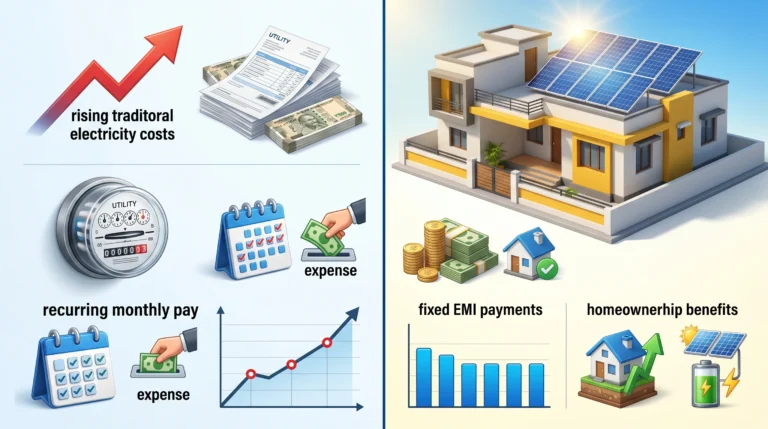
Feature | Electricity Bill | Solar EMI |
|---|---|---|
Monthly Payment | Continues Forever | Fixed Tenure |
Ownership | No Asset Created | You Own the Solar System |
Cost Increases | Yes | No |
Long-Term Savings | None | Significant |
Return on Investment | No | Yes |
Protection from Tariff Hikes | No | Yes |
Energy Independence | No | Yes |
Many homeowners assume their electricity bills will remain stable.
In reality, electricity costs often increase due to:
A ₹3,000 monthly electricity bill today could become ₹5,000 or more in the coming years.
Solar helps reduce dependence on these increasing costs.
Let’s compare a real-world scenario.
Monthly Electricity Bill:
₹5,000
Annual Electricity Cost:
₹60,000
₹60,000
₹6,00,000
₹15,00,000
This estimate doesn’t include future tariff increases.
Actual costs could be significantly higher.
5KW Rooftop Solar System
₹3,000–₹5,000 per month (depending on loan tenure and financing terms)
₹200–₹800 per month
Often comparable to or lower than the previous electricity bill.
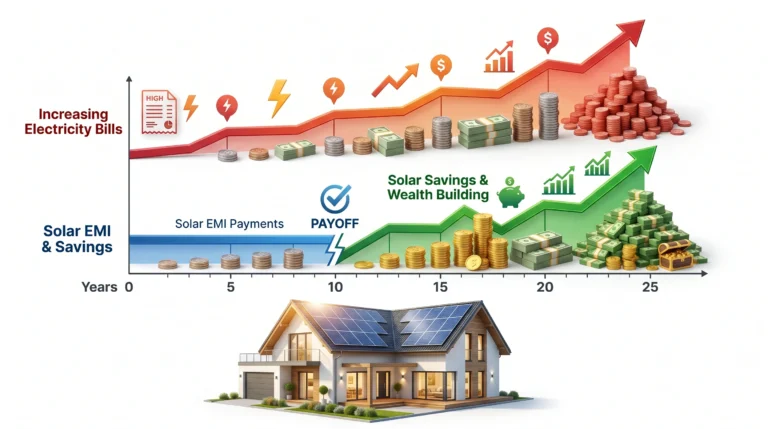
After EMI completion, the solar system continues generating electricity while monthly costs drop dramatically.
Many homeowners are surprised to learn that:
Their solar EMI can be equal to or lower than their existing electricity bill.
Example:
Before Solar
Electricity Bill:
₹6,000 per month
After Solar
Solar EMI:
₹4,500 per month
Remaining Electricity Charges:
₹500 per month
Total Monthly Cost
₹5,000 per month
Monthly Savings
₹1,000
In addition to savings, you’re building ownership of a solar asset.
This is where solar becomes extremely powerful financially.
During EMI Period
Monthly Payment:
EMI + Minimal Electricity Charges
After EMI Completion
Electricity Bill:
Typically 70–100% lower
No EMI
No Loan Payment
Substantial Monthly Savings
The solar system continues generating electricity for 20+ additional years.
Let’s assume:
Monthly Electricity Bill
₹5,000
Annual Electricity Cost
₹60,000
25-Year Electricity Expense
₹15,00,000+
Solar Installation
5KW Solar System
Payback Period
3–6 Years
Estimated 25-Year Savings
₹10–20 Lakhs+
Depending on:
No Large Upfront Investment
Financing options make solar accessible without paying the full amount upfront.
Immediate Bill Reduction
Savings start from the first month after installation.
Better Cash Flow Management
Predictable monthly payments help with budgeting.
Increased Property Value
Solar-equipped homes are often more attractive to buyers.
Long-Term Energy Security
Generate your own electricity and reduce dependence on utility companies.
Solar financing is particularly beneficial if:
✔ Monthly electricity bill exceeds ₹3,000
✔ You plan to stay in the property long term
✔ You have adequate rooftop space
✔ You want to avoid future tariff increases
✔ You prefer monthly payments over a large upfront investment
Paying upfront may be advantageous if:
✔ You have available funds
✔ You want maximum ROI
✔ You prefer avoiding financing costs
✔ You want faster overall payback
Even then, many homeowners choose EMI financing to preserve liquidity.
Solar System Size
Larger systems generally have higher EMIs but also generate greater savings.
Loan Tenure
Longer tenure:
Shorter tenure:
Interest Rate
Financing costs vary based on:
Subsidy Benefits
Government subsidies reduce the total project cost, helping lower financing requirements.
Myth: Solar Is Too Expensive
Reality:
Financing options have made solar affordable for most homeowners.
Myth: EMI Is an Extra Expense
Reality:
EMI often replaces part of your existing electricity bill.
Myth: Solar Takes Decades to Recover Cost
Reality:
Most residential systems recover costs within 3–6 years.
Myth: Solar Requires Constant Maintenance
Reality:
Modern solar systems require minimal maintenance.
Homeowners across:
are increasingly choosing solar financing due to:
Is solar EMI cheaper than my electricity bill?
In many cases, yes. Depending on system size and financing terms, solar EMI can be equal to or lower than your current electricity bill.
What happens after the solar loan is repaid?
The solar system continues generating electricity while your monthly costs reduce significantly.
Is solar worth financing?
For most homeowners with moderate to high electricity consumption, financing can provide immediate savings and long-term returns.
How much can I save with solar?
Savings vary based on system size and electricity consumption, but many homeowners save several lakhs over the system’s lifetime.
Does solar financing affect subsidy eligibility?
Eligible homeowners can still benefit from applicable subsidy programs, subject to prevailing government guidelines.
Can I prepay my solar loan?
Many lenders allow partial or complete prepayment, though terms vary by financing provider.
Is a solar system an asset?
Yes. Unlike electricity bill payments, a solar system is an asset that generates value for decades.
At Roof Rays Solar, we help homeowners find the most cost-effective path to solar ownership.
Our Services
✅ Residential Solar Installation
✅ Commercial Solar Solutions
✅ Solar Financing Assistance
✅ PM Surya Ghar Subsidy Support
✅ Net Metering Assistance
✅ Professional Installation
✅ Long-Term Maintenance Support
We evaluate your electricity bills, roof space, and financial goals to recommend the ideal solar solution.
Phone
Address
📍 HUDA Complex, Tellapur, Hyderabad
Contact our solar experts today for a free consultation and personalized solar savings estimate.
When comparing Solar EMI vs Electricity Bill, the difference becomes clear over the long term.
An electricity bill is a recurring expense that continues indefinitely and increases over time. A solar EMI, on the other hand, helps you build ownership of an asset that generates electricity for 25 years or more.
For many homeowners, solar financing offers the opportunity to reduce monthly energy expenses, protect against rising tariffs, and achieve substantial long-term savings.
If you’re paying high electricity bills every month, now may be the perfect time to explore a rooftop solar solution and start investing in your energy future.
© 2025 Roof Rays Solar Solutions. All Rights Reserved. | Designed by MANI
Check whether your property qualifies for rooftop solar subsidy support.