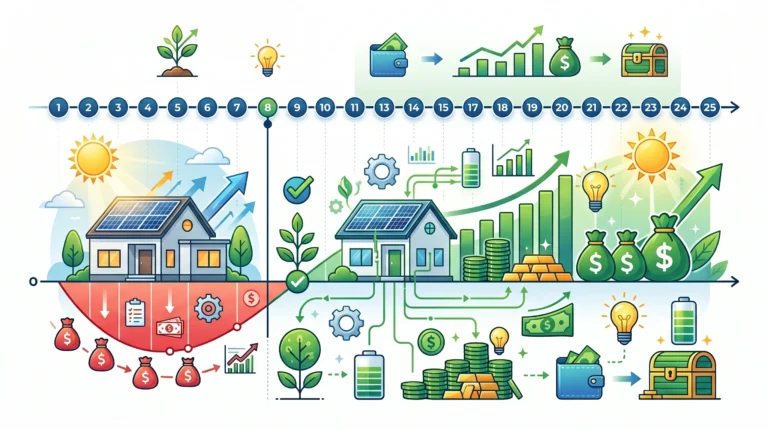
One of the first questions homeowners ask before investing in solar energy is:
“How long will it take for my solar system to recover its cost?”
This is known as the Solar Payback Period or Solar ROI (Return on Investment).
Unlike many household purchases, a solar system is an investment that generates financial returns every month by reducing your electricity bills. Once the system has recovered its installation cost, the electricity it produces is essentially free for the remaining life of the system.
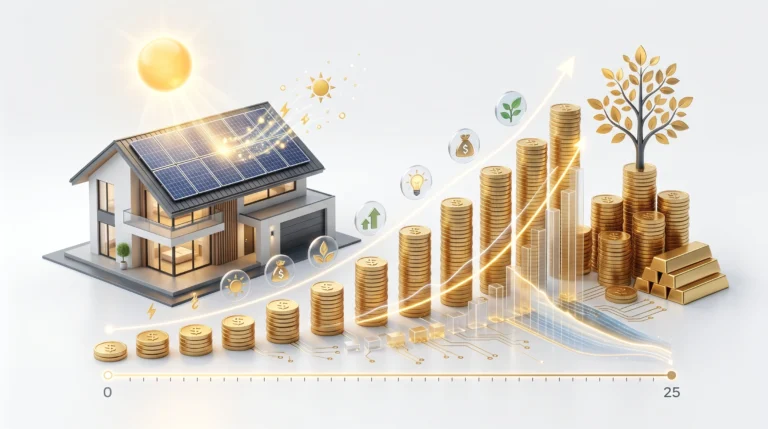
For most homeowners in India, rooftop solar systems typically recover their investment within 3 to 6 years, while continuing to generate savings for 20+ additional years.
In this guide, we’ll explain how solar ROI works, how to calculate your payback period, and the factors that affect your overall returns.
The Solar Payback Period is the amount of time required for the total savings generated by a solar system to equal the amount invested in purchasing and installing it.
In simple terms:
Example
Solar Installation Cost:
₹2,00,000
Annual Electricity Savings:
₹50,000
Payback Period:
4 Years
After four years, the system has effectively paid for itself.
Every year after that represents pure savings.
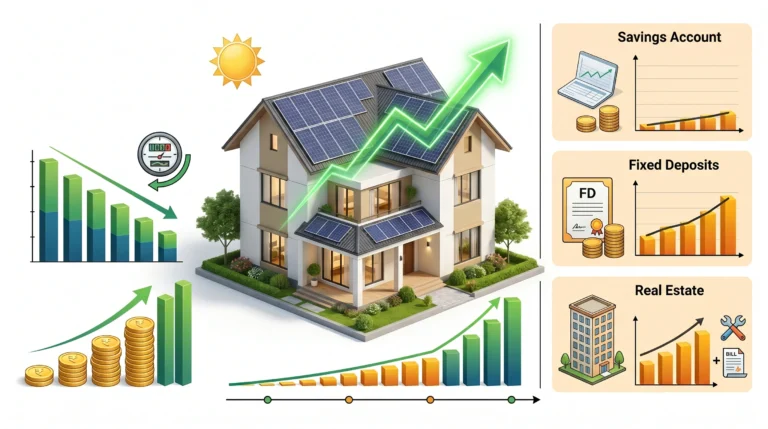
Most household expenses provide convenience but no financial return.
Examples include:
While useful, they don’t generate income or savings.
A rooftop solar system is different because it:
This is why many homeowners consider solar one of the safest long-term investments available.
ROI stands for Return on Investment.
It measures how much financial benefit you receive from your solar system compared to its installation cost.
Simple ROI Formula
ROI=Total Savings−InvestmentInvestment×100ROI = \frac{Total\ Savings – Investment}{Investment} \times 100ROI=InvestmentTotal Savings−Investment×100
A higher ROI means your solar investment is delivering greater financial returns.
The payback period varies based on:
Typical Residential Payback Period
Solar System Size | Average Payback Period |
1KW | 4–7 Years |
3KW | 3–5 Years |
5KW | 3–5 Years |
10KW | 4–6 Years |
Homes with higher electricity consumption often achieve faster payback because they save more on electricity bills.
Let’s consider a homeowner in Hyderabad.
Existing Electricity Bill
Monthly Bill:
₹5,000
Annual Electricity Cost:
₹60,000
Solar Installation
System Size:
5KW
Net Installation Cost (After Subsidy):
₹1,80,000
Annual Savings
Approximate Savings:
₹60,000
Payback Calculation
Payback Period=Installation CostAnnual SavingsPayback\ Period = \frac{Installation\ Cost}{Annual\ Savings}Payback Period=Annual SavingsInstallation Cost
₹1,80,000 ÷ ₹60,000
= 3 Years
In this scenario, the homeowner recovers the entire investment in approximately three years.
This is where solar becomes extremely valuable.
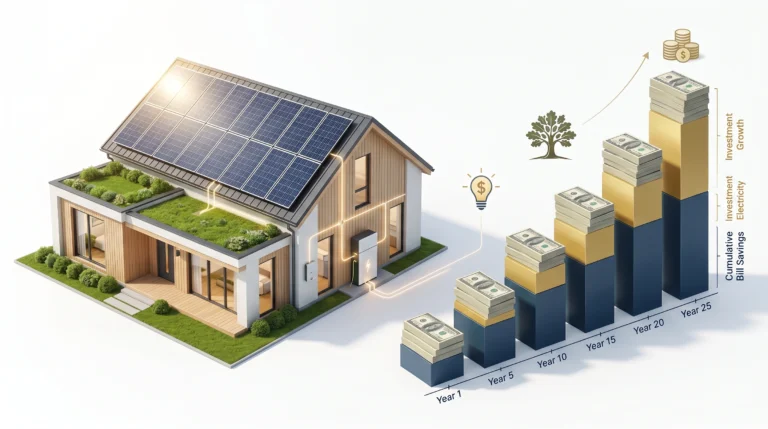
Years 1–3
Recovering installation cost through bill savings.
Years 4–25+
Significant electricity savings continue.
Monthly electricity costs remain low.
The system keeps generating power with minimal operating expenses.
Example
Annual Savings:
₹60,000
Remaining Life After Payback:
22 Years
Total Additional Savings:
₹13,20,000
This demonstrates why solar offers exceptional long-term value.
1. Electricity Consumption
Higher electricity consumption generally leads to greater savings and faster cost recovery.
Faster Payback
Slower Payback
2. Solar System Size
Choosing the right system size is essential.
A properly sized system maximizes both savings and ROI.
Oversized systems may increase investment without delivering proportional benefits.
3. Government Subsidies
Subsidies significantly reduce installation costs.
Lower investment means faster cost recovery.
This is one reason the PM Surya Ghar scheme has accelerated rooftop solar adoption across India.
4. Electricity Tariffs
Higher electricity tariffs improve solar ROI.
As electricity prices increase over time, solar savings generally increase as well.
5. Solar Generation Performance
Performance depends on:
Hyderabad’s excellent solar conditions contribute to strong system performance and attractive payback periods.
Monthly Bill: ₹2,000
Typical Payback:
5–7 Years
Monthly Bill: ₹4,000
Typical Payback:
4–5 Years
Monthly Bill: ₹6,000
Typical Payback:
3–4 Years
Monthly Bill: ₹10,000+
Typical Payback:
2.5–4 Years
Homeowners with larger electricity bills often see the fastest returns.
Example:
Home A
Monthly Bill:
₹2,000
Annual Savings:
₹24,000
Home B
Monthly Bill:
₹8,000
Annual Savings:
₹96,000
Even if Home B installs a larger system, the higher annual savings often lead to faster cost recovery.
Many homeowners compare solar to common investment options.
Fixed Deposit
Returns depend on interest rates and taxation.
Savings Account
Generally offers lower returns.
Real Estate
Requires significant capital and carries market risks.
Solar
Provides:
Unlike many investments, solar generates value through reduced expenses rather than market appreciation.
Choosing the Wrong System Size
Improper sizing can reduce savings.
Poor Installation Quality
Substandard installation may lower system performance.
Ignoring Roof Shading
Shading reduces energy generation and extends payback periods.
Selecting Low-Quality Components
Premium components often deliver better lifetime returns.
Homeowners in:
benefit from:
These factors contribute to attractive solar payback periods and long-term savings.
What is the average solar payback period in India?
Most residential solar systems recover their cost within 3–6 years.
Does subsidy reduce the payback period?
Yes. Subsidies reduce the installation cost, helping homeowners recover their investment faster.
What happens after solar recovers its cost?
The system continues generating electricity, allowing homeowners to enjoy years of additional savings.
Is solar a good investment?
For most homeowners with moderate to high electricity consumption, solar offers excellent long-term returns.
Does solar ROI improve over time?
Yes. Rising electricity tariffs generally increase the value of solar-generated electricity.
Can a solar system last beyond its payback period?
Absolutely. Most quality solar panels are designed to operate for 25 years or more.
Is solar worth it for low electricity consumption?
Yes, although payback periods may be slightly longer compared to high-consumption households.
At Roof Rays Solar, we help homeowners maximize solar ROI through carefully designed rooftop solar solutions.
Our Services
✅ Residential Solar Installation
✅ Commercial Solar Solutions
✅ On-Grid Solar Systems
✅ Hybrid Solar Systems
✅ Subsidy Assistance
✅ Net Metering Support
✅ Professional Installation
✅ Long-Term Maintenance Support
Our team evaluates your electricity usage and roof space to design a solar system that delivers the best possible return on investment.
Phone
Address
📍 HUDA Complex, Tellapur, Hyderabad
Contact our solar experts today for a free consultation and personalized solar savings estimate.
The Solar Payback Period is one of the strongest reasons homeowners choose rooftop solar.
With most systems recovering their cost within 3–6 years and continuing to generate electricity for 25 years or more, solar offers substantial long-term financial benefits.
Whether your goal is reducing electricity bills, improving energy independence, or achieving a strong return on investment, rooftop solar remains one of the smartest investments available for homeowners in India today.
© 2025 Roof Rays Solar Solutions. All Rights Reserved. | Designed by MANI
Check whether your property qualifies for rooftop solar subsidy support.