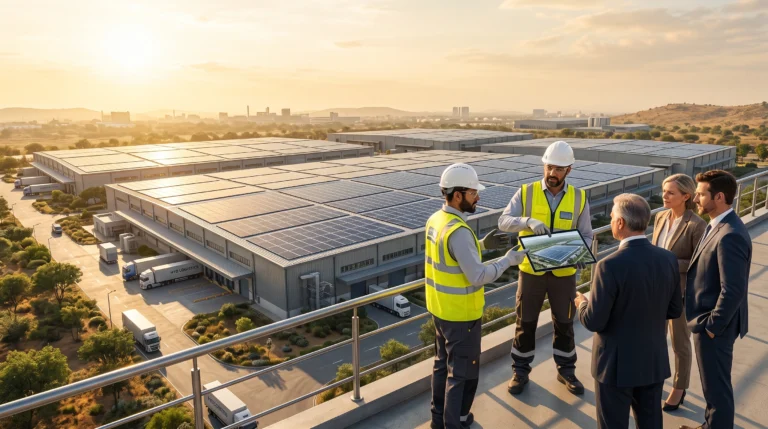
Electricity is one of the highest operating expenses for factories, warehouses, logistics centers, and manufacturing industries. As power tariffs continue to increase, many businesses are turning to industrial solar solutions in Hyderabad to reduce operating costs, improve profitability, and achieve long-term energy security.
Hyderabad has emerged as one of India’s leading industrial and manufacturing hubs, with thousands of factories, industrial parks, warehouses, pharmaceutical companies, food processing units, engineering industries, textile manufacturers, and logistics facilities operating across the city. Most of these businesses consume large amounts of electricity every day, making rooftop solar a highly practical investment.
Industrial solar systems utilize unused factory rooftops, warehouse roofs, and industrial buildings to generate clean electricity. Instead of depending entirely on grid power, businesses can produce a significant portion of their own electricity, lowering monthly utility bills while improving operational efficiency.
Modern industrial solar systems are highly reliable, require minimal maintenance, and continue generating electricity for over 25 years. With proper system design and professional installation, businesses can achieve substantial long-term savings while supporting sustainability goals.
This comprehensive guide explains everything you need to know about industrial solar solutions in Hyderabad, including system sizes, installation costs, government policies, return on investment, and the complete installation process.
Industrial electricity consumption has increased significantly due to automation, advanced manufacturing processes, modern machinery, and expanding production facilities. Rooftop solar offers industries a reliable way to reduce one of their largest recurring operational costs.
Some of the major reasons industries are investing in solar include:
For many industrial businesses, rooftop solar has become a strategic investment rather than simply an environmental initiative.
What Are Industrial Solar Solutions?
Industrial solar solutions are large-scale photovoltaic (PV) systems installed on factories, warehouses, manufacturing plants, logistics facilities, industrial buildings, and processing units to generate electricity for business operations.
A complete industrial solar system generally includes:
The electricity generated can power:
Benefits of Industrial Solar Solutions
Installing rooftop solar provides industries with both financial and operational advantages.
Reduce Electricity Costs
Generating electricity on-site helps reduce dependence on utility power, lowering one of the largest recurring business expenses.
Improve Business Profitability
Lower electricity costs improve operating margins and allow businesses to allocate funds toward expansion, automation, and innovation.
Faster Return on Investment
Industrial solar systems generate electricity every day using free sunlight, helping businesses recover their investment through long-term electricity savings.
Utilize Unused Rooftop Space
Large factory and warehouse rooftops often remain unused. Installing solar panels transforms these rooftops into productive energy-generating assets.
Low Maintenance
Industrial solar systems require minimal maintenance. Periodic cleaning and preventive inspections help maintain efficient operation.
Support Sustainability Goals
Using renewable energy helps businesses reduce their environmental impact while meeting corporate sustainability and ESG objectives.
Increase Property Value
Industrial facilities equipped with solar infrastructure may become more attractive to investors, buyers, and long-term tenants due to lower operating costs.
Industries That Benefit Most from Industrial Solar
Industrial rooftop solar is suitable for a wide range of sectors.
Manufacturing Plants
Manufacturing facilities often consume large amounts of electricity for production lines, machinery, lighting, and utilities. Solar helps reduce production costs and improve profitability.
Warehouses & Distribution Centers
Warehouses generally have expansive rooftops that are ideal for large-scale solar installations. Solar can power lighting, ventilation, office operations, and logistics equipment.
Pharmaceutical Industries
Hyderabad is known as India’s pharmaceutical hub. Pharmaceutical manufacturing facilities require continuous electricity for production equipment, laboratories, HVAC systems, and quality control operations.
Food Processing Units
Food processing industries rely on refrigeration, processing machinery, packaging equipment, and cold storage. Solar helps lower electricity expenses across these operations.
Textile & Garment Industries
Textile manufacturing facilities consume electricity for spinning, weaving, dyeing, finishing, and climate control. Rooftop solar supports long-term cost reduction.
Engineering & Fabrication Units
Engineering industries use heavy machinery, welding equipment, CNC machines, compressors, and fabrication tools, all of which contribute to high electricity consumption.
Logistics Parks
Logistics hubs require electricity for warehouse lighting, security systems, office operations, electric equipment, and material handling. Rooftop solar improves energy efficiency across these facilities.
Types of Industrial Solar Systems
Choosing the right industrial solar system depends on your operational requirements, energy consumption, and business continuity needs.
On-Grid Industrial Solar System
On-grid systems are connected to the utility grid and are the most common choice for industrial facilities.
Advantages
Best For: Factories, warehouses, industrial parks, logistics centers, pharmaceutical companies, and manufacturing plants with reliable grid connectivity.
Off-Grid Industrial Solar System
Off-grid systems include battery storage and operate independently of the utility grid.
Advantages
Best For: Industries located in areas with limited or unreliable grid access.
Hybrid Industrial Solar System
Hybrid systems combine grid connectivity with battery storage, offering energy savings while maintaining backup power during outages.
Advantages
Best For: Industries with critical production processes where power interruptions can result in operational losses.
Recommended Industrial Solar System Sizes
The ideal industrial solar capacity depends on electricity consumption, available rooftop space, production schedules, and future expansion plans.
Solar Capacity | Suitable For | Estimated Monthly Generation |
50KW | Small manufacturing units | 6,000–7,500 Units |
100KW | Medium factories & warehouses | 12,000–15,000 Units |
250KW | Large manufacturing plants | 30,000–37,500 Units |
500KW | Industrial campuses | 60,000–75,000 Units |
1MW+ | Large industrial facilities | 1,20,000–1,50,000 Units |
A detailed energy audit is essential to determine the optimum system size based on current operations and future business growth.
Industrial Solar Installation Cost in Hyderabad (2026)
Industrial solar project costs vary depending on system size, solar panel technology, roof structure, electrical infrastructure, and engineering requirements.
Estimated Investment
Solar Capacity | Estimated Project Cost* |
50KW | ₹18 Lakhs – ₹28 Lakhs |
100KW | ₹35 Lakhs – ₹55 Lakhs |
250KW | ₹80 Lakhs – ₹1.25 Crore |
500KW | ₹1.5 Crore – ₹2.4 Crore |
1MW+ | Custom Project Pricing |
Note: These are indicative estimates. Actual costs depend on equipment specifications, site conditions, electrical upgrades, structural requirements, and applicable government policies.
Roof Space Required
Large industrial rooftops are generally well-suited for solar installations.
Solar Capacity | Approximate Roof Space Required |
50KW | 3,300–4,500 sq. ft. |
100KW | 6,500–8,500 sq. ft. |
250KW | 16,000–20,000 sq. ft. |
500KW | 32,000–40,000 sq. ft. |
1MW | 65,000–80,000 sq. ft. |
The actual roof area required depends on panel efficiency, mounting structure, roof layout, and shading conditions.
Factors That Affect Industrial Solar Project Costs
Several technical and operational factors influence the total investment required.
Higher electricity usage generally requires a larger system, increasing both project cost and long-term savings potential.
The usable rooftop area determines the maximum solar capacity that can be installed.
High-efficiency monocrystalline and N-Type TOPCon panels can generate more electricity from the same roof space, improving overall system performance.
Industrial rooftops must be evaluated to ensure they can safely support the solar installation.
Transformer capacity, switchgear, protection systems, and electrical distribution networks may require upgrades for larger industrial projects.
Industries planning production expansion should design their solar systems with future energy requirements in mind.
Government Policies & Net Metering
Government initiatives and supportive renewable energy policies have encouraged industries across Hyderabad to adopt rooftop solar. While subsidy programs are primarily focused on residential consumers, industrial and commercial establishments can still benefit from regulatory frameworks such as net metering (subject to prevailing DISCOM and government regulations), financing options, and accelerated renewable energy adoption.
Benefits of Government Support
Businesses should consult an experienced solar EPC company to understand the latest state and central government policies applicable to industrial solar projects.
Net Metering for Industrial Solar
Net metering allows eligible on-grid industrial solar systems to export surplus electricity generated during low-consumption periods back to the electricity grid. Depending on applicable regulations, the exported units are adjusted against electricity imported from the grid.
Advantages of Net Metering
The availability and implementation of net metering depend on the applicable electricity distribution company (DISCOM) regulations and government guidelines.
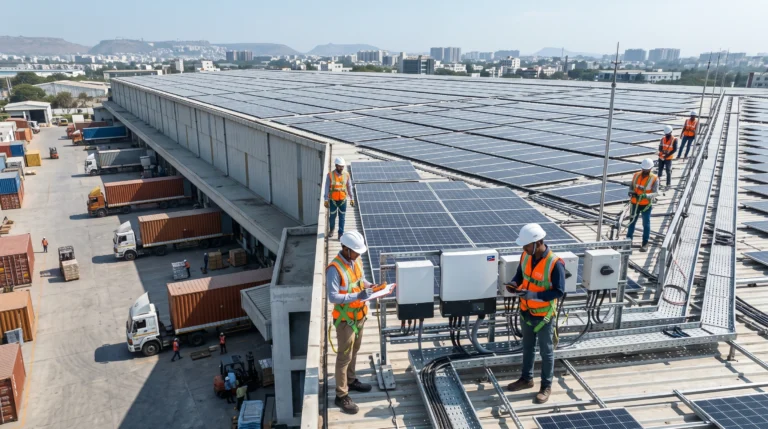
Installing an industrial solar system requires detailed planning, engineering expertise, and quality execution to ensure reliable performance and long-term savings.
Step 1: Energy Audit & Site Survey
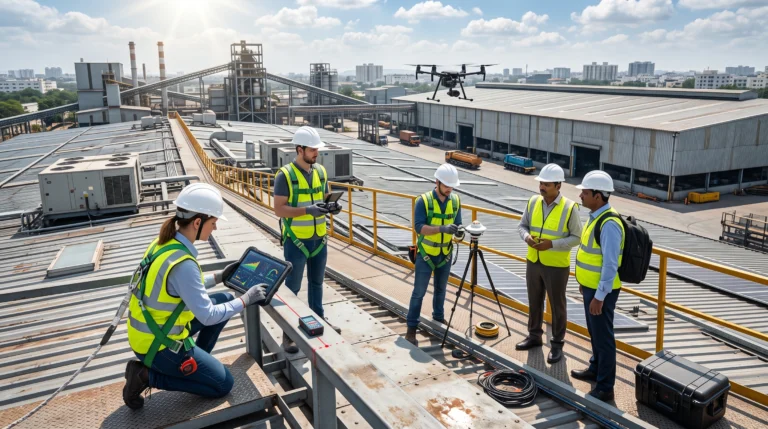
The process begins with a comprehensive assessment of your facility.
During the survey, engineers evaluate:
This information helps determine the ideal system capacity and design.
Step 2: Customized System Design
Based on the site assessment, engineers prepare a tailored solar solution that includes:
A customized design ensures maximum energy production while maintaining operational safety.
Step 3: Proposal & Engineering Approval
A detailed proposal is prepared outlining:
After approval, procurement and project scheduling begin.
Step 4: Installation
Experienced technicians install:
Installation is carried out following industry standards and electrical safety regulations.
Step 5: Testing & Commissioning
Before commissioning, the system undergoes:
Once approved, the system begins generating electricity for industrial operations.
Electricity Bill Savings & Return on Investment (ROI)
Industrial solar offers one of the most attractive long-term returns for energy-intensive businesses. By generating electricity on-site during operational hours, industries can significantly reduce their dependence on grid power.
Estimated Monthly Energy Generation
Solar Capacity | Estimated Monthly Generation |
50KW | 6,000–7,500 Units |
100KW | 12,000–15,000 Units |
250KW | 30,000–37,500 Units |
500KW | 60,000–75,000 Units |
1MW+ | 1,20,000–1,50,000 Units |
Actual generation depends on system design, weather conditions, roof orientation, shading, and equipment efficiency.
Long-Term Business Benefits
Common Mistakes Industries Should Avoid
A well-planned solar project delivers the best results. Avoid these common mistakes to maximize system performance and financial returns.
Choosing the Lowest-Cost Proposal
Selecting a vendor based only on price can lead to lower-quality equipment, poor installation, and reduced long-term performance. Evaluate the overall value, experience, and product quality.
Installing the Wrong System Size
An undersized system may not provide meaningful savings, while an oversized system may not utilize the available energy demand efficiently. A professional energy audit is essential.
Ignoring Roof Structural Assessment
Industrial rooftops must be inspected to ensure they can safely support the additional load of the solar installation.
Overlooking Future Expansion
Industries planning to expand production or add machinery should consider future electricity requirements while designing the system.
Choosing an Inexperienced EPC Partner
Industrial solar projects involve complex engineering, electrical integration, and compliance requirements. Working with an experienced EPC provider helps ensure reliable performance and long-term value.
Real Hyderabad Industrial Success Story
A pharmaceutical manufacturing unit in Genome Valley, Hyderabad, was experiencing high electricity expenses due to continuous production, HVAC systems, laboratory equipment, and utility operations.
After a detailed energy assessment, Roof Rays Solar recommended a 250KW on-grid industrial solar system.
Project Outcomes
This example demonstrates how industrial rooftop solar can convert unused roof space into a valuable energy asset while delivering measurable long-term financial benefits.
What are industrial solar solutions?
Industrial solar solutions are large-scale rooftop photovoltaic (PV) systems installed on factories, warehouses, manufacturing plants, and industrial buildings to generate electricity and reduce energy costs.
Which industries benefit the most from rooftop solar?
Manufacturing units, pharmaceutical companies, food processing plants, engineering industries, logistics parks, textile industries, warehouses, and fabrication units can all benefit from industrial solar.
How much does an industrial solar system cost in Hyderabad?
Project costs vary depending on system capacity, equipment selection, roof structure, electrical infrastructure, and site-specific engineering requirements. A detailed site survey provides the most accurate estimate.
How long do industrial solar panels last?
High-quality industrial solar panels typically deliver reliable performance for 25 years or more, while other components such as inverters have separate warranty periods.
Does industrial solar require frequent maintenance?
No. Regular cleaning, preventive inspections, and periodic servicing are generally sufficient to maintain efficient performance.
Can industrial solar systems be expanded later?
Yes. Many systems can be upgraded as energy requirements increase, provided adequate roof space and electrical infrastructure are available.
Is net metering available for industries?
Eligible on-grid industrial solar systems may benefit from net metering based on applicable DISCOM policies and government regulations.
Is rooftop solar a good investment for industries in Hyderabad?
Yes. Hyderabad’s excellent solar potential, combined with high industrial electricity consumption, makes rooftop solar a practical and financially rewarding long-term investment.
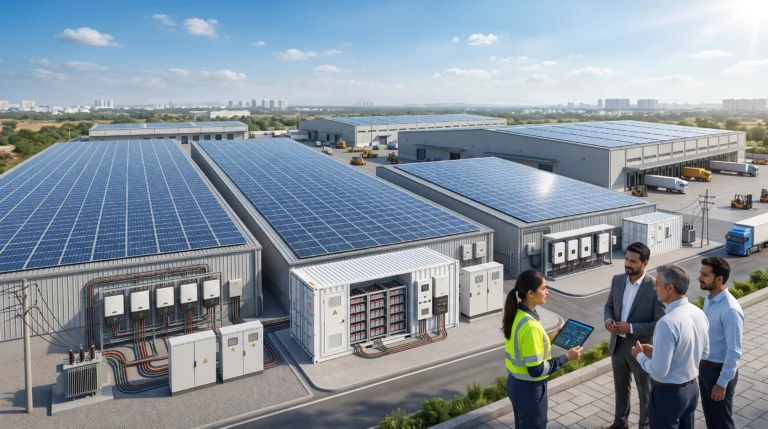
At Roof Rays Solar, we specialize in delivering reliable, high-performance industrial solar solutions for factories, warehouses, manufacturing units, and industrial facilities across Hyderabad and Telangana. We design every project to maximize energy generation, reduce operating costs, and provide dependable performance for decades.
Our experts design customized solar solutions based on your electricity consumption, roof space, and future energy goals—helping you maximize savings and achieve the best possible return on investment.
Phone
Address
📍 HUDA Complex, Tellapur, Hyderabad
Contact our solar experts today for a free consultation and personalized solar savings estimate.
Book Your Free Site Survey Today
Planning to reduce your factory or warehouse electricity costs? Contact Roof Rays Solar today for a free industrial solar site survey and energy assessment. Our experts will evaluate your energy consumption, rooftop potential, and operational requirements to recommend a customized solar solution that delivers maximum savings and long-term value.
Industrial solar has become a strategic investment for factories, warehouses, and manufacturing businesses looking to control energy costs and improve operational efficiency. With Hyderabad’s abundant sunshine and increasing industrial electricity demand, rooftop solar enables businesses to generate clean energy, lower monthly utility bills, and achieve long-term financial savings while supporting sustainability goals.
Whether you operate a manufacturing plant, pharmaceutical facility, logistics center, food processing unit, or engineering workshop, Roof Rays Solar provides customized industrial solar solutions backed by expert engineering, premium equipment, and professional installation. Partner with us to transform your industrial rooftop into a reliable energy asset that powers your business growth for decades to come.
© 2025 Roof Rays Solar Solutions. All Rights Reserved. | Designed by MANI
Check whether your property qualifies for rooftop solar subsidy support.