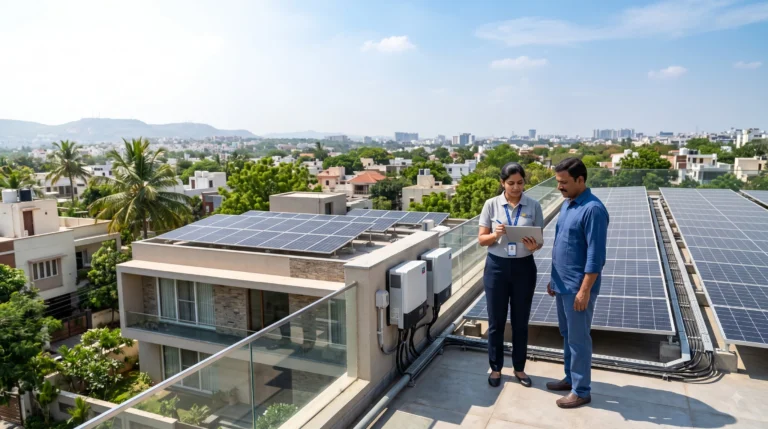
Before installing rooftop solar, homeowners often want to know one important thing: how much electricity will my solar system actually generate?
Knowing how to calculate solar power generation for home can help you understand whether a proposed solar system is appropriately sized, how much electricity it may produce, and how its estimated generation compares with your household consumption.
However, solar generation is not simply equal to the system’s rated capacity multiplied by the number of daylight hours. Actual output changes with sunlight availability, weather, panel temperature, shading, orientation, equipment efficiency, wiring losses and other real-world conditions.
For example, a 5 kW solar system does not continuously generate 5 kW throughout the day. Its output changes throughout the day depending on the available solar radiation.
This guide explains the basic calculation, the meaning of peak sun hours and performance ratio, practical examples, and the factors that can cause actual generation to differ from an estimate.
A simplified formula is:
Daily Solar Generation
Daily Generation ≈ System Capacity × Peak Sun Hours × Performance Ratio
For annual generation:
Annual Solar Generation
Annual Generation ≈ System Capacity × Peak Sun Hours × 365 × Performance Ratio
Where:
Illustrative Example
Assume:
Calculation:
5 × 5 × 0.80 = 20 kWh/day
Estimated annual generation:
20 × 365 = 7,300 kWh/year
That is approximately 7,300 units per year under these assumptions.
This is an illustrative estimate, not a guaranteed output. Actual generation depends on the specific location, roof, weather, equipment and installation conditions.
Key Takeaways
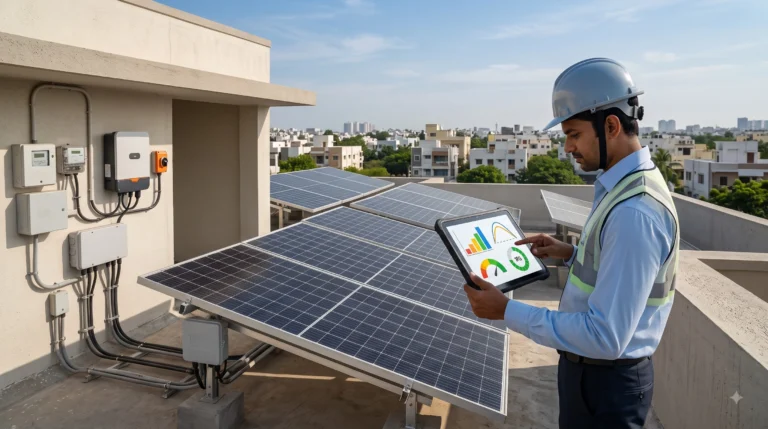
Understanding the difference between capacity and generation is essential.
What Is Solar Capacity?
Solar capacity is measured in kilowatts (kW).
For example:
The kW rating describes the installed system’s rated capacity under specified test conditions.
It does not mean the system will produce that amount of electricity continuously.
What Is Solar Generation?
Solar generation is measured in kilowatt-hours (kWh).
One kWh is commonly referred to as one unit of electricity for billing purposes.
For example, if a solar system generates 20 kWh during a day, it has produced approximately 20 units of electricity.
Remember:
kW = capacity
kWh = energy generated or consumed
This distinction is one of the first things to understand when estimating rooftop solar output.
The Main Formula to Calculate Solar Power Generation
The basic planning formula is:
Daily Generation
Solar Generation = System Capacity × Peak Sun Hours × Performance Ratio
For annual generation:
Annual Solar Generation = System Capacity × Peak Sun Hours × 365 × Performance Ratio
Let’s understand each component.
The first input is the solar system’s installed capacity.
For example:
A larger system can generally generate more electricity under similar conditions, provided the property has sufficient sunlight, suitable roof space and appropriate equipment.
However, the system should not automatically be made as large as possible. Capacity should be matched with electricity consumption, roof conditions and future requirements.
Peak sun hours (PSH) are not simply the number of hours between sunrise and sunset.
Instead, peak sun hours represent the equivalent number of hours of solar irradiation at a standardized strong intensity.
A location may receive sunlight for many hours during the day, but solar radiation varies continuously. Early morning and late afternoon sunlight is generally less intense than the strongest midday period.
Therefore, solar calculations use peak sun hours rather than simply counting all daylight hours.
Peak Sun Hours Can Vary With:
For Hyderabad examples, it is better to use an assumed value for illustration rather than treating one number as guaranteed for every rooftop.
A solar system does not convert all theoretically available sunlight into usable electricity.
The performance ratio (PR) represents the system’s real-world performance after various losses.
These can include:
For simple planning examples, an assumed performance ratio such as 75–85% may be used, but actual performance varies by system design and site conditions.
A professional solar proposal should explain the assumptions used for its generation estimate.
Worked Example: 5 kW Home Solar System
Let’s calculate an illustrative output for a 5 kW residential system.
Assumptions
Step 1: Calculate Daily Generation
5 × 5 × 0.80 = 20 kWh/day
So the illustrative daily generation is:
20 kWh/day
Step 2: Calculate Annual Generation
20 × 365 = 7,300 kWh/year
Therefore:
Estimated annual generation = 7,300 kWh
or approximately:
7,300 units/year
Again, this is an illustrative calculation based on assumed inputs, not a guaranteed production figure for every 5 kW installation.
Illustrative Solar Generation by System Size
Using the same assumptions of 5 peak sun hours and an 80% performance ratio:
Solar System | Assumed PSH | Assumed PR | Approx. Annual Generation |
3 kW | 5 | 80% | 4,380 kWh |
5 kW | 5 | 80% | 7,300 kWh |
10 kW | 5 | 80% | 14,600 kWh |
Important
These figures are illustrative mathematical estimates. They should not be interpreted as guaranteed generation for Hyderabad or any other specific location.
Actual production can differ because of weather, shading, orientation, temperature, soiling, equipment specifications and system availability.
Why Actual Solar Generation Changes
Even two homes with identical 5 kW systems may produce different amounts of electricity.
Shading
Trees, nearby buildings, water tanks, parapet walls and other rooftop structures can reduce sunlight reaching the panels.
Dust and Soiling
Dust accumulation can reduce the sunlight reaching the solar cells. Regular inspection and appropriate cleaning can help maintain performance.
Weather
Cloudy, rainy and overcast conditions can reduce solar generation compared with clear-sky conditions.
Panel Orientation and Tilt
The position and orientation of the panels affect how much sunlight they receive throughout the day.
Temperature
Solar modules can experience reduced electrical output as module temperature rises, depending on their temperature characteristics.
Wiring and Conversion Losses
Electricity passes through cables and an inverter before becoming usable AC electricity. These processes involve losses.
System Downtime
Maintenance, equipment faults or other interruptions can reduce total annual generation.
How to Estimate Generation More Accurately
A simple formula is useful for understanding solar generation, but a real project should use more detailed information.
For a more realistic estimate:
The more site-specific the calculation, the more useful the estimate becomes.
How Solar Generation Relates to Your Electricity Bill
Solar generation and electricity bill savings are related, but they are not exactly the same thing.
Suppose your solar system generates electricity during the afternoon. Your home may consume some of that electricity immediately.
This is known as direct consumption.
If household demand is higher than solar generation, the remaining requirement may come from the grid.
If solar generation exceeds your home’s immediate demand, surplus electricity may potentially be exported to the grid under the applicable utility arrangement.
Therefore, the final electricity bill depends on:
This is why a solar generation estimate should not automatically be presented as an identical amount of bill savings.
How to Calculate the Solar Capacity Your Home Needs
Once you understand expected solar generation, you can work backward to estimate the system capacity your home may require.
A simplified planning formula is:
Required Solar Capacity ≈ Annual Electricity Consumption ÷ (Peak Sun Hours × 365 × Performance Ratio)
Example
Suppose a home consumes approximately 7,200 kWh per year.
Using the same illustrative assumptions:
Then:
7,200 ÷ (5 × 365 × 0.80) ≈ 4.93 kW
This suggests that a system of approximately 5 kW could theoretically produce a similar amount of annual energy under these assumptions.
However, this is only a planning calculation. Actual system sizing should also consider roof space, shading, utility requirements, future consumption and the homeowner’s desired level of solar offset.
Does On-Grid or Hybrid Solar Change Generation?
The solar panels themselves can have similar generation potential under comparable conditions, but the way that electricity is used can differ.
On-Grid Solar
Solar electricity can be used by the home while being generated, while grid electricity can meet remaining demand.
Where applicable, surplus generation may be exported according to the relevant utility arrangement.
Hybrid Solar
A hybrid system adds battery storage. Some solar generation can be used to charge the battery and stored electricity can subsequently be used according to the system configuration.
The battery doesn’t necessarily increase the panels’ generation. Instead, it changes when and how generated electricity can be used.
Solar Installation Process
A professional solar project generally follows these steps:
What Affects Solar Installation Cost?
The cost of a residential solar system depends on several factors:
A larger system generally requires more equipment, but the most appropriate capacity should be determined from your electricity consumption and property conditions rather than choosing the largest available system.
A site survey is recommended before receiving a final quotation.
Government Subsidy & Net Metering
Eligible residential consumers may qualify for applicable government rooftop solar financial assistance. Subsidy eligibility, current amounts, approved installation requirements and documentation should be verified against the latest official guidelines before proceeding.
For grid-connected rooftop solar, surplus electricity may be eligible for net metering or another applicable export arrangement depending on the current electricity utility rules and the property’s connection.
Important: Don’t calculate your solar investment using an old subsidy figure or outdated net-metering rule. Verify the current requirements before making a purchase decision.
Expert Tips for Calculating Solar Generation
kW is system capacity. kWh is electricity generated or consumed.
Peak sun hours represent equivalent strong solar irradiation, not sunrise-to-sunset duration.
Solar irradiation varies by location and season. A Hyderabad estimate should use appropriate local assumptions rather than a generic national figure.
A small-looking obstruction can affect generation depending on its position and the time of day.
A system can produce different amounts of electricity from month to month.
A professional proposal should explain its assumptions, including solar resource, system capacity and losses.
The objective isn’t simply to maximize generation. The system should make sense relative to your home’s electricity requirements.
After installation, monitoring helps you understand how the system is performing against expectations.
At-a-Glance Solar Calculation Guide
Term | Meaning |
kW | Installed solar capacity |
kWh | Electricity generated or consumed |
Peak Sun Hours | Equivalent hours of strong solar irradiation |
Performance Ratio | Accounts for real-world system losses |
Daily Generation | Capacity × PSH × PR |
Annual Generation | Daily generation × 365 |
Solar Capacity | Determined from consumption, site conditions and desired offset |
Illustrative Hyderabad Home Example
Consider a Hyderabad home consuming approximately 600 units per month.
Annual Consumption
600 × 12 = 7,200 kWh/year
Now consider an illustrative 5 kW solar system using:
Estimated Annual Generation
5 × 5 × 365 × 0.80 = 7,300 kWh/year
On paper, the estimated annual generation is close to the home’s annual consumption.
But this does not mean the electricity bill will automatically become zero. Generation varies by month, household consumption occurs at different times, and grid-connected electricity arrangements may involve imports, exports and fixed charges.
The example demonstrates how generation estimates can be compared with annual electricity consumption—not how much every 5 kW system will actually produce.
Use the simplified formula:
System Capacity × Peak Sun Hours × Performance Ratio
For annual generation, multiply the result by 365. For a more accurate estimate, include location, shading, orientation, equipment and seasonal conditions.
kW describes the capacity of a solar system, while kWh measures the amount of electricity generated or consumed.
There is no single guaranteed number. For example, using an illustrative assumption of 5 peak sun hours and 80% performance ratio gives approximately 20 kWh per day, or 7,300 kWh annually. Actual output can vary.
Peak sun hours represent equivalent hours of strong solar irradiation. They are not simply the total number of hours between sunrise and sunset.
Performance ratio accounts for real-world losses such as inverter losses, wiring losses, temperature effects, soiling, mismatch and other system losses.
Yes. Shading can reduce the amount of sunlight reaching the panels and therefore affect energy production. The impact depends on the extent, timing and location of the shading.
Your electricity bills can help determine your annual consumption and required system size, but they don’t directly tell you how much electricity your rooftop can generate. A site assessment is also required.
No. Solar production varies with season, weather, sunlight availability, temperature, shading and other conditions.
A simplified estimate can be made using annual consumption, peak sun hours and performance ratio. The final capacity should also account for roof space, shading, future loads and project requirements.
Roof Rays can review your electricity consumption and assess your rooftop, shading and other site conditions before recommending a suitable solar capacity and generation estimate.
Roof Rays Solar Solutions helps homeowners across Hyderabad and Telangana plan rooftop solar according to their electricity consumption and property conditions.
Why Customers Choose Roof Rays
The approach is simple: understand your energy requirements, assess the property, and recommend a solar solution based on the available information.
Our experts design customized solar solutions based on your electricity consumption, roof space, and future energy goals—helping you maximize savings and achieve the best possible return on investment.
Phone
Address
📍 HUDA Complex, Tellapur, Hyderabad
Contact our solar experts today for a free consultation and personalized solar savings estimate.
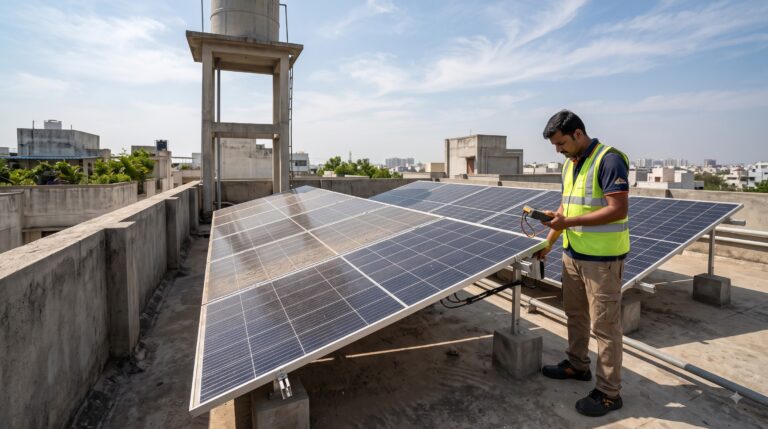
Learning to calculate solar power generation for home starts with understanding three key inputs: system capacity, peak sun hours and performance ratio.
The basic formula provides a useful starting estimate, but actual solar generation depends on the property’s location, roof orientation, shading, weather, temperature, equipment, soiling and system losses.
For homeowners, the most reliable approach is to compare estimated annual solar generation with actual annual electricity consumption and then consider future energy requirements. A professional site survey can make this assessment more specific to the property.
Roof Rays Solar Solutions provides electricity bill analysis, rooftop assessment, solar generation estimation, customized system design, professional installation and ongoing support for homeowners across Hyderabad and Telangana.
Book Your Free Site Survey Today
© 2025 Roof Rays Solar Solutions. All Rights Reserved. | Designed by MANI
Check whether your property qualifies for rooftop solar subsidy support.