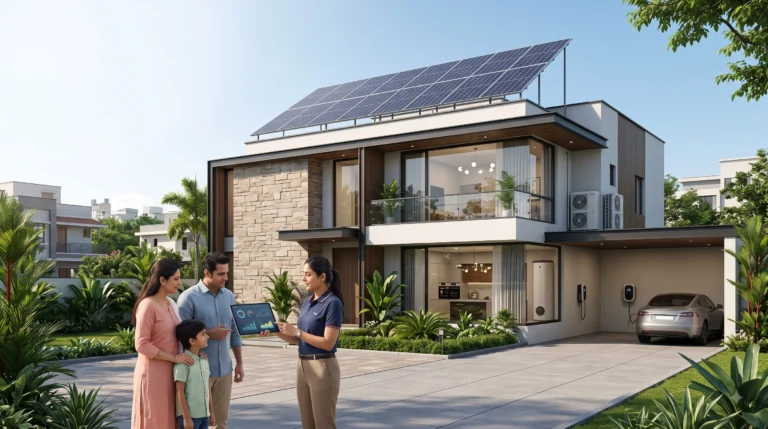
A consistently high electricity bill can make homeowners question whether they are spending too much on grid electricity. In Hyderabad, household consumption can rise considerably during periods of heavy air-conditioner use, while water heaters, refrigerators, kitchen appliances, home-office equipment, and electric vehicles can add further demand.
For these homes, solar for high electricity bill situations can be worth investigating. A properly designed rooftop solar system can generate electricity at the property and potentially reduce the amount of electricity purchased from the grid.
However, a high electricity bill alone does not determine whether solar is the right investment. The important questions are how many units you consume, when you consume them, how much suitable roof space you have, and how much electricity the proposed solar system can realistically generate.
This guide explains how homeowners can evaluate whether rooftop solar makes financial and practical sense, how to determine an appropriate system size, and what to consider before investing.
Rooftop solar is generally worth evaluating when a home has consistently high electricity consumption, suitable rooftop space, adequate sunlight, and long-term plans to remain at the property.
The evaluation should consider:
A high bill can indicate strong potential for solar, but the bill amount alone should not be used to determine system size or expected savings.
Key Takeaways
Get a professional site survey before purchasing a system.
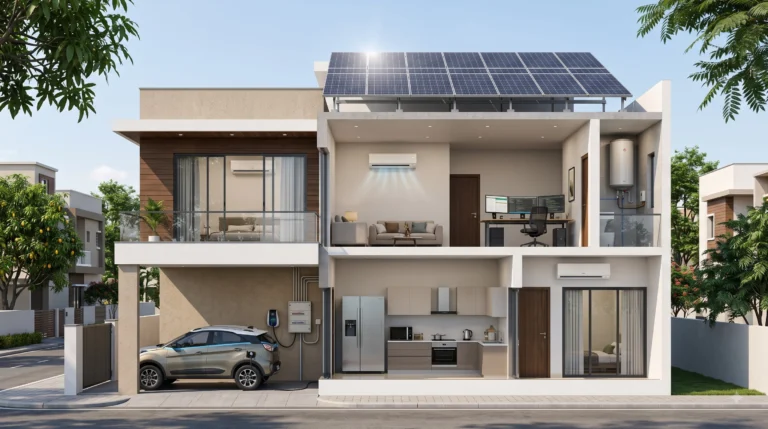
A high electricity bill isn’t necessarily caused by one appliance. Several household loads can combine to produce substantial monthly consumption.
Multiple Air Conditioners
Air conditioners can become one of the largest electricity loads in a home, particularly during Hyderabad’s hotter months.
Usage depends on factors such as:
Homes using multiple ACs regularly may therefore have significantly higher annual electricity consumption.
Water Heaters
Electric geysers and water heaters can add considerable consumption when used frequently.
The impact depends on:
Large Household Appliances
Refrigerators, washing machines, kitchen appliances, lighting and other equipment contribute to overall household electricity demand.
Individually, some loads may appear small, but their combined annual consumption can be significant.
Home Offices
Working from home can add daytime electricity consumption through:
For homes with substantial daytime electricity usage, solar generation can potentially be used directly while it is being produced.
Electric Vehicle Charging
An EV can introduce a significant additional electricity requirement depending on the vehicle, charging frequency, battery capacity and kilometres driven.
If you already own an EV—or plan to purchase one—its expected electricity consumption should be included when evaluating your future solar requirement.
Larger Homes
Larger homes may have higher electricity requirements because they often use more cooling, lighting and appliances.
However, property size alone should never be used to determine solar capacity. Actual electricity consumption is more important.
How to Check Whether Solar Is Worth It
Before purchasing rooftop solar, use a simple evaluation process.
Step 1: Review 12 Months of Electricity Bills
Don’t base your decision on your highest or most recent bill alone.
Review a full year to identify:
This is particularly important in Hyderabad, where summer cooling requirements can significantly affect electricity consumption.
Step 2: Record Annual kWh Consumption
Your electricity bill shows how many units of electricity you consume.
For solar planning, kWh/units consumed are more useful than simply looking at the rupee amount.
For example, two households may have similar bill amounts but different consumption patterns because of tariff structure or billing conditions.
Step 3: Identify Your Major Loads
Make a list of appliances and equipment that contribute significantly to consumption.
Common examples include:
Understanding these loads helps you and your installer evaluate future electricity requirements.
Step 4: Check Daytime Electricity Usage
Solar panels generate electricity during daylight hours.
If your home consumes substantial electricity during the day, some solar generation can potentially be used directly by your household.
This is particularly relevant for homes with:
Step 5: Assess Your Rooftop
A professional site survey should check:
A large roof isn’t automatically a good solar roof if significant portions are shaded or unavailable for installation.
Step 6: Determine a Suitable Solar Capacity
System capacity should be determined using:
The objective isn’t simply to install the largest possible system. It is to install a system that makes sense for the property’s requirements and available solar potential.
Step 7: Compare the Economics
Before investing, consider:
A professional solar proposal should help you understand these factors before making a decision.
How Much Solar Does a High-Bill Home Need?
There is no universal solar capacity for a “high electricity bill” home.
Two households with ₹10,000 monthly bills, for example, may not require identical solar systems because their consumption patterns, tariffs, roof conditions and future requirements may differ.
The appropriate capacity depends on:
Annual Electricity Consumption
Higher annual consumption can support consideration of a larger system, provided adequate roof space and solar generation potential exist.
Roof Space
The available area limits how many panels can practically be installed.
Shading
Shading can reduce the effective solar generation potential of a rooftop.
Daytime Consumption
Understanding when electricity is used helps evaluate how solar generation interacts with household demand.
Future Electricity Requirements
Upcoming EV charging, additional ACs or home expansion should be considered before finalizing the system.
Understanding Solar Savings
It’s important to distinguish between solar generation and electricity bill savings.
Solar Generation
The amount of electricity produced by the solar panels.
Direct Consumption
Solar electricity that your home uses while the panels are generating power.
Grid Import
Electricity purchased from the utility when household demand exceeds available solar generation.
Surplus Export
If applicable, excess generation can be exported to the grid under the relevant utility arrangement.
Final Electricity Cost
Your final bill depends on factors including solar generation, household consumption, tariff structure, grid imports, eligible exports, and applicable utility rules.
Therefore, solar should not automatically be marketed as a way to make every high electricity bill zero.
On-Grid vs Hybrid Solar for High-Bill Homes
On-Grid Solar
An on-grid solar system operates alongside the electricity grid and generally does not include batteries.
It can be suitable for homeowners who primarily want to:
Where eligible, surplus electricity may be exported under applicable net-metering or other utility arrangements.
Hybrid Solar
A hybrid system combines:
Solar + Battery + Grid
It can be considered when homeowners also need:
The additional battery equipment increases upfront cost and introduces considerations such as usable capacity, battery life, maintenance and eventual replacement.
When Solar May Be Less Suitable
A high electricity bill does not automatically mean rooftop solar is the right investment. Some properties require a more detailed assessment before proceeding.
Solar may need additional consideration when:
A professional site survey can help determine whether the property is suitable and what system configuration makes practical sense.
Solar Installation Process for High-Bill Homes
A professional installation generally follows these stages:
Review 12 months of consumption and identify major electricity loads.
Discuss your energy requirements, budget, future plans and preferred system type.
Assess the roof, shading, orientation, access and electrical infrastructure.
Evaluate current and foreseeable electricity requirements.
Determine a suitable solar capacity based on consumption and site conditions.
Review equipment specifications, project scope, pricing and applicable requirements.
Complete applicable utility and documentation procedures.
Install panels, mounting structures, inverter, wiring and required electrical protection.
Test the system before putting it into regular operation.
Explain system operation, monitoring, maintenance and warranty information.
What Affects Solar Installation Cost?
The cost of solar for high electricity bill homes varies according to the system and property.
Important factors include:
A higher electricity bill may justify evaluating a larger solar system, but it does not mean that a particular system capacity or price automatically applies.
For an accurate quotation, a professional site survey and electricity consumption assessment are recommended.
Government Subsidy & Net Metering
Eligible residential consumers may qualify for applicable government rooftop solar financial assistance. Subsidy eligibility, installation requirements, documentation and commissioning conditions should be verified using the latest applicable government guidelines.
For grid-connected systems, surplus electricity may be eligible for net metering or another applicable grid-export arrangement, depending on current utility regulations and the property’s electricity connection.
Important: Subsidy amounts and utility procedures can change. Always confirm current requirements before making a financial decision.
Expert Tips for High Electricity Bill Homes
Use your kWh/units consumed rather than simply the rupee amount.
This helps account for seasonal changes, particularly higher summer cooling loads.
Understand how much electricity is being used by ACs, water heaters, EV charging and other major appliances.
Knowing when you use electricity helps evaluate how much solar generation can potentially be consumed directly.
A large rooftop can still have limited solar potential if significant areas are shaded.
Include expected EV electricity requirements during the initial system planning.
Compare panel specifications, inverter, structure, installation scope, warranties, monitoring and after-sales support—not just the final price.
Understand both equipment warranties and what installation-related support is included.
Ask whether installation, electrical work, approvals, documentation and monitoring are included in the quoted amount.
Look beyond the upfront price and consider expected generation, electricity costs, applicable subsidy, maintenance and long-term usage.
At-a-Glance: Is Solar Worth Considering?
Your Situation | Solar Consideration |
High, consistent electricity consumption | Strong reason to evaluate rooftop solar |
Large usable rooftop | Positive factor |
Good sunlight with limited shading | Positive factor |
High daytime consumption | Can support direct solar utilization |
Frequent power outages | Consider hybrid/battery storage |
Heavy rooftop shading | Requires detailed assessment |
Very low electricity consumption | Evaluate economics carefully |
Planning to move soon | Consider expected ownership period |
Future EV charging | Include future load in system planning |
Illustrative Hyderabad Home Scenario
Consider a Hyderabad family with consistently high electricity consumption because of multiple air conditioners, water heating and an EV.
Rather than choosing a solar system solely because the electricity bill is high, the installer reviews:
The system is then designed around the home’s actual energy profile.
Key Lesson
A high electricity bill can make rooftop solar worth investigating, but professional assessment is necessary to determine the right capacity, expected generation and overall financial suitability.
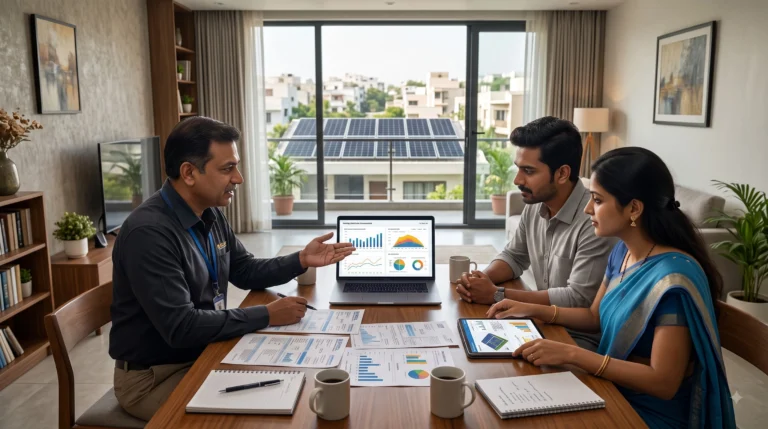
It can be, particularly when high consumption is consistent and the property has suitable rooftop space and sunlight. However, the decision should be based on consumption, system cost, generation potential and long-term economics.
Review your annual electricity consumption in kWh, assess available roof space and shading, and consider future electricity requirements. A professional site assessment can then determine a suitable system capacity.
Use kWh/units consumed as the primary starting point. The rupee amount is useful for evaluating financial savings, but it should not be the sole basis for system sizing.
Not necessarily. Your electricity bill can still include grid consumption, fixed charges, applicable taxes or other charges. Actual results depend on system generation, household consumption and utility arrangements.
On-grid can suit homes primarily seeking to reduce grid electricity purchases. Hybrid can be considered when battery backup is also an important requirement.
It depends on the proposed capacity, panel dimensions, layout, shading and rooftop conditions. A site survey provides a more accurate assessment.
Yes. If EV charging is planned, include its expected electricity consumption during the initial solar design.
Eligible residential consumers may qualify for applicable government rooftop solar assistance. Current eligibility and procedures should be verified before installation.
Depending on the system and applicable utility arrangement, eligible surplus electricity may be exported to the grid. The applicable rules should be confirmed for your electricity connection.
Roof Rays Solar can review your electricity bills, assess your rooftop, evaluate shading and discuss future electricity requirements before recommending a suitable solar solution.
Roof Rays Solar Solutions helps homeowners across Hyderabad and Telangana evaluate rooftop solar according to their actual electricity consumption and property conditions.
Why Customers Choose Roof Rays
Our approach is to understand your energy requirements first and recommend a system based on the property’s actual conditions.
Our experts design customized solar solutions based on your electricity consumption, roof space, and future energy goals—helping you maximize savings and achieve the best possible return on investment.
Phone
Address
📍 HUDA Complex, Tellapur, Hyderabad
Contact our solar experts today for a free consultation and personalized solar savings estimate.
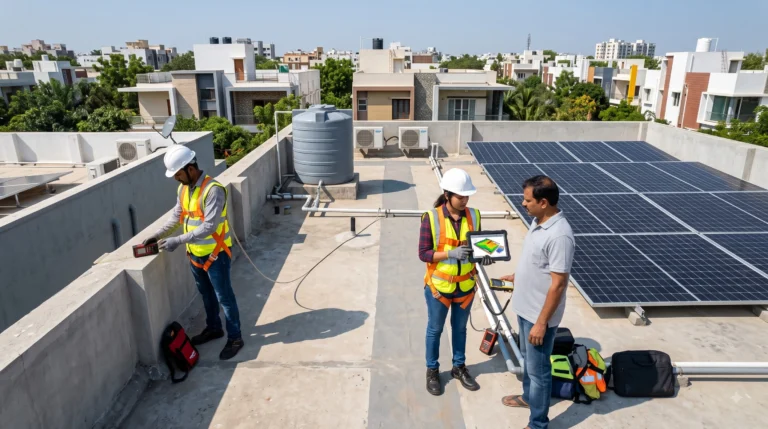
A high electricity bill can be a strong reason to investigate rooftop solar, but the bill amount alone does not determine whether solar is worth the investment.
The right decision starts with your annual kWh consumption, major electricity loads, daytime usage, available rooftop space, shading, system cost, future energy requirements and applicable utility arrangements. Homes that consume substantial electricity consistently and have a suitable rooftop may have a strong case for evaluating solar, while properties with heavy shading, limited space or short expected occupancy may require more careful consideration.
For homeowners across Hyderabad and Telangana, Roof Rays Solar Solutions provides electricity bill analysis, site assessment, customized solar system design, professional installation and ongoing support to help customers make a more informed rooftop solar investment.
Book Your Free Site Survey Today
© 2025 Roof Rays Solar Solutions. All Rights Reserved. | Designed by MANI
Check whether your property qualifies for rooftop solar subsidy support.
