
Installing rooftop solar on a property you live in is relatively straightforward from a decision-making perspective: you pay the electricity bill, install the system and benefit from the reduction in grid electricity purchases.
A rental property is different.
The landlord may own the roof and solar system, while the tenant may be the person consuming electricity and paying the monthly electricity bill.
That creates an important question:
Who receives the financial benefit from the solar installation?
For landlords, solar for rental property can make sense when the electricity arrangement, ownership structure and expected holding period are aligned. But installing solar simply because the property has a large roof does not automatically make it a good investment.
In Telangana, rooftop-solar regulations provide different metering arrangements, including net metering, group net metering, gross metering and virtual net metering for eligible consumers and configurations.
For residential rooftop solar, the Ministry of New and Renewable Energy (MNRE) states that central financial assistance is available to eligible residential electricity consumers under the applicable rooftop-solar programme.
Therefore, landlords should evaluate the electricity connection, consumer category and ownership arrangement before assuming that a rental property will qualify for the same benefits as an owner-occupied home.
Solar can be worth it for a rental property, but it depends on the ownership and electricity-billing arrangement.
It can be particularly attractive when:
However, if the tenant pays the electricity bill directly, the immediate electricity-bill savings generally benefit the tenant rather than the landlord.
That makes the investment decision different from installing solar on your own residence.
Key Takeaways
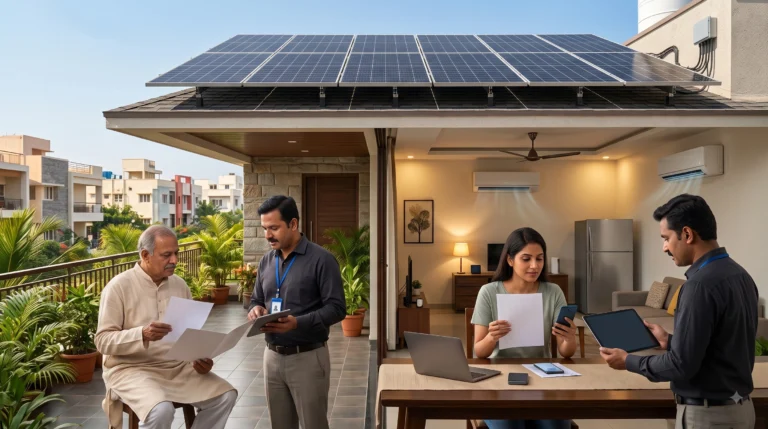
Consider a landlord who owns a house in Hyderabad.
The property has:
The solar system can generate electricity during the day.
If the tenant consumes electricity at that time, the solar generation can reduce the property’s requirement for grid electricity, subject to the applicable system arrangement.
If generation exceeds instantaneous consumption, surplus electricity may be exported under an approved grid-connected arrangement.
The financial benefit depends on who is responsible for the electricity bill and how the solar arrangement is structured.
The Most Important Question: Who Pays the Electricity Bill?
This can significantly change the economics of solar for rental property.
Scenario 1: Tenant Pays the Electricity Bill
This is common in independently metered rental homes.
The tenant pays the electricity utility directly.
If the solar system reduces grid consumption, the tenant may receive the immediate electricity-bill benefit.
The landlord owns the solar asset but may not directly receive the monthly savings.
In this situation, the landlord needs to consider whether the solar installation provides sufficient value through:
Scenario 2: Landlord Pays the Electricity Bill
If electricity is included in rent or otherwise paid by the landlord, solar savings can directly reduce the landlord’s operating costs.
This can make the financial case more straightforward.
The landlord can compare:
Electricity savings → Solar investment → Payback period
Scenario 3: Shared or Common Electricity Connection
Apartment buildings, multi-unit properties and some rental arrangements may involve shared electricity connections.
In these cases, the applicable metering arrangement becomes especially important.
The landlord should confirm:
Don’t assume that a standard single-home net-metering model automatically applies.
Solar for Rental Property: Who Owns the Solar System?
Before installation, ownership should be clear.
Landlord-Owned Solar
The landlord pays for and owns the system.
The landlord may recover the investment through:
Tenant-Funded Solar
A tenant may sometimes propose paying for or contributing toward solar.
This requires a clear written agreement covering:
Shared Investment
The landlord and tenant may agree to share the investment.
Again, the financial and ownership terms should be documented clearly.
Is Solar a Good Investment for Landlords?
It can be, particularly when the landlord expects to retain the property for a long period.
Solar is generally a long-term infrastructure investment.
Therefore, the investment becomes more attractive when:
Expected ownership period > Solar payback period
For example, if a landlord expects to own a property for many years after the solar investment has recovered its cost, the system may provide meaningful long-term value.
If the landlord plans to sell the property soon, the calculation becomes different.
What If the Tenant Moves Out?
This is one of the biggest concerns with rental-property solar.
Suppose the landlord installs a solar system and the tenant leaves after two years.
The solar system remains on the property.
The landlord then needs to consider:
This is why solar for rental property should be evaluated over the property’s long-term ownership period, not just the current lease.
Can Solar Increase Rental Property Value?
Potentially, but this should not be treated as a guaranteed percentage increase.
Solar can make a property more attractive because it may offer:
For a tenant who pays a high electricity bill, a solar-equipped property can be an attractive option.
However, the actual rental premium a landlord can command depends on:
Solar should therefore be considered an amenity and operating-cost advantage, not automatically a guaranteed rent increase.
Solar for Independent Rental Houses & Villas
Independent rental houses and villas can be relatively straightforward compared with multi-unit buildings because the property may have:
The landlord can evaluate the tenant’s electricity consumption and determine whether rooftop solar is appropriate.
However, the electricity connection and consumer arrangement still need to be checked before installation.
Solar for Multi-Unit Rental Properties
Apartment buildings and properties with multiple tenants require more careful planning.
Potential questions include:
Telangana’s 2025 rooftop-solar regulations recognize Group Net Metering and Virtual Net Metering arrangements for specified eligible consumers and capacities.
This means larger or multi-connection properties should be evaluated according to the specific regulatory arrangement rather than assuming conventional residential net metering.
Net Metering for Rental Properties
Net metering can be particularly relevant when the solar system is connected to the same electricity account that consumes the generated electricity.
The current Telangana regulatory framework permits eligible consumers to install rooftop solar under net-metering arrangements subject to the applicable conditions and capacity provisions.
TGSPDCL also states that eligible consumers using net metering require a bidirectional meter, and prior permission is required before installing a rooftop solar system under net metering.
Therefore, a landlord should not install a grid-connected solar system first and attempt to determine the metering arrangement afterward.
Confirm the applicable utility process before installation.
Does PM Surya Ghar Subsidy Apply to Rental Properties?
This requires particular attention.
MNRE’s rooftop-solar programme describes central financial assistance for residential electricity consumers.
That does not mean every landlord-owned rental property automatically qualifies.
Eligibility can depend on the electricity connection, consumer status, scheme requirements and applicable documentation.
Therefore:
Don’t assume that “residential property” automatically means “eligible for subsidy.”
Before calculating your investment, verify the current eligibility requirements applicable to the specific electricity connection.
Solar Installation Process for a Rental Property
Understand current consumption and who pays the bill.
Decide who will own and fund the solar system.
Assess roof area, orientation, shading and structural conditions.
Confirm consumer category, sanctioned load and applicable metering arrangement.
Match capacity with actual consumption and future requirements.
Compare investment with expected savings and ownership period.
If the property is rented, clarify solar-related responsibilities in the lease or a separate agreement.
Complete the required utility process before installation.
Install panels, inverter, mounting structure and electrical protection.
Test the system and monitor generation.
What Should Be Included in the Rental Agreement?
If a landlord installs solar, it is sensible to clearly document relevant responsibilities.
The agreement can address:
Legal drafting should be reviewed by an appropriate professional for the specific tenancy arrangement.
What Affects Solar Installation Cost?
The cost of solar for a rental property depends on:
For landlords, the important figure is not simply the installation price.
Evaluate:
Solar investment → expected savings → payback → remaining ownership period
Expert Tips for Landlords
If the tenant pays the electricity bill, don’t assume the landlord receives the monthly savings.
Meter ownership and consumer category can affect the applicable solar arrangement.
Solar generally makes more sense when the property will be retained for several years.
Size the system according to realistic electricity consumption and applicable rules.
Avoid future disagreements about ownership, maintenance and savings.
Lower electricity costs can make a rental property more attractive.
Don’t include a subsidy in your ROI calculation until eligibility is confirmed.
The current tenant may leave; the solar system remains.
Generation data helps demonstrate the system’s performance.
Solar should be considered as part of the property’s long-term investment strategy.
At-a-Glance: Is Solar Worth It for Your Rental Property?
Situation | Solar Case |
Landlord pays electricity | Strong potential |
Tenant pays electricity | Needs careful financial structuring |
Long-term property ownership | More attractive |
Short-term ownership | Needs closer ROI analysis |
Large daytime electricity use | Potentially favorable |
Suitable, mostly shade-free roof | Positive factor |
Multi-unit property | Requires detailed metering assessment |
Battery required for backup | Higher investment; assess separately |
Subsidy assumed but unverified | Don’t include until eligibility is confirmed |

It can be. The answer depends mainly on who pays the electricity bill, who owns the solar system, the property’s electricity consumption, expected ownership period and applicable metering arrangement.
There is no universal answer. If the landlord owns the property long term, landlord-funded solar may make sense. If the tenant receives most of the electricity savings, the financial arrangement should be structured accordingly.
Yes. If solar generation reduces the electricity purchased for the property, a tenant who pays the electricity bill may benefit from lower electricity costs, subject to the applicable metering arrangement.
Eligibility should be verified against the current government scheme and the specific electricity connection. MNRE’s rooftop-solar CFA is directed to eligible residential electricity consumers; property ownership alone does not establish eligibility.
Potentially, yes. But the landlord should confirm the electricity connection, consumer arrangement, solar ownership and applicable utility requirements before installation.
The solar system normally remains with the property unless the parties have agreed otherwise. The landlord should plan for the next tenant and clearly document ownership and maintenance responsibilities.
It may make the property more attractive, but there is no guaranteed rental premium. The actual benefit depends on the local rental market and demonstrable electricity savings.
Not necessarily. A grid-connected system can work without a battery. Battery storage becomes more relevant when backup power or shifting solar energy to later hours is an important requirement.
Potentially, but the metering and allocation arrangement becomes more complex. Telangana’s regulations provide for specified group and virtual net-metering arrangements for eligible consumers.
Roof Rays can assess electricity consumption, roof suitability, solar capacity, shading, system economics and the applicable installation requirements before developing a solar proposal.
Roof Rays Solar Solutions helps Hyderabad property owners evaluate rooftop solar based on the property’s actual electricity consumption and roof conditions.
Roof Rays Can Help With:
For landlords, the focus should be on creating a solar plan that makes sense not only technically, but also over the property’s expected ownership and rental period.
Our experts design customized solar solutions based on your electricity consumption, roof space, and future energy goals—helping you maximize savings and achieve the best possible return on investment.
Phone
Address
📍 HUDA Complex, Tellapur, Hyderabad
Contact our solar experts today for a free consultation and personalized solar savings estimate.

Solar for rental property can be a worthwhile long-term investment, but the economics are different from solar installed on an owner-occupied home.
The biggest question is not simply whether the property has enough sunlight. It is who pays for electricity and who benefits from the solar generation.
When the landlord pays the electricity bill, solar savings can directly reduce operating costs. When the tenant pays the bill, the tenant may receive much of the immediate electricity-saving benefit, while the landlord retains ownership of the solar asset.
That makes the investment dependent on the property’s rental structure, expected ownership period, tenant demand, electricity connection and applicable metering arrangement.
For Telangana properties, current rooftop-solar regulations provide multiple metering frameworks for eligible consumers, but the appropriate arrangement must be determined from the specific connection and property circumstances.
Similarly, residential rooftop-solar subsidy eligibility should be verified rather than assumed simply because a property is being rented. MNRE’s current programme describes CFA for eligible residential electricity consumers.
For landlords considering rooftop solar, the best approach is to evaluate the property, electricity bill, tenant arrangement, solar ownership, expected savings and long-term holding period together.
The right solar investment for a rental property is one where the ownership, electricity savings and long-term property strategy all work together.
Book Your Free Site Survey Today
© 2025 Roof Rays Solar Solutions. All Rights Reserved. | Designed by MANI
Check whether your property qualifies for rooftop solar subsidy support.