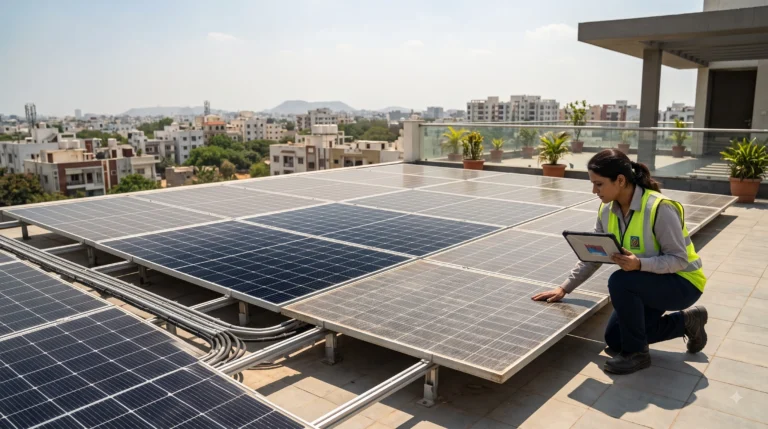
Solar panels are designed to generate electricity for many years, but their output does not remain exactly the same throughout their operating life. The gradual reduction in a panel’s electricity-generating capability is known as solar panel degradation.
This is a normal part of long-term photovoltaic operation. It is different from a sudden generation problem caused by shading, dirt, inverter faults, damaged modules or electrical issues.
For homeowners considering rooftop solar, understanding degradation is important because the initial panel wattage is only one part of the long-term picture. A panel’s annual degradation rate and performance warranty help indicate how much of its original generating capability is expected to remain over time.
For Hyderabad properties, long-term performance is also influenced by the local operating environment, including strong sunlight, high summer temperatures, dust, monsoon conditions and repeated temperature changes.
The good news is that degradation is generally gradual. Solar panels can continue producing useful electricity for decades, even though their output slowly declines.
Solar panel degradation is the gradual loss of electricity-generating capability as a solar module ages.
For planning purposes, degradation rates of approximately 0.3%–0.5% per year are commonly encountered among modern crystalline-silicon panels, although the actual rate depends on the specific technology and manufacturer.
Some modern panels are warranted for lower degradation rates.
Important
There is no single degradation rate that applies to every solar panel.
Always check the manufacturer’s published performance warranty to understand the expected long-term power retention of the specific panel you are considering.
Key Takeaways
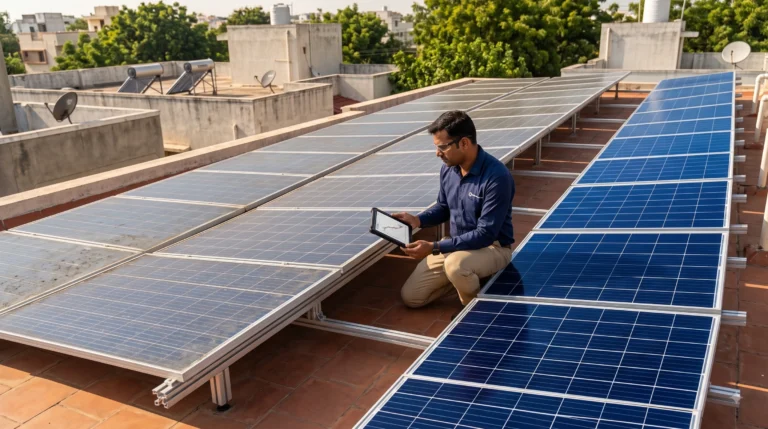
Solar panel degradation refers to the gradual decline in a solar module’s ability to generate electricity over time.
A new solar panel has a rated power under specified test conditions. As the module operates for years, exposure to sunlight and environmental conditions can gradually affect its materials and electrical characteristics.
For example, a panel initially rated at a particular wattage may retain slightly less generating capacity after several years.
This does not mean the panel suddenly becomes unusable.
Instead, the normal pattern is generally:
Initial output → gradual reduction → continued electricity generation
The exact rate depends on the panel’s technology, construction, manufacturer specifications and operating environment.
How Does Solar Panel Degradation Work?
A solar module contains photovoltaic cells protected by several layers and electrical components.
Over its operating life, it is exposed to:
Repeated environmental exposure can gradually affect the materials and electrical characteristics of the module.
The result can be a gradual reduction in its power-producing capability.
This is why manufacturers provide long-term performance warranties specifying how much power the panel is expected to retain after a defined period.
Solar Panel Degradation Example
Consider a hypothetical 550 W solar panel.
If we use an illustrative annual degradation rate of 0.5%, the simplified first-year retained capacity would be:
550 W × 99.5% = 547.25 W
The important concept is that degradation accumulates over time.
However, this simple calculation should not be used as a substitute for the manufacturer’s actual warranty formula. Different manufacturers can specify their long-term performance guarantees differently.
When comparing panels, always refer to the specific product’s published performance warranty.
Why Is Degradation Expressed as a Percentage?
Manufacturers commonly communicate long-term panel performance using:
For example, a manufacturer may specify how much of the panel’s original rated output will be retained after a particular number of years.
This information is valuable because two panels can have the same initial wattage but different long-term performance guarantees.
Example
Imagine two panels:
Panel A: 550 W initial rating
Panel B: 550 W initial rating
If Panel B has a lower warranted degradation rate, it may retain a greater proportion of its original power over the long term.
Therefore, buyers should evaluate:
Initial wattage + degradation rate + performance warranty
rather than looking only at the number printed on the panel.
What Causes Solar Panel Degradation?
Several environmental and physical processes can contribute to long-term degradation.
Solar modules spend their operating life exposed to sunlight. Long-term ultraviolet exposure can gradually affect certain materials used within the module.
Panels heat up during the day and cool down later.
Repeated expansion and contraction can place mechanical stress on materials, connections and other components.
Moisture can contribute to deterioration if the protective structure or sealing of a module becomes compromised.
Long-term environmental exposure can affect certain materials and electrical components.
Wind and other environmental loads can place stress on solar modules and their mounting systems.
Dust, pollution and other site-specific environmental factors can contribute to long-term wear.
The actual effect depends on the panel’s construction, environmental conditions and installation quality.
Normal Degradation vs Solar Panel Damage
This distinction is important.
Normal Degradation
A gradual reduction in panel output expected over its operating life.
Physical Damage
Damage can result from events such as:
Performance Problems
A sudden reduction in generation can also result from:
Therefore, if your solar generation suddenly drops, don’t automatically assume it is normal solar panel degradation.
A sudden change should be investigated.
How Long Do Solar Panels Last?
Modern solar panels are designed for long-term operation, and many manufacturers provide performance warranties of 25 years or more.
A 25-year performance warranty does not necessarily mean that the panels stop producing electricity after 25 years.
Panels can continue generating electricity beyond the warranty period, although their output may continue to decline.
Actual service life depends on factors such as:
Therefore, warranty period and physical operating life should not be treated as exactly the same thing.
Does Hyderabad’s Climate Affect Solar Panel Degradation?
Hyderabad’s climate is relevant when considering long-term solar performance.
A rooftop system can experience:
High module temperatures can affect short-term operating output, while long-term exposure to sunlight and environmental conditions contributes to the broader aging process.
However, it would be incorrect to assume that Hyderabad’s temperature automatically produces one fixed degradation percentage.
The better approach is to review the specific panel’s technical specifications and warranty while considering the property’s actual installation environment.
How Degradation Affects Solar Generation
Imagine a rooftop system producing a certain amount of electricity when it is new.
As the panels gradually degrade, their generating capability may also gradually decline.
Conceptually:
Year 1 → highest expected output
Later years → gradual reduction
Long-term operation → continued generation at reduced capacity
The change is generally gradual rather than an abrupt loss of production.
For this reason, long-term solar planning should consider expected degradation rather than assuming that first-year generation will remain identical for the entire life of the system.
How Solar Panel Degradation Affects ROI
Solar ROI should ideally be evaluated over the expected ownership period rather than only using first-year generation.
A long-term calculation can consider:
A panel with a slightly higher initial price could potentially provide stronger long-term value if it has suitable technology, a lower warranted degradation rate and a stronger long-term performance guarantee.
The correct comparison should consider total lifetime value, not simply the lowest upfront quotation.
How to Compare Solar Panel Degradation
When comparing solar panels, review these specifications:
Specification | Why It Matters |
Initial wattage | Defines starting rated power |
Annual degradation rate | Indicates expected yearly decline |
Performance warranty | Defines long-term output commitment |
Product warranty | Covers specified product-related issues |
Temperature coefficient | Helps understand temperature-related power changes |
Panel technology | Influences performance characteristics |
Manufacturer | Important for product support and warranty |
A panel with the highest wattage is not automatically the best long-term choice.
What Should You Check Before Buying Solar Panels?
Before choosing a solar panel, ask the installer or manufacturer for:
Understand the panel’s rated wattage.
Check the stated degradation rate.
Understand how much output is guaranteed at the end of the performance warranty.
Check what product-related issues are covered.
Review the temperature coefficient.
Understand how warranty claims and after-sales support are handled.
Make sure the panel is appropriate for the proposed system and rooftop environment.
Solar Installation Process
Long-term panel performance depends not only on the module but also on the quality of the complete solar installation.
Understand current consumption and future electricity requirements.
Assess roof condition, orientation, shading and available installation space.
Select an appropriate solar capacity based on consumption and site conditions.
Compare specifications, warranties, efficiency and long-term performance.
Estimate expected production while considering realistic system losses.
Install the mounting structure, panels, inverter and electrical protection equipment correctly.
Verify that the system is operating correctly.
Track generation over time to identify unexpected performance changes.
Keep the system properly maintained and investigate unusual generation drops.
What Affects Solar Installation Cost?
The initial cost of a solar system depends on factors such as:
A lower-priced panel is not automatically the better long-term choice. Buyers should compare initial cost, performance warranty, degradation rate, equipment quality and expected lifetime generation.
Government Subsidy & Net Metering
Eligible residential consumers may qualify for applicable government rooftop solar financial assistance. Current eligibility, subsidy requirements and documentation should be verified before installation.
For grid-connected rooftop solar, surplus generation may be eligible for net metering or another applicable export arrangement, depending on current utility regulations and the property’s electricity connection.
When calculating solar ROI, use the current applicable subsidy and utility rules, rather than relying on older figures.
Can Maintenance Reduce Solar Panel Degradation?
Maintenance cannot stop the natural aging of photovoltaic modules, but proper system maintenance can help prevent avoidable performance losses.
Important practices include:
For example, dust accumulation can reduce current generation, but this is soiling, not permanent panel degradation. Cleaning may recover some of that lost production.
Similarly, a new tree causing shade is not degradation. It is a site-related generation issue.
Expert Tips for Solar Panel Degradation
Don’t look only at the product warranty. Check the performance warranty as well.
A lower stated degradation rate can mean better expected power retention over the long term.
Find out what percentage of the original rated power is guaranteed at the end of the performance warranty.
A dirty panel can temporarily produce less electricity. That doesn’t necessarily mean the panel has permanently degraded.
Normal degradation is gradual. A sudden production reduction deserves investigation.
Generation history can help identify changes in performance.
When comparing quotations, consider expected long-term output rather than only first-year generation.
Look at degradation, temperature coefficient, warranty and other relevant technical specifications.
A good panel still requires proper installation and system design.
Initial panel wattage is important, but it is not the complete measure of long-term value.
At-a-Glance Summary
Question | Answer |
Do solar panels degrade? | Yes, gradually |
Is degradation usually sudden? | No |
Common planning range? | Around 0.3%–0.5% annually for many modern crystalline-silicon products, depending on the product |
Do all panels degrade equally? | No |
Can panels operate beyond 25 years? | They can continue generating beyond the warranty period |
Does heat affect output? | Yes, operating temperature affects electrical performance |
Is dust the same as degradation? | No |
Should performance warranty be checked? | Yes |
Does degradation affect lifetime ROI? | Yes |
Illustrative Hyderabad Home Scenario
Consider a Hyderabad homeowner installing a rooftop solar system with modern solar panels.
During the first year, the system produces electricity according to its capacity, sunlight conditions, shading, equipment and installation quality.
Over subsequent years, the panels naturally experience gradual degradation.
However, suppose the homeowner notices a large generation drop within a short period.
That should not automatically be attributed to degradation.
The homeowner should investigate possible causes such as:
Key Lesson
Normal solar panel degradation is gradual. A sudden drop in generation should be investigated separately.
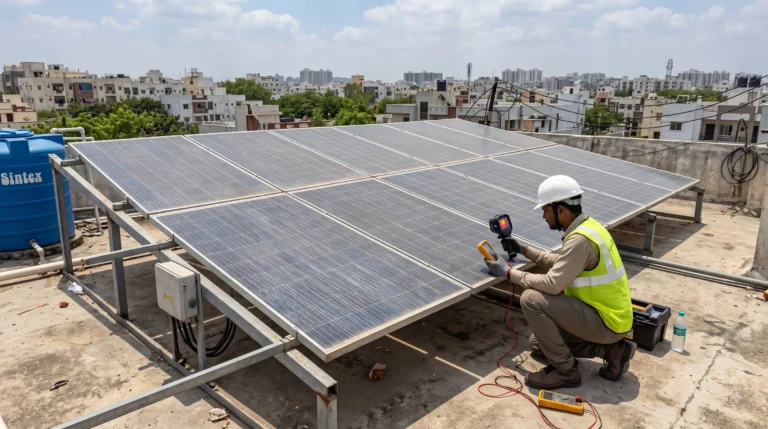
Solar panel degradation is the gradual reduction in a module’s electricity-generating capability as it ages and remains exposed to operating and environmental conditions.
A commonly encountered planning range for many modern crystalline-silicon panels is around 0.3%–0.5% per year, but the actual rate varies by product. Always check the manufacturer’s performance warranty.
No. Degradation depends on panel technology, manufacturer, construction, environmental conditions and other factors.
Many modern panels have performance warranties of 25 years or more and can continue producing electricity beyond the warranty period, although output gradually declines.
High temperatures affect panel operating performance, while long-term environmental exposure contributes to aging. The exact degradation rate should be determined from the manufacturer’s specifications rather than assuming a fixed Hyderabad-specific percentage.
A product warranty generally addresses specified defects or product-related issues, while a performance warranty addresses the module’s expected power retention over time.
Yes. Degradation generally reduces generating capability gradually; it does not mean the panel suddenly stops producing electricity.
Yes. Long-term generation gradually changes as panels age, so degradation can be included when estimating lifetime solar generation and ROI.
Monitor generation over time. A sudden or unusual drop should be investigated for shading, soiling, inverter issues, electrical faults or physical damage before assuming normal degradation.
Roof Rays can help evaluate panel specifications, performance warranties, system requirements, rooftop conditions and expected generation when planning a solar installation.
Roof Rays Solar Solutions helps homeowners and businesses across Hyderabad and Telangana evaluate solar systems with attention to both immediate requirements and long-term performance.
Why Customers Choose Roof Rays
The objective is to help customers understand the complete solar investment, including equipment specifications, expected generation, warranties and long-term requirements.
Our experts design customized solar solutions based on your electricity consumption, roof space, and future energy goals—helping you maximize savings and achieve the best possible return on investment.
Phone
Address
📍 HUDA Complex, Tellapur, Hyderabad
Contact our solar experts today for a free consultation and personalized solar savings estimate.
Solar panel degradation is a normal part of long-term solar operation. Panels generally lose a small amount of generating capability over time rather than suddenly stopping after a fixed number of years.
For planning purposes, degradation rates around 0.3%–0.5% per year are commonly encountered among many modern crystalline-silicon products, but the exact rate depends on the specific module. The manufacturer’s performance warranty is therefore the most useful reference when comparing long-term power retention.
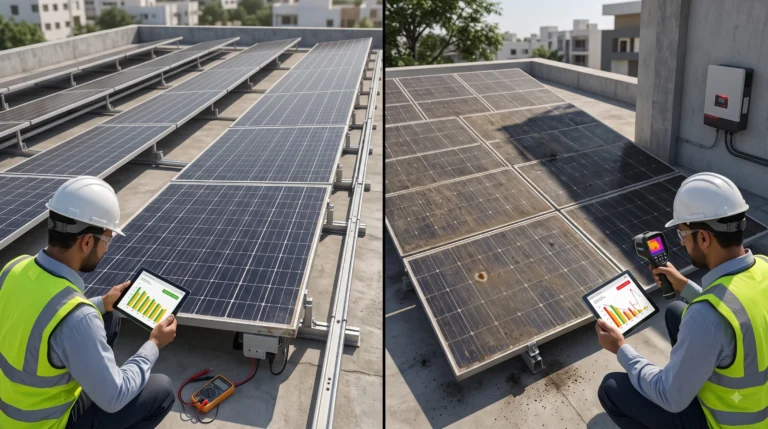
It is equally important to distinguish degradation from other causes of reduced generation. Dust, shading, inverter faults, wiring problems or physical damage can cause performance losses that are not normal panel degradation.
For a long-term solar investment, look beyond initial wattage and price. Consider degradation rate, performance warranty, product warranty, panel specifications, installation quality and expected lifetime generation.
Roof Rays Solar Solutions can help homeowners and businesses across Hyderabad and Telangana assess their electricity requirements, rooftop conditions, solar equipment and long-term performance considerations before installation.
The goal isn’t simply to install solar panels—it’s to make a well-informed long-term energy investment.
Book Your Free Site Survey Today
© 2025 Roof Rays Solar Solutions. All Rights Reserved. | Designed by MANI
Check whether your property qualifies for rooftop solar subsidy support.
