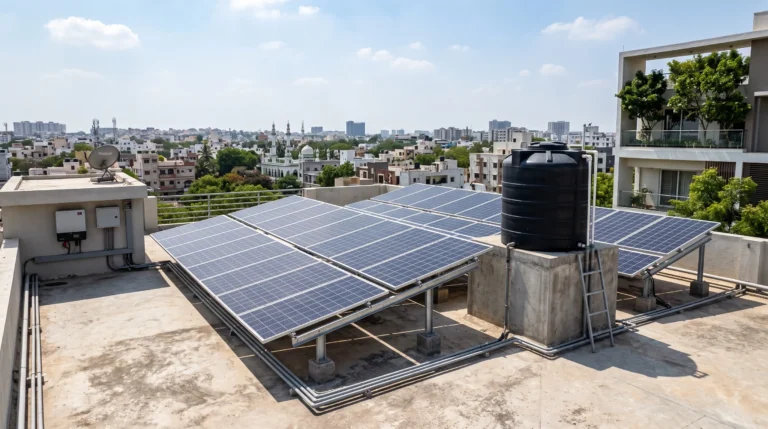
One of the most common concerns homeowners have before installing rooftop solar is whether their roof is suitable when it already contains a water tank or other rooftop obstacles.
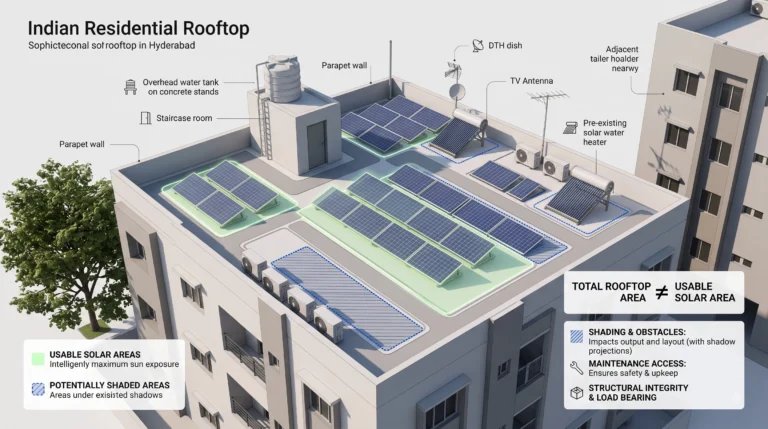
Residential terraces are rarely completely empty. A typical Hyderabad rooftop may have an overhead water tank, staircase room, parapet walls, solar water heater, AC outdoor units, pipes, antennas or nearby trees. Neighboring buildings can also affect the amount of sunlight reaching the roof.
The good news is that the presence of these obstacles does not automatically mean solar panels cannot be installed.
Instead, the rooftop needs to be assessed carefully to determine where panels can be positioned while considering sunlight, shading, panel orientation, tilt, spacing, structural requirements and access for maintenance.
For homeowners searching for information about solar panels around water tank, the key question is therefore not simply whether panels can fit around the tank. It is whether the available roof can be designed efficiently around the tank without creating unnecessary shading or compromising essential access.
A site-specific solar survey is the best way to determine the practical layout.
Yes, solar panels can often be installed around a water tank and other rooftop obstacles.
The water tank itself does not automatically make a rooftop unsuitable for solar.
However, the tank can create shadows depending on:
A professional solar layout should identify the tank as a fixed rooftop obstacle, evaluate its potential shadow and position panels in suitable areas.
It should also maintain practical access to the water tank for inspection, cleaning, repairs and other maintenance.
The Basic Principle
Don’t design solar around empty roof space alone. Design it around usable, shade-aware roof space.
Key Takeaways
An overhead water tank is one of the most common fixed structures found on residential terraces.
When planning solar, it should be considered together with the rest of the rooftop rather than treated as an isolated object.
A roof may contain:
Each can affect where solar panels can practically be installed.
The question should therefore be:
Where can the panels be positioned to achieve useful solar exposure while maintaining safe access and avoiding unnecessary shading?
A professional design can identify the most suitable areas and create the panel arrangement around existing rooftop structures.
Can Solar Panels Be Installed Around a Water Tank?
Yes, in many cases.
A water tank can simply be treated as one of the fixed obstacles in the rooftop layout.
For example, if the tank is positioned toward one side of the terrace, the remaining roof may provide sufficient usable space for the solar system.
However, the installer should not assume that every area surrounding the tank is equally suitable.
The layout needs to consider:
There is no single minimum distance from a water tank that works for every rooftop.
The appropriate arrangement depends on the physical dimensions and specific geometry of the property.
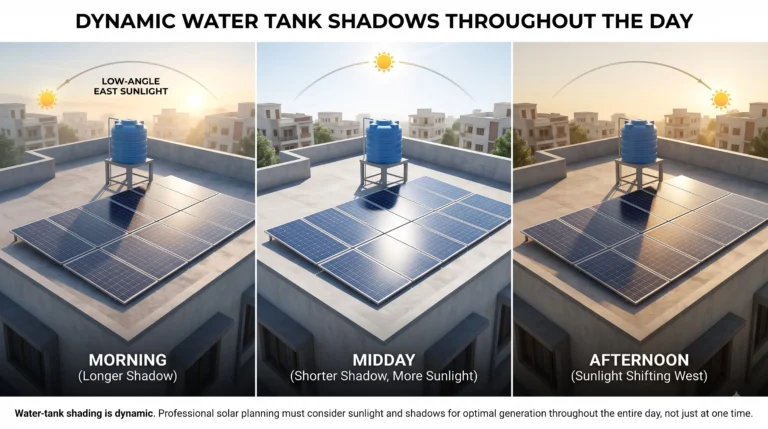
How Water Tank Shadows Affect Solar Panels
The biggest solar-design issue associated with a water tank is usually shading.
When sunlight reaches the tank before reaching a panel, the tank can create a shadow on the roof or module.
A simple representation is:
Sun → Water Tank → Shadow → Solar Panel
The size and location of this shadow can change as the sun moves.
During Morning
The sun is lower toward the eastern side, potentially creating longer shadows in a particular direction.
Around Midday
The sun is generally higher, so shadows can be shorter depending on the season.
During Afternoon
The sun moves toward the west, changing the direction of the shadow.
Therefore, a water tank that appears to have little impact during a midday inspection may still create recurring morning or afternoon shading.
Why You Shouldn’t Check the Roof Only at Noon
A common mistake is to inspect the rooftop once during the middle of the day and conclude that it is completely suitable for solar.
For example:
10:00 AM: Tank creates a shadow over part of the proposed solar area.
1:00 PM: Shadow is much smaller.
4:00 PM: Shadow moves to another area.
If the design considers only the 1:00 PM condition, it may overlook shading that occurs during other periods.
This is why solar panel shadow analysis should be part of the site assessment when rooftop obstacles are present.
Seasonal Shadow Changes
The sun’s apparent path changes throughout the year.
As a result, the same water tank can produce different shadow patterns during different seasons.
Factors that can change include:
This is especially important when designing a solar system expected to operate for many years.
The objective is not to eliminate every possible small shadow at every moment, which may not be practical, but to understand the rooftop’s solar exposure and minimize significant, avoidable shading where possible.
Does a Water Tank Make the Entire Roof Unsuitable?
No.
A water tank generally affects the area around it rather than automatically making the entire roof unusable.
For example, imagine a rectangular rooftop with a tank occupying a relatively small portion of one side.
The remaining areas may still provide substantial space for solar panels.
The designer can evaluate:
Total roof area
minus
obstacle areas + unsuitable shaded areas + required access
to identify the practical solar installation area.
This is why system sizing should not be based solely on the overall roof dimensions.
Other Common Roof Obstacles
Water tanks are only one of many structures that can influence a solar layout.
A staircase enclosure can be relatively tall and may create significant shadows.
It can also require regular access, so panels should not block the entrance or maintenance route.
Parapet walls can cast localized shadows, particularly when the sun is at a lower angle.
Their effect depends on:
A solar water heater already occupies part of the roof and can create a shadow over nearby areas.
Its location should be included in the solar layout from the beginning.
Air-conditioning equipment needs service access.
Panels should not be positioned in a way that makes essential maintenance unnecessarily difficult.
Trees can create changing shadows and are particularly important because they can grow over time.
A tree that produces little shading today may create a larger problem in future years.
Tall nearby buildings can cast shadows onto the rooftop, particularly when the sun is lower in the sky.
This is an important consideration in densely developed Hyderabad neighborhoods.
Smaller rooftop structures can create localized shadows or restrict panel placement.
Their individual effect may be small, but the complete roof should be considered as one integrated layout.
Why You Shouldn’t Simply Fill Every Open Space With Panels
One of the most common rooftop solar planning mistakes is assuming:
“If a panel physically fits there, it should be installed there.”
That isn’t necessarily true.
Every proposed panel position should ideally be considered for:
A panel installed in a heavily shaded or poorly accessible location may not provide the same practical value as one positioned in a better-exposed area.
Therefore, panel count should not be the only objective.
How to Design Solar Panels Around a Water Tank
A professional layout can follow a structured approach.
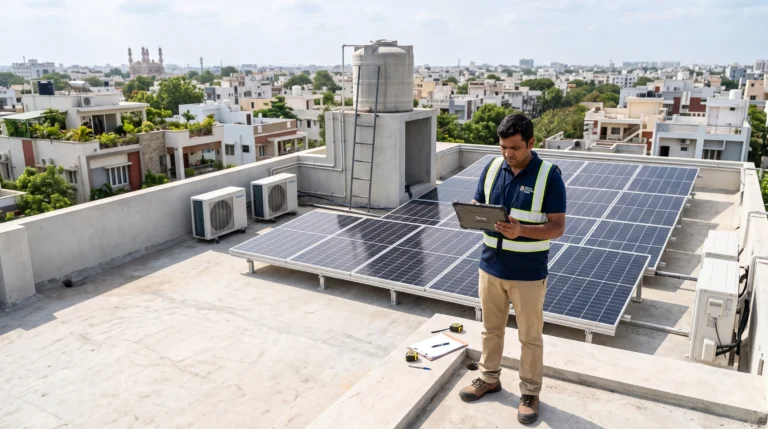
Step 1: Map the Rooftop
Measure and identify:
Step 2: Identify Potential Shadow Sources
Locate every structure that could obstruct sunlight.
Step 3: Evaluate Sun Exposure
Assess how sunlight reaches different sections of the roof throughout the day.
Step 4: Identify Usable Areas
Separate the roof into areas with better solar exposure and areas where shading or other restrictions may make installation less suitable.
Step 5: Design the Panel Layout
Position panels around the obstacles while considering direction, tilt and spacing.
Step 6: Preserve Access
Ensure the water tank and other important rooftop equipment remain accessible.
Step 7: Estimate Generation
Use the actual site conditions to develop a realistic generation estimate.
Illustrative Hyderabad Rooftop Example
Consider a Hyderabad independent house with a flat terrace.
The rooftop contains:
There may still be enough roof area for a suitable solar system.
Instead of placing panels wherever there is empty space, the installer evaluates:
The resulting layout may place more panels in one section of the roof and fewer or no panels in another section.
Key Lesson
A rooftop does not need to be completely obstacle-free to support solar. It needs to be properly planned.
Solar Panels Around Water Tank: Hyderabad Considerations
Hyderabad residential rooftops often combine several uses in a relatively limited area.
An independent house or villa may need space for:
This makes usable roof area more important than simply measuring the terrace’s total square footage.
A solar survey should consider how the roof is actually used and how the system can coexist with existing equipment.
Does the Water Tank Have to Be Moved?
Not necessarily.
Homeowners sometimes assume that installing more panels requires relocating the water tank.
In many situations, the solar layout can simply be designed around the existing tank.
Before considering relocation, compare:
If the required solar capacity can be achieved without moving the tank, relocation may not provide enough benefit to justify the additional work.
Any proposed tank relocation should be assessed by the appropriate professionals because it can involve plumbing, structural and waterproofing considerations.
Can Elevated Solar Structures Help?
An elevated mounting structure can sometimes provide additional layout flexibility, but it should not automatically be used to solve every rooftop obstacle.
The design must consider:
A higher structure may change the relationship between the panels and the obstacle, but whether it actually improves the solar layout depends on the specific rooftop.
Does Partial Shading Make a Roof Unsuitable?
Not necessarily. A rooftop with some shading can still be suitable for solar if the system is designed around the actual shading conditions.
The goal is to identify:
Depending on the system design, module-level or other electrical approaches may also help manage partial shading. However, the best solution is usually to reduce avoidable shading through physical layout planning first.
Solar Panel Rows Around Water Tanks
Flat-roof solar systems require another important consideration: inter-row shading.
Panels are typically mounted at an angle. If rows are installed too close together, the front row can cast a shadow onto the row behind it.
When a water tank is also present, the designer needs to consider both:
Water-tank shading + inter-row shading
Increasing row spacing can reduce self-shading, but it also uses more roof area.
Therefore, the layout needs to balance:
The objective is not simply to install the maximum possible number of panels.
Detailed Solar Panel Shadow Analysis
For a roof containing a water tank or multiple obstacles, shadow analysis should consider more than a single visual inspection.
Time of Day
Morning, midday and afternoon sunlight can produce different shadow patterns.
Season
The sun’s position changes throughout the year, affecting shadow length and direction.
Obstacle Height
A taller structure generally has greater potential to cast a shadow, depending on its position relative to the panels.
Distance
The distance between the obstacle and panel influences where the shadow falls.
Panel Position
Moving panels to another section of the roof may significantly change their exposure.
Future Changes
Growing trees or new rooftop structures can change the shading environment over time.
A professional solar designer can use site measurements and appropriate design tools to incorporate these factors into the proposed layout.
Solar Installation Process
A well-planned project should consider rooftop obstacles before the final design is approved.
Understand current consumption and future electricity requirements.
Measure the rooftop and identify the water tank and other obstacles.
Evaluate potential shading from tanks, buildings, trees and rooftop equipment.
Identify practical areas for panel installation.
Determine an appropriate solar capacity.
Position panels while considering orientation, tilt, row spacing and access.
Select suitable panels, inverter and mounting structure.
Install the system according to the approved design.
Check the electrical and operational performance.
Track generation after installation.
Provide maintenance and technical assistance when required.
What Affects Solar Installation Cost?
The presence of a water tank does not automatically mean solar installation will be expensive.
Project cost depends on the overall system and rooftop conditions, including:
A final quotation should be prepared after assessing the actual roof rather than estimating cost solely from roof size.
Government Subsidy & Net Metering
Eligible residential consumers may qualify for applicable rooftop solar financial assistance.
For grid-connected rooftop solar in Telangana, current subsidy, net-metering and utility requirements should be verified before installation because applicable rules and procedures can change.
The physical presence of a water tank does not itself determine subsidy eligibility. Eligibility is based on the applicable government and utility requirements for the solar installation.
Expert Tips for Installing Solar Around Water Tanks
A tank often requires better layout planning rather than complete relocation.
The tank’s position and height can be more important than its physical size alone.
Morning and afternoon shading may be different.
Leave sufficient practical access for inspection, cleaning and repairs.
Look beyond the tank. Staircases, parapets, trees, AC units and neighboring buildings matter too.
A shade-free roof today may not remain shade-free in future years.
A well-positioned system can be more useful than simply filling every available space.
Review where the installer plans to place the panels before approving installation.
Ask whether shading and rooftop obstacles were considered in the projected generation.
First determine whether the solar system can be designed effectively around the existing tank.
At-a-Glance Summary
Roof Obstacle | Main Concern | Design Approach |
Water Tank | Shading + access | Position panels around suitable areas |
Staircase Room | Shadow + access | Maintain access and assess shading |
Parapet Wall | Local shading | Consider panel distance and mounting |
AC Unit | Access + localized shade | Keep service area clear |
Solar Water Heater | Space + shadow | Integrate into overall layout |
Tree | Changing/future shade | Consider growth |
Nearby Building | Longer shadows | Evaluate sun path |
Panel Rows | Self-shading | Optimize row spacing |
Yes. In many homes, panels can be installed around the existing tank after assessing shading, available space, access and the overall roof layout.
Usually not. The tank can often remain in its existing position if the available roof area supports a suitable panel layout.
It can. The impact depends on the tank’s height, location, distance from the panels and the sun’s position.
There is no universal distance for every property. The required arrangement should be determined from the tank dimensions, panel layout, shadow analysis, access and safety requirements.
Yes, provided the design considers shading, access, structural requirements and safe maintenance.
Yes. The panel position and mounting arrangement should account for the wall’s height and potential shading.
Often, yes. The roof should first be assessed to identify usable areas and understand the extent and timing of shading.
Not necessarily. A properly designed layout may allow the panels to work around the existing tank. Relocation should be considered only after comparing the alternatives.
Potentially. Elevated structures can provide additional layout flexibility, but structural requirements, wind loading, cost, access and shading must be evaluated.
Roof Rays can assess your electricity consumption, rooftop dimensions, water tank, other obstacles and shading before developing a customized panel layout.
Roof Rays Solar Solutions helps homeowners and businesses across Hyderabad and Telangana plan rooftop solar around their actual electricity requirements and property conditions.
Our Approach Includes:
The objective is not simply to fit the maximum number of panels onto the roof. It is to create a practical system that considers solar exposure, shading, access, safety and long-term maintenance.
Our experts design customized solar solutions based on your electricity consumption, roof space, and future energy goals—helping you maximize savings and achieve the best possible return on investment.
Phone
Address
📍 HUDA Complex, Tellapur, Hyderabad
Contact our solar experts today for a free consultation and personalized solar savings estimate.
Solar panels around a water tank are often possible with proper rooftop planning. The presence of an overhead tank, staircase room, parapet wall, tree or other obstacle does not automatically make a roof unsuitable for solar.
The most important considerations are shading, panel placement, usable roof area, access, safety and long-term maintenance.
A water tank can create shadows that change throughout the day and across seasons. Other structures can create similar issues, while solar panels themselves can create inter-row shading on flat roofs.
Therefore, the best approach is to survey the complete rooftop first, identify usable solar areas and then design the panel layout around the existing structures.
In many cases, the water tank does not need to be moved. A carefully designed system can work around it while preserving access and minimizing avoidable shading.
For Hyderabad homeowners, Roof Rays Solar Solutions can assess your electricity consumption, roof dimensions, water tank, other obstacles and shading conditions before recommending a suitable rooftop solar layout.
Your rooftop doesn’t need to be obstacle-free to go solar. It needs to be intelligently designed.
Book Your Free Site Survey Today
© 2025 Roof Rays Solar Solutions. All Rights Reserved. | Designed by MANI
Check whether your property qualifies for rooftop solar subsidy support.
