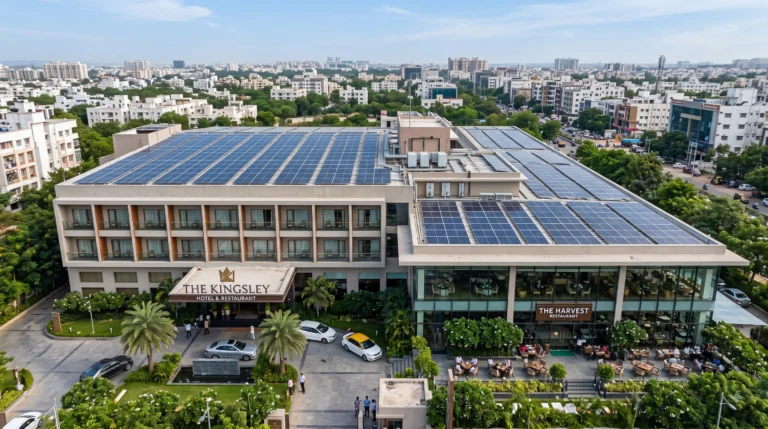
Hotels and restaurants are among the businesses where electricity costs can have a significant impact on operating expenses.
Lighting, air conditioning, refrigeration, kitchen equipment, water heating, ventilation, pumps, elevators and other systems can operate for long hours. In hotels, some loads may continue throughout the night, while restaurants often have substantial daytime and evening electricity consumption.
This makes solar for hotels and restaurants worth evaluating, particularly when the property has a suitable rooftop and meaningful daytime electricity usage.
A commercial rooftop solar system can generate electricity during daylight hours and help offset electricity purchased from the grid, subject to the applicable system and metering arrangement.
However, the right solar system should not simply be based on the available roof area.
A proper assessment should consider:
For hotels and restaurants, the strongest solar opportunity often comes from matching daytime solar generation with daytime operating loads.
It can be, particularly for properties with high daytime electricity consumption and a suitable rooftop.
Restaurants and hotels can have several loads that operate while the sun is available, including:
When solar generation coincides with these loads, the business can use more of the generated electricity directly.
The actual financial benefit depends on the property’s consumption, tariff, solar capacity, roof conditions, system performance and applicable electricity arrangement.
Key Takeaways
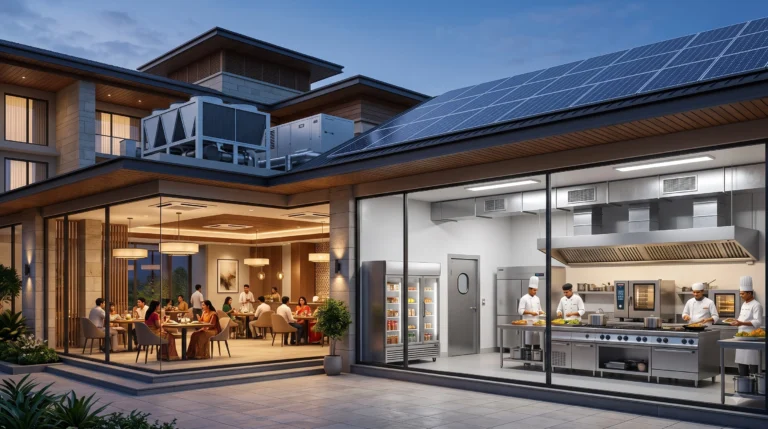
A hotel or restaurant is not an ordinary electricity consumer.
A restaurant may use electricity for:
A hotel can have additional loads such as:
The exact consumption profile varies significantly between properties.
That is why a commercial solar proposal should begin with actual electricity consumption data rather than assumptions based on the property’s size alone.
How Rooftop Solar Can Reduce Energy Costs
A grid-connected rooftop solar system generates electricity during daylight hours.
The basic flow is:
Sunlight → Solar panels → Inverter → Business loads
If the restaurant or hotel is consuming electricity while the solar system is generating, the solar power can offset part of the electricity that would otherwise be purchased from the grid.
This can reduce grid electricity consumption.
The financial benefit depends on the property’s tariff, solar generation and applicable metering arrangement.
Why Daytime Consumption Matters
Solar panels generally generate electricity during daylight hours.
This makes the property’s daytime load profile particularly important.
For example, a restaurant may have substantial daytime consumption from:
A hotel may have daytime consumption from:
The more effectively solar generation aligns with the property’s consumption, the more useful the system can be.
Solar for Restaurants
Restaurants can be good candidates for rooftop solar when they have suitable roofs and substantial electricity consumption.
Major Restaurant Loads
Refrigeration
Refrigerators and freezers can operate continuously or for long periods.
Air Conditioning
HVAC can represent a significant portion of electricity consumption, especially during hot weather.
Kitchen Equipment
Depending on the restaurant, electrical equipment may include:
Lighting
Dining areas, kitchens, signage and external areas can all contribute to electricity consumption.
Pumps & Ventilation
Water pumps and ventilation equipment can add to the load.
Solar for Hotels
Hotels can have a broader electricity profile than restaurants.
A hotel may consume electricity across:
Because hotel operations can continue throughout the day, there may be substantial opportunity to use solar generation directly during daylight hours.
However, hotel electricity consumption also varies significantly by:
Therefore, historical electricity bills are essential for accurate solar sizing.
Solar for Hotels and Restaurants: How Much Solar Do You Need?
There is no single solar capacity suitable for every hotel or restaurant.
System sizing depends on:
For example, two restaurants with similar floor areas can have very different electricity consumption because their kitchen equipment, operating hours and air-conditioning requirements differ.
The same applies to hotels.
Better Approach
Instead of asking:
“How many panels can fit on the roof?”
Ask:
“What solar capacity is appropriate for our electricity consumption, roof and financial objectives?”
Roof Assessment for Hotels & Restaurants
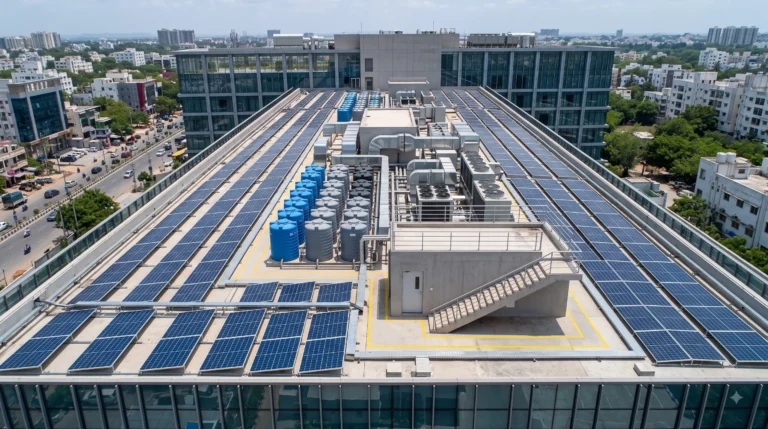
Commercial rooftops may contain:
These obstacles can affect panel placement.
A professional site survey should identify:
The objective is to create a practical solar layout without compromising essential rooftop operations.
Solar Panel Shadow Analysis
Shading can reduce the energy generated by rooftop solar.
Potential shading sources include:
Shadows can change during the day and throughout the year.
Therefore, a commercial solar design should consider the rooftop’s actual shading environment.
A good design should minimize significant and avoidable shading while maintaining appropriate access and equipment clearances.
Can Solar Work on a Restaurant with Limited Roof Space?
Yes, potentially.
A restaurant does not necessarily need an enormous roof to benefit from solar.
The available roof can be assessed against:
If the roof cannot accommodate the desired capacity, the business can evaluate whether a smaller system still provides worthwhile savings.
The correct approach is to calculate the economics of the available solar opportunity, rather than rejecting solar simply because the roof cannot support a very large system.
Solar for Hotels with Multiple Buildings
Large hotels may have:
A rooftop solar assessment may need to consider multiple roof sections.
The designer can evaluate:
The final system should be designed around the hotel’s electrical infrastructure rather than simply selecting the largest roof.
CAPEX vs OPEX for Hotels & Restaurants
Businesses can evaluate different financing approaches.
CAPEX
The hotel or restaurant purchases and owns the solar system.
Advantages:
Considerations:
OPEX
A third-party provider typically finances and owns the system, while the business purchases solar electricity under a contractual arrangement.
Advantages:
Considerations:
The best model depends on the hotel’s or restaurant’s financial position and long-term property strategy.
Solar ROI for Hotels & Restaurants
Solar ROI should be calculated using actual business data.
Important inputs include:
A simplified CAPEX calculation is:
Simple Payback Period = Solar Investment ÷ Annual Electricity Savings
This is only a basic calculation.
A detailed commercial investment assessment may also consider:
Businesses should have their financial advisors validate tax and accounting assumptions.
What About Electricity Consumption at Night?
Hotels and restaurants may continue operating after sunset.
Solar generation decreases after daylight hours.
This does not automatically make rooftop solar unsuitable.
A grid-connected system can still offset daytime consumption, while electricity required outside solar-generation hours can continue to come from the grid under the applicable arrangement.
Businesses that require backup or greater energy independence can separately evaluate battery storage or hybrid systems.
Battery storage should not be added automatically. Its economics should be assessed based on the property’s actual load profile and backup requirements.
Solar Installation Process for Hotels & Restaurants
Review historical bills and consumption patterns.
Understand daytime and evening consumption.
Assess roof area, condition and existing equipment.
Identify significant shading sources.
Determine suitable solar capacity.
Compare CAPEX and OPEX options where appropriate.
Finalize panel layout, inverter placement and electrical configuration.
Complete applicable utility and regulatory procedures.
Install the solar system professionally.
Verify system operation.
Track generation and system performance.
Keep the system operating effectively over its service life.
Commercial Solar Safety Considerations
Hotels and restaurants are active commercial environments.
Solar installation should therefore consider:
The solar design should not interfere with essential building safety systems or access routes.
What Affects Solar Installation Cost?
Commercial solar cost depends on:
Hotels may have larger or more complex electrical infrastructure, while restaurants may have challenging rooftop conditions due to exhaust systems and kitchen-related equipment.
Therefore, a site survey is necessary before a final quotation.
Telangana Regulatory Considerations
For grid-connected rooftop solar in Telangana, the applicable metering and connectivity arrangement depends on the consumer and project configuration.
TGERC’s Rooftop Solar PV Grid Interactive Systems Regulation, 2025 is the current state regulatory framework and includes provisions covering different rooftop-solar arrangements. (tgerc.telangana.gov.in)
Businesses should verify the applicable requirements with the relevant electricity distribution utility before finalizing the system.
Commercial businesses should also not automatically assume eligibility for residential rooftop-solar subsidies. MNRE’s current rooftop-solar CFA programme specifically describes support for eligible residential electricity consumers. (mnre.gov.in)
Expert Tips for Hotels & Restaurants
Don’t size the system from roof area alone.
Kitchen, refrigeration and HVAC loads can make daytime solar particularly relevant.
HVAC, water tanks and other equipment can reduce usable space.
A large roof can still have poor solar exposure.
Consider both upfront capital and long-term cost.
First determine whether backup storage is financially justified.
Installation should minimize disruption to hotel or restaurant operations.
Solar should not block access to HVAC, tanks or other equipment.
Ask how shading, orientation and roof conditions were considered.
Commercial solar is an infrastructure investment. Evaluate it over the expected property-use period.
At-a-Glance: Solar for Hotels & Restaurants
Factor | Restaurant | Hotel |
Kitchen load | Often significant | Often significant |
HVAC | Significant depending on size | Often substantial |
Refrigeration | Important | Important |
Daytime consumption | Often strong | Often strong |
Night consumption | Can be significant | Usually significant |
Roof obstacles | Exhaust, tanks, HVAC | HVAC, tanks, structures |
Solar opportunity | Depends on roof + load | Depends on roof + load |
Battery need | Project-specific | Project-specific |
Best first step | Bill + roof survey | Bill + roof survey |
Yes, restaurants with suitable rooftops and meaningful electricity consumption can be good candidates for rooftop solar.
Yes. Hotels can have substantial electricity consumption from HVAC, kitchens, laundry, pumps, lighting and other systems, creating an opportunity to offset part of their grid electricity consumption.
Savings vary according to electricity consumption, tariff, system size, solar generation, roof conditions and applicable metering arrangements. A site-specific assessment is required for a reliable estimate.
Solar-generated electricity can offset electricity consumed by electrical kitchen equipment during solar-generation hours, subject to the system’s design and electrical arrangement.
Solar generation can offset part of the electricity consumed by air-conditioning systems during daylight hours. Actual performance depends on the solar capacity and the hotel’s load.
Not necessarily. Grid-connected solar can operate without batteries. Battery storage should be evaluated separately if backup power or energy shifting is required.
It depends on available capital, electricity consumption, property ownership and the business’s long-term financial strategy.
Potentially, but the tenant must have appropriate rights to use the roof and the lease should address installation, access, ownership and what happens when the lease ends.
Often yes. The solar layout can be designed around existing rooftop equipment, provided shading, access, structural and safety requirements are addressed.
Roof Rays can assess electricity bills, daytime consumption, roof conditions, shading and system requirements before preparing a customized commercial solar proposal.
Roof Rays Solar Solutions helps Hyderabad businesses evaluate rooftop solar according to their actual electricity consumption, operating requirements and property conditions.
Roof Rays Can Help With:
For hotels and restaurants, the objective is not simply to install as many panels as possible.
The goal is to design a system that works alongside the property’s kitchen, HVAC, refrigeration, lighting, water systems and other operational requirements.
Our experts design customized solar solutions based on your electricity consumption, roof space, and future energy goals—helping you maximize savings and achieve the best possible return on investment.
Phone
Address
📍 HUDA Complex, Tellapur, Hyderabad
Contact our solar experts today for a free consultation and personalized solar savings estimate.
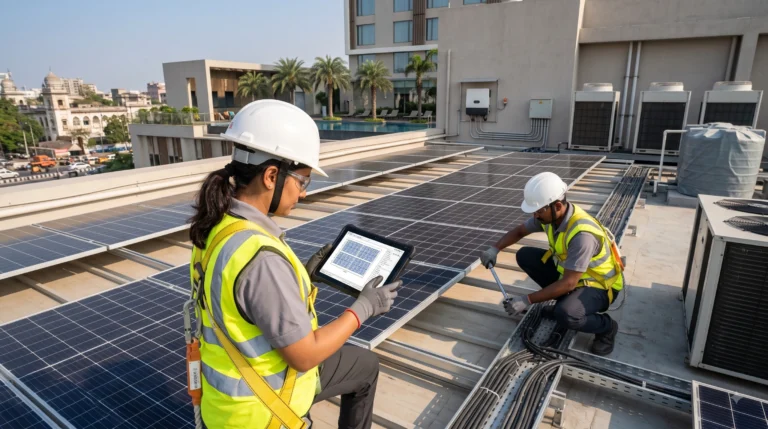
Solar for hotels and restaurants can be an effective way to reduce dependence on grid electricity when the property’s electricity consumption, rooftop conditions and solar system are properly matched.
Restaurants can benefit from the combination of daytime kitchen operations, refrigeration, air conditioning, lighting and ventilation. Hotels can have even broader electricity requirements across guest rooms, HVAC, kitchens, laundry, pumps, common areas and other facilities.
The strongest opportunity generally comes from understanding when the business consumes electricity and when the solar system generates it.
However, a large electricity bill alone does not guarantee that rooftop solar will deliver a particular level of savings.
The final result depends on:
Businesses should therefore evaluate solar using actual electricity bills and a professional rooftop survey.
For Hyderabad hotels and restaurants, Roof Rays Solar Solutions can assess the property and develop a solar proposal around its real electricity requirements rather than relying on generic system sizes.
The best commercial solar system is not simply the largest one—it is the one that fits the property’s electricity demand, roof and long-term business goals.
Book Your Free Site Survey Today
© 2025 Roof Rays Solar Solutions. All Rights Reserved. | Designed by MANI
Check whether your property qualifies for rooftop solar subsidy support.
