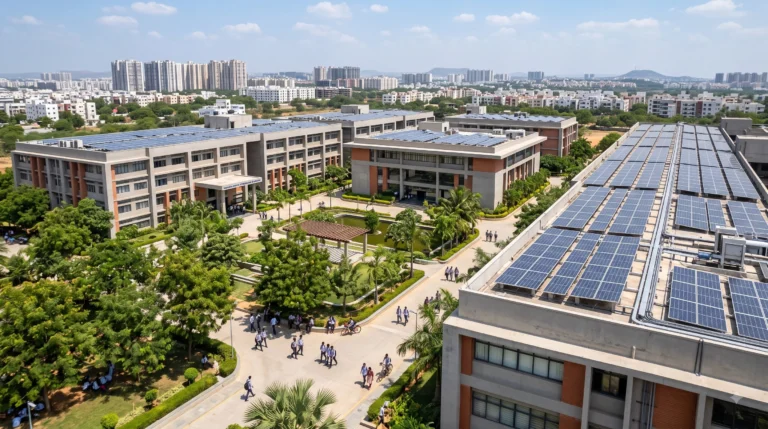
Schools and colleges use electricity across classrooms, laboratories, offices, libraries, computer rooms, hostels, canteens, lighting systems, fans, air conditioning, water pumps and other facilities.
For educational institutions with suitable rooftops, solar for schools and colleges can be a practical way to generate renewable electricity and reduce dependence on grid power.
However, planning solar for an educational campus is different from installing a small residential rooftop system.
A school or college may have:
The right solar design therefore needs to consider the campus electricity profile, available roof area, building structure, safety, shading, maintenance access and future energy requirements.
The objective should not simply be to install the maximum number of panels.
It should be to create a rooftop solar system that is safe, practical, appropriately sized and capable of delivering useful long-term energy savings.
Yes, many schools and colleges can be suitable for rooftop solar, particularly when they have substantial daytime electricity consumption and usable roof space.
Educational institutions can have a useful solar-consumption match because many activities take place during daylight hours.
For example:
Solar generation → classrooms + offices + laboratories + computers + fans + HVAC + pumps
This can allow the institution to consume a meaningful portion of solar generation directly, depending on its actual load profile and system configuration.
However, suitability depends on:
A professional site survey and electricity-bill analysis should therefore come before final system sizing.
Key Takeaways
Solar planning should account for future campus expansion and electricity demand.
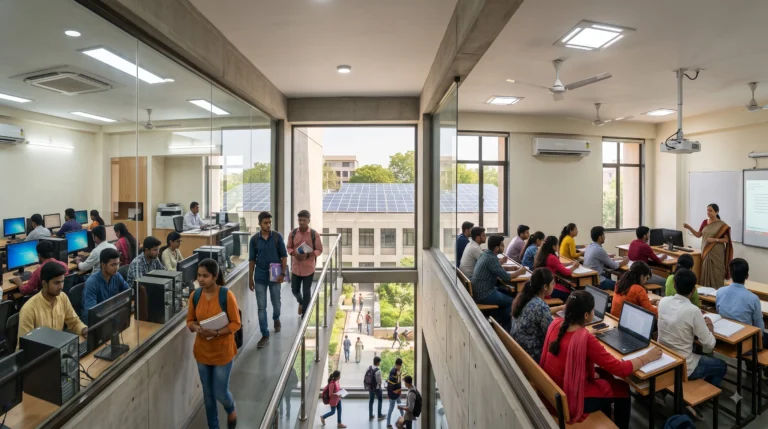
Schools and colleges have a unique electricity-consumption pattern.
Many institutions operate primarily during daylight hours.
Typical electricity loads can include:
Classrooms
Computer Laboratories
Administrative Offices
Laboratories
Specialized equipment may consume substantial electricity depending on the institution.
Libraries
Lighting, cooling and computer systems can operate for extended periods.
Canteens
Refrigeration, cooking equipment, ventilation and lighting can add significant loads.
Water Systems
Pumps and other water-management equipment may consume electricity throughout the day.
These loads can create an opportunity for solar generation to offset part of the institution’s grid electricity consumption.
Why Daytime Consumption Matters
Solar panels generate most of their electricity during daylight hours.
Schools and colleges often have substantial daytime activity, which can be advantageous.
For example:
9:00 AM–4:00 PM
Students and staff may be using:
At the same time, rooftop solar may be generating electricity.
This creates the potential for direct solar consumption.
However, the actual match depends on the institution’s operating schedule.
A college with evening classes may have a different load profile from a school operating only during the daytime.
Therefore, historical electricity consumption should be reviewed before deciding the system size.
Solar for Schools
Schools can use rooftop solar across several electricity-consuming areas.
Classroom Buildings
Fans, lighting, smart classroom equipment and air conditioning can contribute to daytime consumption.
Computer Rooms
Computer laboratories can have concentrated electrical loads during school hours.
Administrative Buildings
Office equipment, lighting and cooling can operate throughout the working day.
Canteens
Refrigeration and other electrical equipment may operate during school hours.
Outdoor & Common Areas
Lighting, pumps and other equipment also contribute to electricity consumption.
A school with multiple buildings may need a rooftop assessment for each suitable structure rather than assuming that one roof can accommodate the entire solar system.
Solar for Colleges
Colleges and universities can have more complex electricity requirements.
A campus may contain:
This creates a broader opportunity for solar but also makes planning more complex.
A commercial-scale or institutional solar assessment should examine:
How Much Solar Capacity Does a School Need?
There is no universal solar capacity for every school.
A suitable system depends on:
For example, a small school may need a relatively modest system, while a large campus with laboratories, hostels and air-conditioned facilities may have a substantially higher requirement.
Better Approach
Instead of asking:
“How many solar panels can fit on our roof?”
Ask:
“What solar capacity matches our electricity consumption and available rooftop space?”
This produces a more useful starting point for system design.
Campus Roof Assessment
Educational campuses often have multiple rooftop structures.
A solar survey should identify:
The usable solar area is not necessarily equal to the total roof area.
Some portions may need to remain clear for:
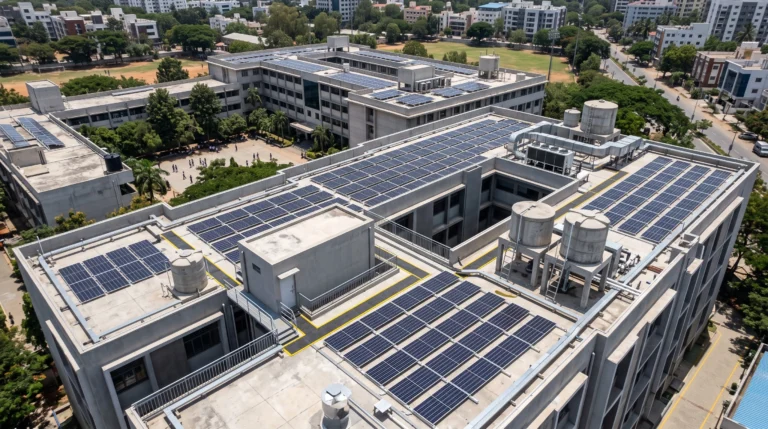
Solar Panels Around Water Tanks
Water tanks are common on school and college rooftops.
They don’t automatically prevent solar installation.
Panels can often be positioned around the tank after assessing:
The same principle applies to staircase rooms and other rooftop obstacles.
Important
Do not sacrifice access to essential campus equipment simply to fit additional solar panels.
Water tanks may need periodic cleaning, inspection and maintenance, so the final panel layout should preserve practical access.
Solar Panel Shadow Analysis
Shading can reduce solar generation.
Potential sources on an educational campus include:
The sun’s position changes throughout the day and throughout the year.
Therefore, a rooftop that appears suitable at midday may experience shading during morning or afternoon periods.
A proper solar design should assess the relevant shadow conditions before finalizing the panel arrangement.
Structural Safety for School & College Roofs
Structural safety is particularly important because educational buildings can have different ages and construction types.
Before installing solar, assess:
An RCC roof should not be assumed to have unlimited additional load capacity simply because it is made from reinforced concrete.
Where structural suitability is uncertain, an appropriate qualified structural assessment should be obtained.
Solar Mounting on Institutional Roofs
The mounting arrangement depends on the building and roof.
Potential approaches can include:
The selected method should consider:
For institutional buildings, the mounting solution should be planned carefully because the system may cover a significant roof area.
Waterproofing & Drainage
Schools and colleges should not overlook roof waterproofing.
Poor installation practices can potentially create leakage problems if roof penetrations or waterproofing systems are not handled appropriately.
The solar design should consider:
Solar structures should not block essential rainwater drainage.
This is especially important for large institutional rooftops where even a small drainage problem can affect a larger building area.
Student & Staff Safety
Safety is a major consideration when installing solar on educational premises.
The installation should appropriately address:
Students should not have unrestricted access to rooftop solar equipment.
Maintenance should be performed by appropriately trained personnel.
Solar Installation Process for Schools & Colleges
Review historical electricity consumption.
Understand classrooms, laboratories, hostels, HVAC and other major loads.
Assess all suitable rooftops.
Evaluate the suitability of the proposed solar installation.
Identify shading from rooftop and surrounding structures.
Determine appropriate capacity.
Design the arrangement around rooftop obstacles and access requirements.
Plan inverter locations, cable routes and electrical protection.
Complete applicable approvals and connectivity requirements.
Install, test and commission the system.
Track generation and system performance.
Solar for Hostels & Larger Campuses
Large educational campuses often have electricity consumption beyond classrooms and offices.
Hostels can add substantial loads from:
Because hostel electricity consumption can extend beyond normal academic hours, the institution should distinguish between daytime solar consumption and evening/night electricity requirements when sizing the system.
A campus with multiple buildings should also assess whether the available electricity connections and distribution infrastructure are suitable for the proposed solar arrangement.
CAPEX vs OPEX Solar for Schools & Colleges
Educational institutions can evaluate both CAPEX and OPEX/RESCO-style solar models.
CAPEX Model
The institution purchases and owns the solar system.
Potential Advantages
Considerations
OPEX Model
A third-party solar provider generally finances and owns the system while the institution purchases solar electricity under an agreed contractual arrangement.
Potential Advantages
Considerations
The better model depends on the institution’s budget, building ownership, electricity consumption and long-term plans.
Solar ROI for Educational Institutions
Solar savings should be calculated using the institution’s actual electricity data.
Important factors include:
A simple CAPEX payback calculation is:
Simple Payback Period = Solar Investment ÷ Annual Electricity Savings
This is only a preliminary calculation. A detailed institutional investment assessment should also consider financing, system degradation, maintenance, electricity-price changes and applicable accounting or tax treatment.
Schools and colleges should therefore avoid relying on a generic “X-year payback” without reviewing their actual electricity bills.
Can Solar Reduce a School’s Electricity Bill to Zero?
Not necessarily.
Solar can significantly reduce grid electricity consumption, but the final electricity bill depends on:
If the institution consumes electricity when solar generation is low, grid electricity may still be required.
Similarly, solar generation may exceed instantaneous campus consumption at certain times.
The applicable metering and settlement arrangement determines how such electricity is accounted for.
Therefore:
Solar generation ≠ automatically zero electricity bill.
What Happens to Excess Solar Generation?
When solar generation exceeds the institution’s instantaneous electricity consumption, surplus electricity may be exported to the grid under an approved arrangement, subject to applicable regulations and utility requirements.
For Telangana projects, the applicable rooftop-solar and metering framework should be confirmed based on the institution’s specific electricity connection and consumer category.
Do not assume that the same arrangement used for a residential house automatically applies to a school, college or institutional campus.
Government & Telangana Regulatory Considerations
Telangana’s Rooftop Solar PV Grid Interactive Systems Regulation, 2025 provides the current state framework for rooftop solar and includes provisions covering different metering arrangements and eligible consumers. (tgerc.telangana.gov.in)
Schools and colleges should verify their specific:
before finalizing the project.
Educational institutions should also avoid assuming that residential rooftop-solar subsidies automatically apply to institutional electricity connections. Applicable government assistance depends on the current scheme and eligibility conditions.
Solar Installation Cost for Schools & Colleges
Institutional solar costs vary according to the project.
Important cost factors include:
A campus with several buildings may require additional electrical design and cabling compared with a single-rooftop installation.
Therefore, the final project cost should be based on a site survey and detailed technical proposal.
Solar Maintenance for Educational Institutions
A solar system should be treated as long-term infrastructure.
Routine attention can include:
Panel Cleaning
Dust and dirt can reduce sunlight reaching the modules.
Visual Inspection
Check for visible damage or unusual conditions.
Inverter Monitoring
Review system alerts and generation data.
Electrical Inspection
Electrical work should be handled by qualified personnel.
Mounting Inspection
Check mounting structures and associated components as appropriate.
Roof Drainage
Ensure drainage paths remain clear.
Shading Review
Growing trees or new structures can change the solar environment.
A maintenance plan should also account for school calendars and campus operations so service work can be performed with minimal disruption.
Educational Solar Safety Checklist
Before commissioning the project, review:
The rooftop should not become an uncontrolled access area for students.
Solar equipment should be accessible to authorized personnel only.
Solar as an Educational Opportunity
Beyond reducing electricity costs, a rooftop solar installation can also support environmental education.
Schools and colleges can use system monitoring data to demonstrate:
For example, a display showing daily solar generation can turn an operational solar system into a practical educational resource.
This should be treated as an additional benefit rather than the primary financial justification for installation.
Planning Solar Around Future Campus Expansion
A school or college may expand over time.
Future plans could include:
If the institution expects electricity demand to increase, the solar plan should consider the future rather than sizing the system entirely around today’s consumption.
However, future demand should be based on realistic expansion plans rather than assumptions.
Expert Tips for Schools & Colleges
Review at least the available historical consumption data before sizing the system.
Classrooms, labs, offices and HVAC can align well with solar generation.
A large campus may have several useful rooftop areas.
Older institutional buildings should receive appropriate assessment where required.
Installation should not unnecessarily compromise the roof.
Use appropriate access controls and safety practices.
Don’t place panels where tanks, inverters or other equipment become inaccessible.
Look at long-term cost rather than only upfront price.
Account for realistic changes in campus electricity demand.
Generation data helps the institution understand whether the system is performing as expected.
At-a-Glance Solar Planning Guide
Factor | School | College / Campus |
Daytime load | Usually important | Usually important |
Computer labs | Possible | Often significant |
HVAC | Property-dependent | Can be substantial |
Hostels | Sometimes | Common on larger campuses |
Kitchen/canteen | Common | Common |
Multiple buildings | Possible | Often relevant |
Roof obstacles | Tanks, stairs, parapets | Tanks, HVAC, multiple structures |
Future expansion | Consider | Important |
Safety access | Critical | Critical |
Best first step | Bill + roof survey | Campus-wide energy + roof survey |
Yes. Educational institutions with suitable roofs and meaningful electricity consumption can potentially reduce their grid electricity purchases through rooftop solar.
Many schools consume electricity during daylight hours for classrooms, computers, fans, lighting, offices and other facilities, which can align with solar generation.
Potentially. Multiple rooftops can be evaluated and incorporated into an overall solar design, subject to electrical, structural and utility considerations.
Solar electricity can offset electricity consumed by computers and other equipment during solar-generation hours, subject to system capacity and electrical configuration.
Not necessarily. Battery storage should be considered separately based on backup requirements, load profile and project economics.
Yes. Solar can still offset daytime electricity consumption. Electricity required after solar-generation hours can continue to be supplied through the applicable grid arrangement or stored energy where batteries are installed.
It depends on the institution’s available capital, building ownership, electricity consumption and long-term plans.
Yes, often. Panels can be positioned around tanks after assessing shading, access, roof area and maintenance requirements.
The need depends on the building and proposed installation. Where structural suitability is uncertain, an appropriate qualified structural assessment should be obtained.
Roof Rays can assess electricity consumption, campus rooftops, shading, structural considerations, solar capacity and installation requirements before developing a customized institutional solar proposal.
Roof Rays Solar Solutions helps Hyderabad institutions and businesses evaluate rooftop solar according to their actual electricity requirements and property conditions.
Roof Rays Can Help With:
For schools and colleges, the focus is on creating a solar system that works alongside the institution’s academic activities, electrical infrastructure, safety requirements and long-term campus plans.
Our experts design customized solar solutions based on your electricity consumption, roof space, and future energy goals—helping you maximize savings and achieve the best possible return on investment.
Phone
Address
📍 HUDA Complex, Tellapur, Hyderabad
Contact our solar experts today for a free consultation and personalized solar savings estimate.
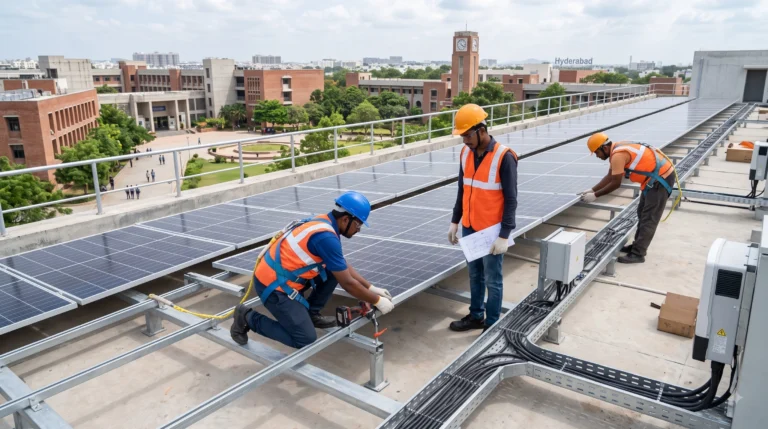
Solar for schools and colleges can provide both an energy-saving opportunity and a practical renewable-energy solution when the system is properly planned.
Educational institutions often have meaningful daytime electricity consumption across classrooms, computer laboratories, offices, libraries, laboratories, kitchens, HVAC systems and water pumps. Larger colleges and campuses can have additional loads from hostels, workshops, auditoriums and other facilities.
This daytime consumption can align well with rooftop solar generation.
However, the right system should not be selected simply by counting available roof space.
A proper institutional solar plan should evaluate:
For Hyderabad schools and colleges, Roof Rays Solar Solutions can assess the campus and develop a rooftop solar proposal based on actual electricity usage and site conditions.
The goal is not simply to put solar panels on a school or college roof. The goal is to build a safe, practical and financially sensible energy solution for the institution.
Book Your Free Site Survey Today
© 2025 Roof Rays Solar Solutions. All Rights Reserved. | Designed by MANI
Check whether your property qualifies for rooftop solar subsidy support.