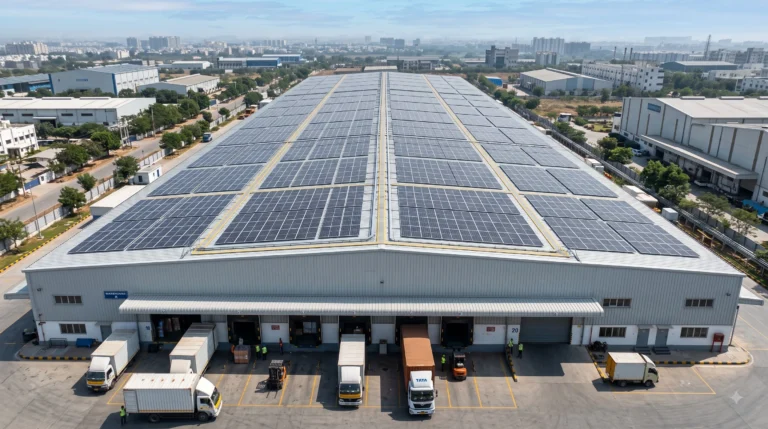
Warehouses can offer an excellent opportunity for rooftop solar because many have large, relatively open roof areas combined with significant electricity consumption from lighting, ventilation, material-handling equipment, offices, refrigeration and other operations.
For businesses operating warehouses in Hyderabad, rooftop solar can help reduce electricity purchased from the grid while making productive use of otherwise unused roof space.
However, installing solar on a warehouse is not simply about covering the entire roof with panels.
A proper commercial solar design should consider:
The right system should balance generation, roof utilization, safety, operational practicality and long-term business economics.
Yes. Many warehouses can be strong candidates for rooftop solar, particularly when they have large, relatively unobstructed roofs and substantial daytime electricity consumption.
Warehouse operations may consume electricity through:
When these loads operate during daylight hours, solar generation can potentially offset part of the electricity purchased from the grid.
However, the actual opportunity depends on the warehouse’s electricity consumption, roof condition, available area, shading, electrical connection and solar design.
Key Takeaways
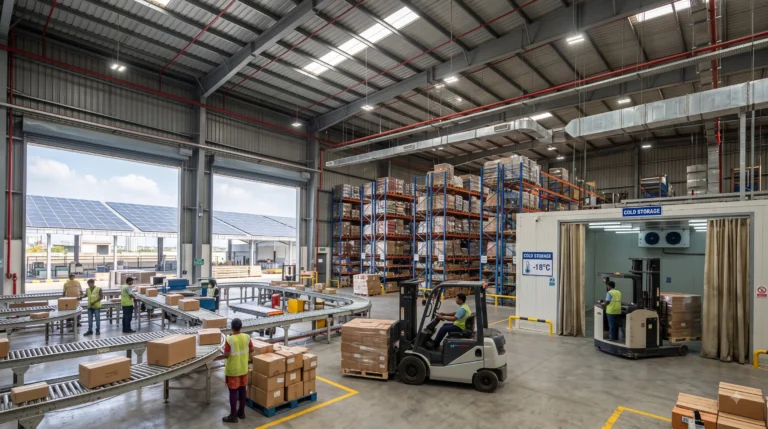
Many warehouses have characteristics that can support rooftop solar.
Large Roof Area
Warehouses often have expansive roofs compared with their occupied office area.
This can provide substantial space for solar modules.
Daytime Operations
Many warehouses operate during daylight hours.
Electricity may be consumed by:
This creates an opportunity for direct use of solar electricity.
Long Operating Hours
Warehouses may operate for extended shifts, increasing electricity consumption.
High Energy Requirements
Cold-storage warehouses and distribution facilities can have particularly significant electricity loads.
Electricity Loads in Warehouses
Not every warehouse has the same energy profile.
General Storage Warehouses
Typical loads can include:
Distribution Centres
Additional loads may include:
Cold Storage Warehouses
Electricity consumption can be significantly higher because of:
Manufacturing-Linked Warehouses
Some facilities may also contain production or processing equipment.
This makes actual electricity-bill analysis essential before determining solar capacity.
Why Daytime Consumption Matters
Solar generation is primarily available during daylight hours.
A warehouse operating during the day may consume solar electricity directly through:
Solar panels → Inverter → Warehouse electrical loads
For example:
The actual amount of electricity offset depends on the system size and the facility’s load profile.
A warehouse that operates mainly at night may have a different solar opportunity from one operating continuously throughout the day.
Solar for Cold Storage Warehouses
Cold storage deserves special consideration.
Refrigeration equipment can operate for long periods, including during daylight hours.
This can create a strong match between:
Solar generation + refrigeration demand
However, refrigeration systems also require reliable operation.
Solar planning should therefore distinguish between:
A standard grid-connected solar system should not automatically be considered emergency backup.
If refrigeration must continue operating during a grid outage, a dedicated backup architecture involving appropriate generators, batteries or other systems should be evaluated separately.
How Much Solar Capacity Does a Warehouse Need?
There is no universal capacity for every warehouse.
System sizing depends on:
The same 50,000-square-foot warehouse can have very different electricity consumption depending on whether it is used for general storage, cold storage, logistics or processing.
Better Approach
Don’t ask:
“How many panels can fit on the warehouse roof?”
Ask:
“What solar capacity provides the right balance between our electricity consumption, usable roof area and investment?”
Warehouse Rooftop Solar Design
A proper rooftop design should consider:
Panel Orientation
Panels should be arranged to achieve suitable solar exposure while accounting for roof geometry.
Tilt
The mounting structure should provide an appropriate panel angle for the site.
Row Spacing
Panels should be spaced appropriately to reduce avoidable self-shading and preserve maintenance access.
Roof Obstacles
Design around:
Maintenance Paths
Technicians should be able to safely access relevant equipment.
Solar Panels on Metal Warehouse Roofs
Many warehouses use metal roofing systems.
These roofs require careful consideration before solar installation.
The assessment should examine:
The mounting system must be compatible with the roof construction.
Do not assume that every metal roof can support the same solar mounting arrangement.
Where structural suitability is uncertain, an appropriate structural assessment should be obtained.
Solar Panels on RCC Warehouse Roofs
Some warehouses have RCC roofs.
The same fundamental considerations apply:
RCC construction can provide a suitable foundation for rooftop solar in many projects, but it should not automatically be assumed to have unlimited additional load capacity.
Roof Condition Assessment
Before installing solar, inspect the warehouse roof for:
Installing solar over a roof that already needs major repairs can complicate future maintenance.
If the roof requires replacement or significant repair, it may be better to address those issues before finalizing the solar installation.
Solar Panel Shadow Analysis for Warehouses
Large warehouse roofs can appear completely open but still experience shading.
Potential sources include:
A shadow assessment can help identify the most productive roof areas.
For large commercial projects, shading should be evaluated as part of the overall solar design rather than assumed to be insignificant.
Roof Drainage & Waterproofing
Warehouse roofs must continue to handle rainwater effectively after solar installation.
The solar design should not obstruct:
Where mounting penetrations are used, suitable sealing and waterproofing practices should be followed.
For metal roofs, the condition of roofing sheets and fasteners should also be considered.
For RCC roofs, existing waterproofing should be protected as far as practical.
Structural Safety for Warehouse Solar
Structural assessment can be particularly important for large rooftop installations.
The project may introduce additional loads from:
Wind loading is also important because warehouse roofs can present large exposed surfaces.
A professional structural assessment should be considered where the roof’s capacity or condition is uncertain.
Solar Installation Process for Warehouses
Review historical electricity consumption and tariff structure.
Understand daytime, evening and continuous loads.
Measure usable areas and assess roof condition.
Evaluate the suitability of the proposed installation where required.
Identify shading from surrounding and rooftop structures.
Determine the appropriate solar capacity.
Finalize panel orientation, row spacing and maintenance pathways.
Plan inverter locations, cable routes and electrical protection.
Compare CAPEX and OPEX options.
Complete applicable approvals and connectivity requirements.
Install mounting structures, panels and electrical equipment.
Test the system and complete required procedures.
Track generation and system performance.
CAPEX vs OPEX Solar for Warehouses
Businesses can evaluate different financing approaches.
CAPEX Solar
The business purchases and owns the solar system.
Advantages
Considerations
OPEX Solar
A third-party provider generally finances and owns the solar system while the warehouse operator purchases solar electricity under a contractual arrangement.
Advantages
Considerations
The better option depends on the company’s financial position, property ownership and long-term strategy.
Business Benefits of Warehouse Solar
Solar can offset part of the electricity purchased from the grid.
The roof becomes a productive energy-generating asset.
A properly sized system can generate electricity for many years.
Generating part of the facility’s electricity can reduce dependence on grid purchases.
Businesses can increase their use of renewable electricity and support their sustainability objectives.
Monitoring solar generation can help businesses understand their electricity consumption and energy performance.
Solar ROI for Warehouses
A basic CAPEX payback calculation is:
Simple Payback Period = Solar Investment ÷ Annual Electricity Savings
However, commercial solar investment analysis should go beyond this simple formula.
Consider:
For OPEX projects, compare:
Existing electricity cost vs contracted solar electricity cost
while considering escalation, contract duration and other contractual terms.
Telangana Regulatory Considerations
For grid-connected rooftop solar projects in Telangana, the current state framework is the Rooftop Solar PV Grid Interactive Systems Regulations, 2025 issued by TGERC. (tgerc.telangana.gov.in)
For industrial, commercial and other applicable consumers, the regulations include specific provisions relating to rooftop-solar capacity, sanctioned load/contract demand and metering arrangements. The exact eligibility and requirements should be confirmed for the warehouse’s electricity connection before system finalization. (tgerc.telangana.gov.in)
Commercial warehouses should not assume that residential rooftop-solar subsidy provisions apply to them. MNRE’s current rooftop-solar CFA programme is directed to eligible residential electricity consumers. (mnre.gov.in)
Solar Installation Cost for Warehouses
The final project cost depends on:
Large warehouse roofs can sometimes simplify panel layout, but the actual project cost still depends on the roof and electrical infrastructure.
A site-specific quotation is therefore more useful than a generic per-kW estimate.
Warehouse Solar Maintenance
A commercial solar system should be monitored and maintained throughout its operating life.
Important areas include:
Solar Panels
Keep modules reasonably clean and inspect for visible damage.
Inverter
Monitor system alerts and performance.
Mounting Structure
Check relevant components for corrosion, looseness or deterioration.
Roof
Inspect the roof around mounting areas and drainage paths.
Electrical Equipment
Qualified personnel should inspect and maintain electrical equipment.
Generation Monitoring
Unexpected drops in generation can indicate:
Expert Tips for Warehouse Owners
Roof size should not be the only basis for system sizing.
Metal and RCC roofs require different installation considerations.
Don’t install a long-life solar asset on a roof that may require replacement soon without planning appropriately.
Especially for large solar arrays.
Nearby buildings and rooftop equipment can affect production.
Do not cover every available square metre.
Account for planned warehouse extensions and increased electricity consumption.
Evaluate total long-term economics.
If the warehouse has critical refrigeration or logistics equipment, separately assess backup requirements.
Track actual generation against expectations.
At-a-Glance Warehouse Solar Guide
Factor | General Warehouse | Cold Storage | Distribution Centre |
Daytime load | Moderate–high | High | Often high |
Refrigeration | Usually limited | Major load | Usually limited |
Lighting | Important | Important | Important |
Material handling | Variable | Variable | Often significant |
HVAC | Property-dependent | Important | Important |
Solar opportunity | Roof + load dependent | Potentially strong | Potentially strong |
Backup requirement | Project-specific | Often important | Project-specific |
Best first step | Bill + roof survey | Load + refrigeration analysis | Energy + roof assessment |
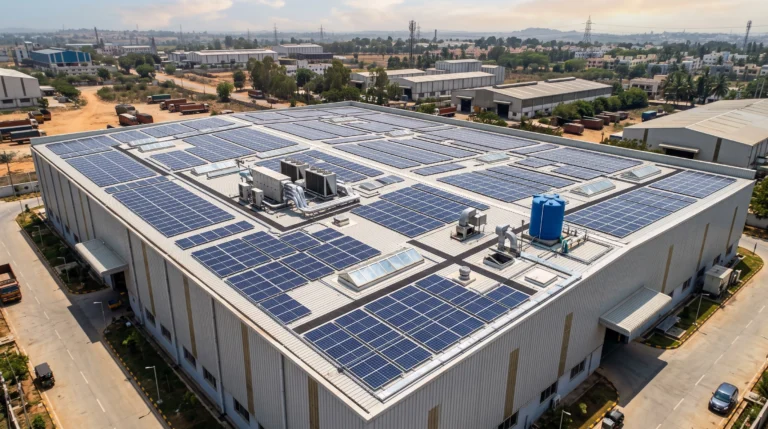
It can be. Warehouses with suitable roofs, substantial electricity consumption and meaningful daytime loads can potentially achieve attractive long-term energy savings.
Many warehouses have large roof areas and operate during daylight hours, creating a potential match between solar generation and electricity consumption.
The suitable capacity depends on electricity consumption, usable roof area, shading, structural conditions, electrical connection and applicable utility requirements.
Potentially. The roof type, structural framing, condition, mounting method and wind requirements should be assessed before installation.
Yes, where the roof is suitable. Structural capacity, waterproofing, drainage, mounting and shading should be evaluated.
Solar generation can offset electricity consumed by refrigeration systems during solar-generation hours. However, backup requirements for refrigeration should be assessed separately.
A conventional grid-connected system does not automatically provide backup during grid outages. A dedicated battery/hybrid or other backup solution may be required.
It depends on available capital, property ownership, electricity consumption, contract preferences and long-term financial objectives.
Potentially, but the lease should provide appropriate rights for rooftop installation, access and long-term use. Ownership and removal provisions should also be clearly documented.
Roof Rays can assess electricity consumption, roof area, structural considerations, shading, solar capacity, generation potential and suitable commercial financing options.
Roof Rays Solar Solutions helps Hyderabad businesses evaluate commercial rooftop solar based on actual electricity consumption and property conditions.
Roof Rays Can Help With:
For warehouses, the goal is to develop a solar solution that works with the building’s roof structure, operating schedule, electrical consumption and long-term business plans.
Our experts design customized solar solutions based on your electricity consumption, roof space, and future energy goals—helping you maximize savings and achieve the best possible return on investment.
Phone
Address
📍 HUDA Complex, Tellapur, Hyderabad
Contact our solar experts today for a free consultation and personalized solar savings estimate.
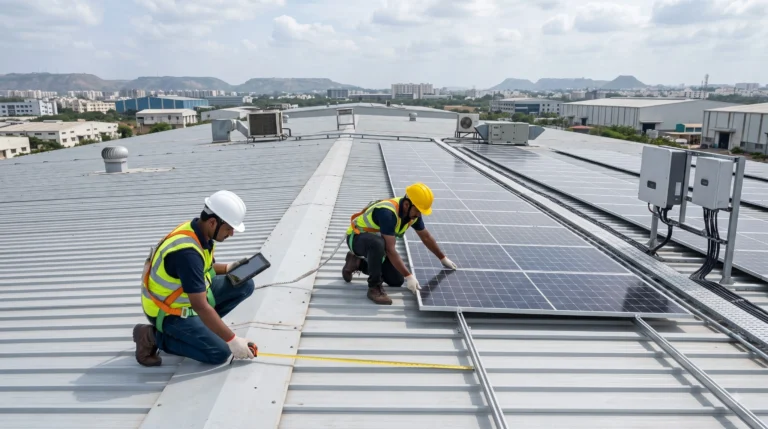
Solar for warehouses can be a practical long-term energy solution when the rooftop, electricity consumption and solar system are properly matched.
Warehouses often have a valuable combination of large roof areas and daytime electricity consumption, making them worth evaluating for rooftop solar.
General storage facilities may primarily consume electricity through lighting, ventilation and office systems. Distribution centres can add material-handling and packaging loads, while cold-storage facilities can have substantial refrigeration demand.
The solar opportunity therefore varies from warehouse to warehouse.
A successful project should begin with:
The roof should also be evaluated for its remaining useful life. Installing solar on a roof that requires major replacement soon can complicate the economics and maintenance strategy.
For Hyderabad warehouses, Roof Rays Solar Solutions can help assess the property and develop a rooftop solar proposal based on actual electricity consumption and site conditions.
The best warehouse solar system is not simply the largest system that fits the roof—it is the system that makes effective use of the roof while matching the warehouse’s electricity demand, safety requirements and long-term business objectives.
Book Your Free Site Survey Today
© 2025 Roof Rays Solar Solutions. All Rights Reserved. | Designed by MANI
Check whether your property qualifies for rooftop solar subsidy support.