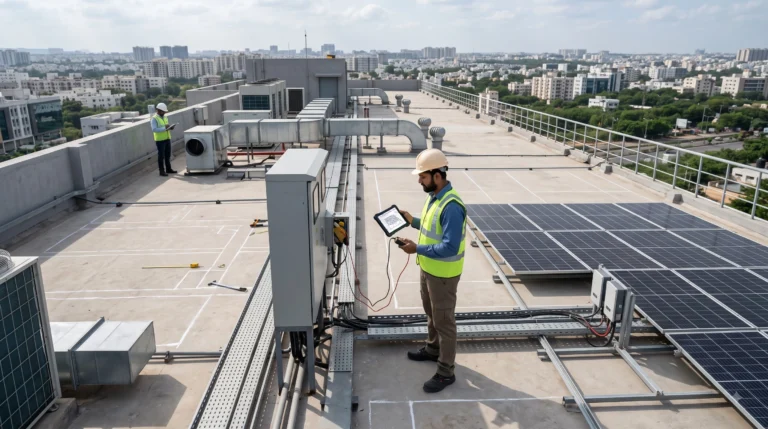
Choosing the right rooftop solar capacity is one of the most important decisions a business makes before installing a commercial solar system.
A system that is too small may leave significant electricity demand uncovered. A system that is larger than the property’s practical requirement may not deliver the expected financial value, particularly when daytime consumption, sanctioned load, contracted demand, roof limitations and applicable metering rules are considered.
This is where a commercial solar energy audit becomes valuable.
Instead of starting with a fixed system size such as 50 kW, 100 kW or 250 kW, an energy audit starts with the business’s actual electricity consumption and works toward a suitable solar capacity.
For businesses in Hyderabad and Telangana, the analysis should also consider the property’s sanctioned load or contracted demand. Under Telangana’s 2025 rooftop solar regulation, industrial, commercial and other consumers are generally permitted rooftop solar capacity up to 80% of sanctioned load or contracted demand under net and gross metering.
A commercial solar energy audit combines several factors:
Electricity consumption + load profile + sanctioned load/contract demand + daytime usage + available roof area + shading + solar generation potential + electrical infrastructure + metering arrangement + project economics
The objective is not necessarily to maximize the number of panels on the roof.
The objective is to identify a capacity that is technically feasible, compatible with the property’s electricity requirements and regulatory conditions, and financially sensible for the business.

A commercial solar energy audit is a structured assessment of a business’s electricity consumption and site conditions to determine how rooftop solar can be integrated into the property.
It typically examines:
The result should be a site-specific basis for designing the solar system rather than relying on a generic capacity recommendation.
The first step is to understand how much electricity the business actually consumes.
Ideally, the audit should review approximately 12 months of electricity bills to identify:
Looking at only one month’s bill can give an incomplete picture.
For example, an office, hotel, restaurant, warehouse or manufacturing facility may have significantly different consumption during different seasons.
Why 12-month data matters
Suppose a business consumes:
A solar system designed from only one month’s consumption could produce a very different recommendation from one based on the full year’s pattern.
Total electricity consumption is only part of the calculation.
The audit should also determine when the business uses electricity.
This is important because rooftop solar generates electricity during daylight hours.
A business with substantial daytime consumption may be able to directly use a large portion of its solar generation.
Common daytime commercial loads include:
The audit should therefore distinguish between:
Total energy consumption and daytime energy consumption.
This is particularly important for commercial properties in Telangana.
The proposed solar capacity cannot be determined from electricity consumption alone.
The auditor should verify the property’s:
Under the current TGERC 2025 rooftop solar regulation, the maximum rooftop solar capacity for industrial, commercial and other consumers under net and gross metering is generally 80% of sanctioned load/contracted demand.
Example
If a commercial consumer has a sanctioned load or contracted demand of 250 kW, the general 80% regulatory ceiling would correspond to 200 kW for the applicable net/gross metering provision.
That does not automatically mean the business should install 200 kW.
It means the audit can then determine whether a capacity up to that applicable limit makes technical and financial sense.
The next question is:
How much of the solar electricity can the business actually use?
This depends heavily on operating patterns.
Example
Consider a commercial facility that operates primarily from 9 AM to 7 PM.
Its solar generation also occurs mainly during daylight hours, making daytime consumption an important factor when assessing the value of the system.
In contrast, a facility that consumes very little electricity during the day may need a different approach to system sizing and excess-generation management.
Therefore, a commercial solar energy audit should examine the relationship between:
Solar generation hours ↔ business operating hours ↔ electrical load
Once electricity requirements have been assessed, the available roof becomes another capacity constraint.
The survey should identify:
TGSPDCL’s published solar FAQ gives approximately 10 square metres per kW as an indicative roof-space requirement for grid-connected rooftop solar. Actual requirements vary according to module dimensions, layout, mounting configuration, setbacks and site conditions.
Important
Available roof space ≠ required solar capacity.
A large commercial roof does not automatically mean the business should install the maximum possible system.
Shading can affect both the usable roof area and expected solar generation.
The audit should identify potential shading from:
The location and movement of shadows should be considered when designing the panel layout.
A roof that appears completely open during a site visit may experience significant shading at other times of the day.
The proposed solar capacity must also be compatible with the physical roof.
The assessment should examine:
For larger systems, TGSPDCL advises obtaining the opinion of a qualified structural engineer where appropriate.
If structural suitability is uncertain, the project should not proceed based solely on a roof-area calculation.
The energy audit should also examine where and how the solar system will connect to the building’s electrical network.
This may include reviewing:
The proposed solar capacity needs to work with the property’s existing electrical infrastructure and applicable utility requirements.
After determining a technically feasible capacity range, the audit should estimate how much electricity the system can generate.
The calculation should consider:
TGSPDCL’s published FAQ provides a broad indicative benchmark of around 1,000–1,200 units per kW per year for south-facing systems, while noting that east/west orientation can reduce generation. This should be treated as an indicative utility reference rather than a site-specific production guarantee.
A commercial project should preferably use a site-specific generation model.
This is where the energy audit becomes particularly useful.
Suppose a business has a proposed solar system capable of generating a certain annual amount of electricity.
The next question is:
How much of that generation coincides with the business’s actual consumption?
A simplified analysis can compare:
Factor | What to Review |
Annual consumption | Total electricity used |
Daytime consumption | Electricity used during solar-generation hours |
Proposed solar capacity | Potential system size |
Solar generation | Expected annual production |
Self-consumption | Solar electricity used directly |
Export | Electricity sent to the grid where applicable |
Grid import | Electricity still purchased |
Tariff/value | Applicable electricity cost |
Project cost | Total investment |
O&M | Ongoing operating cost |
This produces a more meaningful basis for capacity selection than simply dividing annual consumption by an assumed solar-generation number.
A commercial solar system can sometimes generate more electricity than the business is consuming at a particular moment.
The audit should therefore examine:
This is especially important when considering a system close to the maximum permitted capacity.
The aim is not necessarily to eliminate every unit of grid export, but to understand how excess generation affects the project’s economics and billing arrangement.
A good energy audit does not necessarily jump directly to one number.
It can be useful to model several scenarios.
Example
A business might evaluate:
Option A: Smaller system
Lower initial investment and potentially higher proportion of direct consumption.
Option B: Medium system
Balances investment, generation and daytime consumption.
Option C: Larger system
Uses more available roof space but may require greater consideration of excess generation and applicable capacity limits.
The purpose is to understand how the economics change as system capacity increases.
A Simple Commercial Solar Capacity Calculation
A basic starting point can be expressed as:
Required Solar Capacity ≈ Target Annual Solar Generation ÷ Expected Annual Generation per kW
For example, if a business wants to offset a portion of its annual electricity consumption and the project-specific generation estimate is known, the required capacity can be approximated from that relationship.
But this is only a preliminary calculation.
The final capacity also needs to consider:
Load profile + daytime consumption + roof space + shading + sanctioned load/contract demand + electrical infrastructure + metering arrangement + financial objectives
This is why a commercial solar energy audit is more useful than relying on an online solar calculator alone.
How to Decide Between 100 kW, 200 kW or 300 kW?
The correct answer depends on the business.
Consider a hypothetical commercial property with substantial annual electricity consumption and a large rooftop.
A 100 kW system may leave considerable electricity demand supplied by the grid.
A 300 kW system may generate significantly more electricity, but whether that additional capacity creates proportional financial value depends on the property’s daytime load, regulatory limit, export arrangement, roof conditions and project economics.
Therefore, the question should not be:
“How many panels can fit on my roof?”
It should be:
“What system capacity provides the appropriate balance between consumption, generation, site feasibility, regulatory limits and project economics?”
Commercial Solar Energy Audit for Different Businesses
Offices
Important factors include:
Hotels
The audit may need to consider:
Restaurants
Key loads can include:
Warehouses
The assessment should consider:
Hospitals
A hospital’s energy audit requires additional attention to:
Manufacturing Facilities
The analysis should examine:
Commercial Solar Capacity: Technical vs Financial Limit
A business may have three different capacity limits.
The capacity permitted under the applicable rooftop solar and metering framework.
The capacity that can practically be installed based on the roof, electrical system, shading, structure and site conditions.
The capacity that makes financial sense based on investment, electricity consumption, generation and applicable billing arrangements.
The final project size should be selected only after considering all three.
How a Commercial Solar Energy Audit Supports ROI
A solar energy audit creates the inputs required for a more realistic financial model.
The assessment can feed into:
System capacity → expected generation → self-consumption → grid offset → export → annual savings → O&M → project cost → payback
However, the audit should not promise a fixed ROI.
Electricity tariffs, consumption patterns, system performance, project cost and applicable utility arrangements can affect actual financial results.
A responsible proposal should clearly state its assumptions.
Common Mistakes When Sizing Commercial Solar
Installing the maximum possible capacity
Maximum roof utilization is not automatically the same as maximum financial value.
Looking only at annual electricity consumption
The timing of consumption matters because rooftop solar produces electricity during daylight hours.
Ignoring sanctioned load or contracted demand
This can create a regulatory mismatch between the desired system and the applicable capacity limit.
Using only roof area to determine capacity
Roof space is a physical constraint, not the sole sizing criterion.
Ignoring shading
A large roof can still have limited productive area.
Using one month’s electricity bill
Seasonal consumption can make a single-month analysis misleading.
Ignoring future electricity demand
A business planning expansion should consider how its electricity requirements may change.
Treating generation estimates as guarantees
Actual generation depends on site and operating conditions.
Commercial Solar Energy Audit Checklist
Before finalizing the rooftop solar capacity, a business should have answers to these questions:
Electricity
Site
Electrical
Solar Design
Financial
Commercial Solar Energy Audit in Hyderabad
For businesses in Hyderabad, solar capacity planning should be based on the property’s actual electricity profile and site conditions rather than using a standard system size.
The audit should account for the local rooftop environment, roof orientation, shading from surrounding buildings, commercial operating schedules and the property’s electrical connection.
For Telangana commercial consumers, the current TGERC framework is particularly important because the general net/gross metering capacity ceiling is linked to 80% of sanctioned load or contracted demand.
Businesses should also verify current DISCOM requirements before finalizing the design, particularly when project capacity, connection type or metering arrangements differ.
What Should a Commercial Solar Energy Audit Report Include?
A useful audit report should clearly document:
The report should make it possible for a business owner or facility manager to understand why the recommended capacity was selected.
What is a commercial solar energy audit?
A commercial solar energy audit is an assessment of a business’s electricity consumption, load profile and site conditions to determine an appropriate rooftop solar system size and evaluate its technical and financial feasibility.
How is commercial solar capacity calculated?
Capacity is estimated by comparing electricity consumption and solar-generation potential, then adjusting for daytime load, roof space, shading, electrical infrastructure, sanctioned load or contracted demand, metering arrangements and project economics.
Is annual electricity consumption enough to determine solar capacity?
No. Annual consumption is important, but the timing of electricity use is also critical because rooftop solar generates primarily during daylight hours.
What is the maximum commercial rooftop solar capacity in Telangana?
Under Telangana’s 2025 rooftop solar regulation, industrial, commercial and other consumers are generally limited to up to 80% of sanctioned load or contracted demand for net and gross metering.
How much roof space does commercial solar require?
TGSPDCL gives approximately 10 square metres per kW as an indicative requirement for grid-connected rooftop solar. Actual space requirements depend on module size, layout, mounting arrangement and site conditions.
Should a business use all its available roof space for solar?
Not necessarily. The appropriate capacity depends on electricity consumption, daytime load, regulatory limits, roof conditions, electrical infrastructure, generation potential and financial objectives.
Why are daytime electricity loads important for commercial solar?
Solar generation occurs during daylight hours. A business with substantial daytime consumption may directly use more of its solar generation, while a business with low daytime demand needs to consider how excess generation will be handled.
Should future business expansion be considered during a solar energy audit?
Yes. If electricity consumption is expected to increase because of additional equipment, production, floor area or operating hours, that should be considered when evaluating potential system capacity.
Can a commercial solar energy audit guarantee savings?
No. An audit provides estimates based on documented assumptions. Actual savings can vary because of electricity consumption, tariffs, solar generation, system performance, maintenance and applicable billing arrangements.
At Roof Rays Solar, we are committed to delivering reliable rooftop solar solutions that combine quality products, professional installation, and long-term customer support. Whether you’re a homeowner, business owner, or industrial customer, our team works closely with you to design a solar system that matches your energy goals and budget.
Why Customers Trust Roof Rays Solar
Our experts design customized solar solutions based on your electricity consumption, roof space, and future energy goals—helping you maximize savings and achieve the best possible return on investment.
Phone
Address
📍 HUDA Complex, Tellapur, Hyderabad
Contact our solar experts today for a free consultation and personalized solar savings estimate.
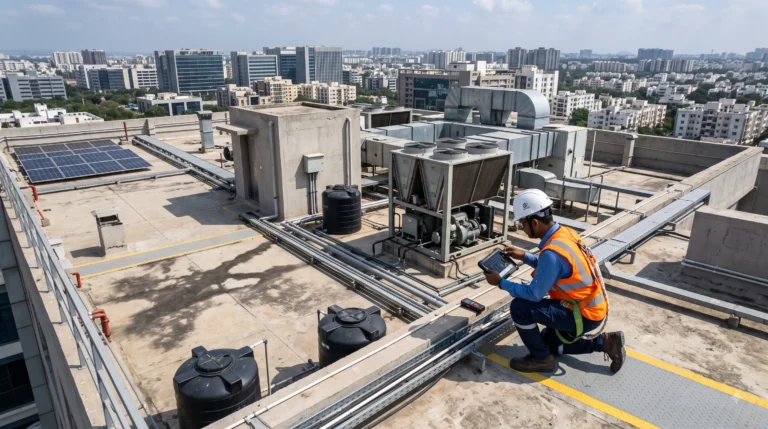
A commercial solar energy audit provides the foundation for selecting an appropriate rooftop solar capacity.
The right system size is not determined by electricity consumption, roof area or regulatory limits alone. It comes from evaluating all of these factors together:
Electricity demand + daytime load + roof feasibility + solar generation + electrical infrastructure + regulatory limits + project economics.
For Hyderabad and Telangana businesses, checking sanctioned load or contracted demand is particularly important because the current state rooftop-solar framework places a general 80% capacity limit for industrial, commercial and other consumers under net and gross metering.
Book Your Free Site Survey Today
© 2025 Roof Rays Solar Solutions. All Rights Reserved. | Designed by MANI
Check whether your property qualifies for rooftop solar subsidy support.
