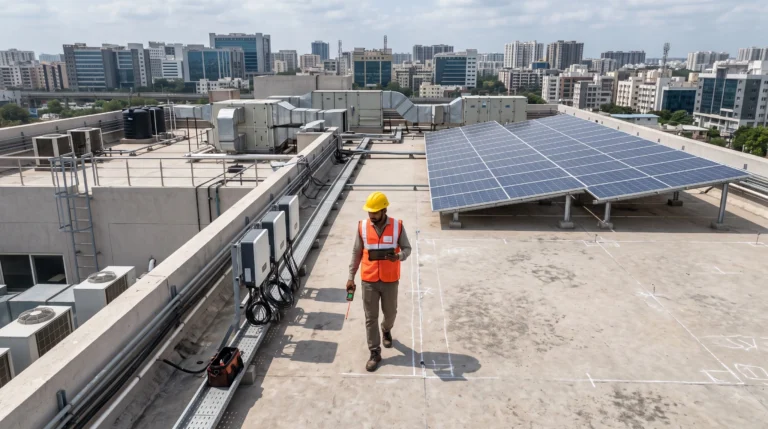
Installing solar for a commercial property is more than placing solar panels on an available roof. The system needs to match the building, electricity consumption, electrical infrastructure, roof conditions, available space, safety requirements and applicable utility regulations.
That is why a commercial solar site survey should be completed before the final system design or installation.
For businesses in Hyderabad and across Telangana, a proper site survey can identify potential problems early and help the solar installer determine an appropriate system configuration. It can also help businesses understand whether the proposed capacity is practical based on their sanctioned load or contracted demand.
The Telangana Electricity Regulatory Commission’s 2025 rooftop solar regulation generally limits rooftop solar capacity for industrial, commercial and other consumers to up to 80% of sanctioned load or contracted demand under net and gross metering arrangements.
A commercial solar site survey is a technical inspection of a business property before designing and installing a rooftop solar PV system.
The survey should evaluate:
A good survey converts the physical site and electricity data into information that can be used for a realistic solar proposal.
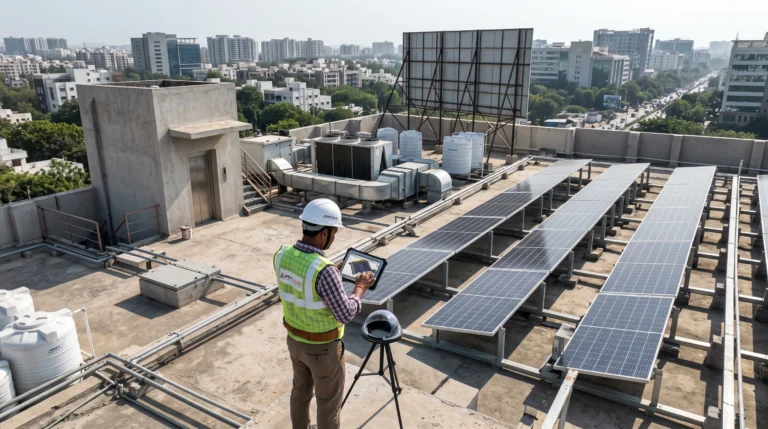
The first step is understanding how much electricity the business actually uses.
The survey team should review recent electricity bills and identify:
Solar capacity should not be selected simply because a particular roof area is available. The system should be designed around the property’s electricity requirements and applicable electrical limits.
For Telangana commercial consumers, the 2025 TGERC regulation specifies a general maximum rooftop solar capacity of up to 80% of sanctioned load or contracted demand for net and gross metering.
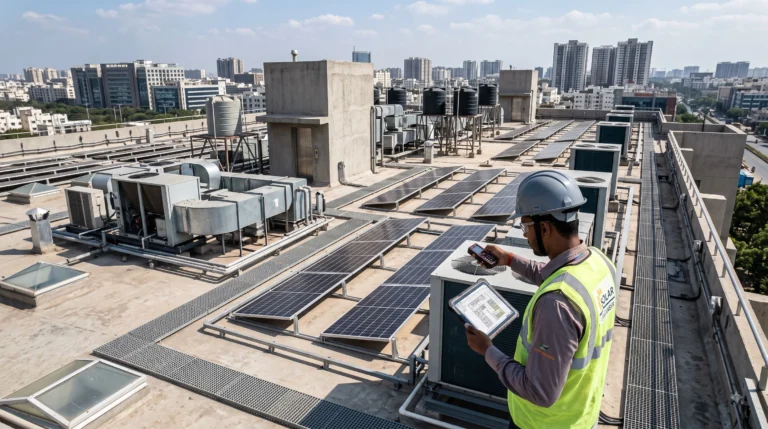
The total roof area is not the same as the usable solar area.
A survey should identify areas occupied by:
The installer should determine how many panels can realistically be installed while maintaining appropriate access and clearances.
TGSPDCL’s published FAQ gives an indicative figure of approximately 10 square metres of roof area per kW for a grid-connected solar PV system. Actual space requirements vary with module dimensions, mounting arrangement, setbacks and site-specific constraints.
A commercial solar system can remain on a roof for many years, so the existing roof should be assessed before installation.
The survey should look for:
For larger systems or roofs where structural capacity is uncertain, a qualified structural engineer may need to assess the roof. TGSPDCL also notes that larger rooftop systems may require the opinion of a qualified structural engineer.
A solar installation should not be used to cover up an unresolved roofing problem.
Solar panels need adequate exposure to sunlight throughout the day.
A commercial site survey should identify potential shading from:
Shading can change during different times of the day and seasons. Therefore, the survey should consider the movement of shadows rather than relying only on a single visual inspection.
This information helps determine panel placement and whether certain roof sections should be avoided.
The survey should determine how panels can be positioned on the available roof.
The team should consider:
The objective is not simply to fill the roof with panels. The layout should balance energy generation, safe access, structural considerations and maintainability.
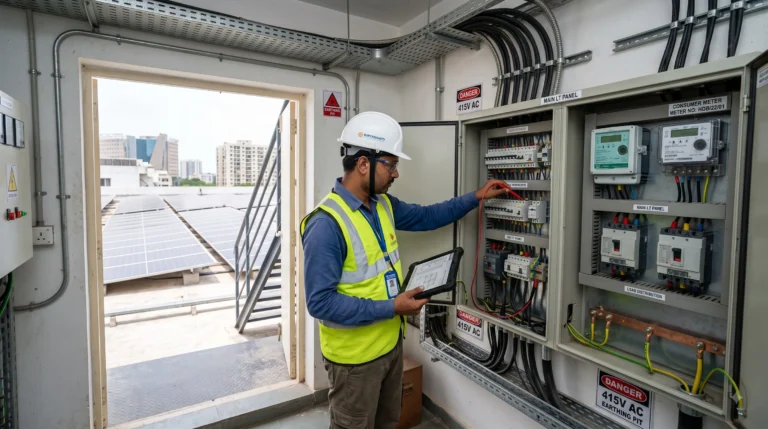
The solar system must integrate safely with the property’s electrical system.
The survey should examine:
The proposed solar capacity should be compatible with the site’s electrical infrastructure and applicable utility requirements.
For Telangana projects, the current TGERC rooftop solar regulation defines sanctioned/contracted load and demand as important parameters for rooftop solar eligibility and capacity considerations.
This is particularly important for commercial and industrial properties.
A business should not assume that its desired solar capacity can automatically be installed simply because there is sufficient roof space.
The site survey should compare:
Proposed solar capacity → sanctioned load/contract demand → applicable metering arrangement → utility requirements
For commercial consumers in Telangana, the 2025 regulation generally provides an 80% limit based on sanctioned load or contracted demand for net and gross metering.
This check can prevent designing a system that later requires changes to the proposed capacity or electrical arrangement.
Solar panels are only one part of a commercial solar installation.
The survey should identify suitable locations for:
The location should provide appropriate ventilation, protection from environmental exposure, safe access and practical cable routing.
The distance between panels, inverters and electrical connection points should also be considered because cable routing affects installation complexity and system design.
A commercial rooftop may have several operational zones. Cables therefore need to be routed carefully.
The survey should identify:
Cables should not obstruct normal business operations or create unnecessary trip, fire or maintenance hazards.
The system design should also account for appropriate isolation and protection equipment.
Electrical safety should be considered during the site survey rather than after installation.
The survey should examine the existing earthing arrangement and determine what additional provisions may be required for the proposed solar system.
Other safety considerations may include:
The exact protection design should be determined by qualified electrical professionals according to the project and applicable requirements.
A technically suitable roof may still present installation challenges.
The survey should check:
This is particularly important for warehouses, factories, hotels, hospitals, malls and multi-storey commercial buildings.
A good design should allow technicians to inspect, clean and maintain the system without unnecessarily disrupting business operations.
Before installation, businesses should understand the applicable utility process.
The survey and project documentation should establish:
TGSPDCL currently provides a dedicated rooftop solar net-metering service through its official portal.
Its published solar FAQ also identifies documents such as the current electricity bill and applicable application documentation for the solar net-metering process.
Requirements can change depending on project size, connection type and applicable regulations, so the final project should be checked against the current DISCOM and regulatory requirements.
What Should a Commercial Solar Site Survey Report Include?
After the physical inspection, the business should ideally receive a clear technical assessment rather than only a quotation.
A useful survey report can include:
Survey Area | What It Should Establish |
Electricity consumption | Current and historical energy usage |
Sanctioned load | Maximum applicable solar capacity considerations |
Roof area | Total and usable installation space |
Structural condition | Whether additional assessment is required |
Shading | Potential generation losses and panel placement |
Orientation | Suitable panel arrangement |
Electrical system | Connection and integration requirements |
Inverter location | Safe and practical equipment placement |
Cable routing | Approximate installation pathway |
Safety | Earthing and protection requirements |
Access | Installation and maintenance practicality |
Project design | Proposed capacity and layout |
The exact contents will vary by project size and property type.
Commercial Solar Site Survey for Different Businesses
A site survey is not identical for every commercial property.
Offices
The survey may focus on daytime consumption, rooftop availability, HVAC loads and electrical room integration.
Hotels and Restaurants
Hot water systems, kitchen equipment, HVAC, refrigeration and extended operating hours can significantly influence the load profile.
Warehouses
Large roof areas may be available, but the survey must consider roof structure, skylights, ventilation equipment and internal electrical distribution.
Hospitals
Critical electrical loads, backup systems, operational continuity and safety requirements require additional attention.
Shopping Malls and Retail Stores
Large HVAC systems, lighting, elevators, escalators, refrigeration and tenant-related electrical arrangements can make load analysis particularly important.
How a Commercial Solar Site Survey Helps With ROI
A site survey does not guarantee a particular return on investment. Instead, it improves the quality of the assumptions used to calculate project economics.
A reliable assessment should consider:
Solar capacity + expected generation + electricity consumption + tariff + self-consumption + export/metering arrangement + project cost + operating costs
For a business, using electricity generated during its own operating hours can be particularly important because the value of solar depends on how the generated energy interacts with the property’s consumption and applicable billing arrangement.
Therefore, the survey should be treated as the starting point for a realistic commercial solar financial model—not simply a roof measurement exercise.
Common Mistakes Businesses Should Avoid
Choosing capacity based only on roof size
A large roof does not automatically mean the business needs a large solar system.
Ignoring sanctioned load
The proposed capacity must be checked against the property’s sanctioned load or contracted demand and current regulations.
Skipping structural assessment
Older, damaged or complex roofs may require additional engineering review.
Ignoring shadows
A few shaded areas can affect panel placement and expected generation.
Designing without studying electricity bills
Solar capacity should reflect actual consumption patterns, not just the available roof.
Treating the quotation as the site survey
A price quotation alone does not demonstrate that the roof, electrical infrastructure, access and regulatory requirements have been properly evaluated.
Not planning maintenance access
Panels should remain accessible for cleaning, inspection and maintenance.
Commercial Solar Site Survey in Hyderabad: What Businesses Should Consider
Hyderabad commercial properties can have very different building types, from offices and retail spaces to warehouses, hospitals, hotels and manufacturing facilities.
A local site survey should therefore consider the property’s actual construction, roof design, electrical connection, operating schedule and local utility requirements.
For Telangana commercial and industrial consumers, the current rooftop solar regulation is especially relevant because the applicable solar capacity under net/gross metering is linked to sanctioned load or contracted demand.
Businesses should also confirm current requirements with the relevant DISCOM before finalizing the system.
What is a commercial solar site survey?
A commercial solar site survey is a technical assessment of a business property before solar installation. It evaluates electricity consumption, roof space, structural condition, shading, electrical infrastructure, safety, access and regulatory requirements.
Why is a site survey necessary before commercial solar installation?
It helps identify site limitations and provides the information required to develop a practical solar system design, installation plan and financial assessment.
How much roof space is required for commercial solar?
The requirement depends on the solar capacity, module dimensions, mounting configuration and usable roof area. TGSPDCL gives approximately 10 square metres per kW as an indicative figure for grid-connected rooftop solar.
Can every commercial roof install solar panels?
Not necessarily. Roof condition, structural suitability, shading, usable space, electrical infrastructure, access and applicable regulations all need to be evaluated.
How is commercial solar capacity decided in Telangana?
It depends on factors including electricity consumption, site conditions, sanctioned load or contracted demand and the applicable metering arrangement. Under Telangana’s 2025 rooftop solar regulation, industrial, commercial and other consumers are generally subject to an 80% limit of sanctioned load/contracted demand for net and gross metering.
Does a commercial solar site survey include electricity bill analysis?
A proper commercial assessment should review electricity bills and relevant load information because consumption patterns are important when determining an appropriate system size and financial model.
Does the roof need a structural inspection?
Not every roof requires a separate structural-engineer assessment, but larger systems or roofs with uncertain structural capacity may require one. TGSPDCL specifically recommends qualified structural-engineer input for larger systems where appropriate.
What happens after the solar site survey?
The survey information can be used to develop the proposed system capacity, layout, equipment configuration, generation estimate, project cost and installation plan, followed by the applicable utility and project processes.
At Roof Rays Solar, we are committed to delivering reliable rooftop solar solutions that combine quality products, professional installation, and long-term customer support. Whether you’re a homeowner, business owner, or industrial customer, our team works closely with you to design a solar system that matches your energy goals and budget.
Why Customers Trust Roof Rays Solar
Our experts design customized solar solutions based on your electricity consumption, roof space, and future energy goals—helping you maximize savings and achieve the best possible return on investment.
Phone
Address
📍 HUDA Complex, Tellapur, Hyderabad
Contact our solar experts today for a free consultation and personalized solar savings estimate.
A commercial solar site survey is one of the most important steps before installing rooftop solar for a business. It brings together the property’s electricity consumption, roof characteristics, structural condition, shading, electrical infrastructure, safety, access and regulatory requirements.
For Hyderabad and Telangana businesses, the survey should also account for the current rooftop solar regulations and the property’s sanctioned load or contracted demand.
The goal is simple: design the solar system around the actual business site and its electricity requirements—not around assumptions.
A detailed site assessment gives businesses a stronger foundation for evaluating system capacity, installation feasibility, expected generation and long-term project economics.
Book Your Free Site Survey Today
© 2025 Roof Rays Solar Solutions. All Rights Reserved. | Designed by MANI
Check whether your property qualifies for rooftop solar subsidy support.
