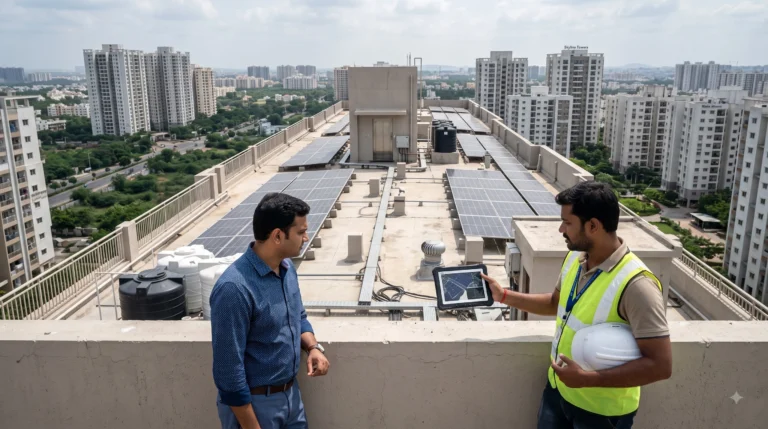
Living in a high-rise apartment does not necessarily mean you have to miss out on rooftop solar. However, solar for apartment residents in Hyderabad works differently from solar for an independent house or villa.
The biggest difference is simple: an individual flat owner usually does not have exclusive ownership of the entire rooftop.
The terrace may be a common area, the available roof space may need to serve many apartments, and the building’s electrical system may involve individual flat meters as well as common-area connections.
That means installing a few solar panels above your flat and connecting them directly to your electricity meter is not something an apartment owner should assume is automatically possible.
Instead, apartment residents need to understand the available individual flat solar, society rooftop solar and shared-metering options before deciding what is practical.
Yes, apartment residents in Hyderabad can potentially benefit from rooftop solar, but the available option depends on the building’s roof ownership/use, electrical connections, society arrangements and applicable DISCOM regulations.
For an individual flat owner, there are generally three situations:
For most high-rise apartment residents, the first step should therefore be to understand who controls the rooftop and which electricity connection the proposed solar system would serve.
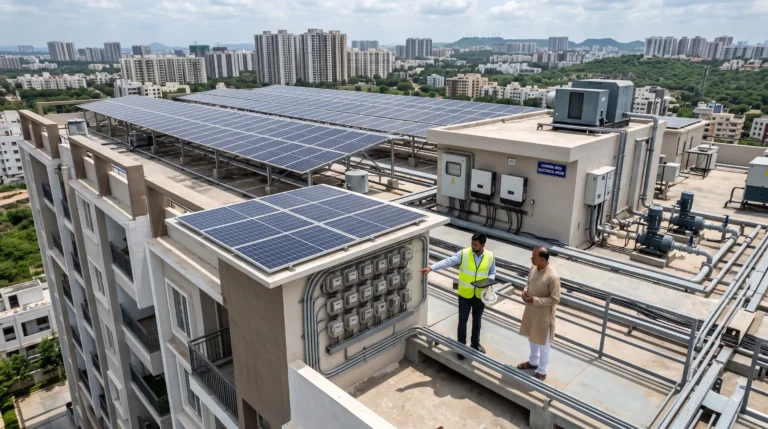
For an independent house, the homeowner generally controls the roof, electrical system and solar installation.
In a high-rise apartment, these can be separate.
You may have:
This creates a fundamental question:
Who will own the solar system, where will it be installed, and whose electricity bill will receive the benefit?
The answer determines which apartment solar option makes sense.
Can an Individual Flat Owner Install Solar?
This is one of the most common questions about solar for high-rise apartments.
The answer depends on the physical and electrical arrangement.
Situation 1: You Have an Exclusive Rooftop Area
If your apartment has a legally/contractually designated rooftop or terrace area that can be used for solar, an individual installation may be possible, subject to building permissions, structural suitability, electrical requirements and DISCOM approval.
You should not assume that access to a terrace automatically means exclusive rights to install equipment there.
The ownership and usage rights should be confirmed before planning the system.
Situation 2: The Roof Is a Common Area
This is more typical in high-rise apartment buildings.
If the rooftop is a common facility, an individual resident should not simply install panels there for their private meter without obtaining the necessary association/building approval and establishing an appropriate electrical and metering arrangement.
In this situation, society rooftop solar may be more practical.
What Is Society Rooftop Solar?
Instead of each flat owner installing a separate system, the apartment association can install solar on the common rooftop.
The generated electricity can be used for common facilities such as:
This can reduce the electricity consumption that the association purchases from the grid for common services.
For an apartment community, this can sometimes be more straightforward than trying to install separate panels for every flat.
What Is Individual Flat Solar?
Individual flat solar refers to a rooftop solar system associated with a particular residential electricity connection rather than a common-area electricity connection.
For an apartment resident, the important question is not simply:
“Can I put panels on the terrace?”
It is:
“Can a rooftop solar system be legally and technically connected to my individual residential electricity connection under an applicable metering arrangement?”
This distinction is critical.
A solar system physically located on a common roof may potentially be associated with participating residential connections through an approved group or virtual arrangement, but the applicable conditions must be satisfied.
Group Net Metering & Virtual Net Metering in Telangana
Telangana’s 2025 rooftop-solar regulation provides for several arrangements, including Net Metering, Group Net Metering, Gross Metering and Virtual Net Metering.
The regulation specifically allows LT-I domestic and HT-VI townships/residential colonies to install rooftop solar under Group Net Metering for systems below 100 kWp, while Virtual Net Metering is also provided for systems below 100 kWp. The minimum system size for Group Net Metering and Virtual Net Metering is 10 kWp, with participating connections subject to the applicable requirements.
This is particularly relevant to apartment communities because a shared rooftop can potentially serve multiple participating residential connections through an approved arrangement.
However, the existence of a regulatory mechanism does not mean every apartment can automatically use it. Technical feasibility, eligible connections, rooftop ownership/use, participation arrangements and DISCOM procedures still need to be checked.
What Can Individual Apartment Owners Actually Install?
The practical options can be understood like this:
Apartment Situation | Potential Solar Option |
Exclusive authorised rooftop/terrace | Individual rooftop solar, subject to approvals and technical feasibility |
Common apartment rooftop | Society/common-area solar |
Multiple flats want to share rooftop generation | Group/Virtual Net Metering, where eligible and approved |
No suitable rooftop access | Explore society-level or other approved shared arrangements |
Only common-area electricity connection | Solar primarily for common facilities |
Apartment community planning EV charging | Consider solar for common EV infrastructure as part of a wider society project |
The final arrangement should be confirmed with the apartment association and the relevant DISCOM before installation.
Apartment Rooftop Solar for Common Facilities
For many high-rise buildings, the most straightforward application is reducing common-area electricity consumption.
Consider an apartment complex with:
These loads can contribute significantly to the association’s electricity consumption.
A properly designed apartment rooftop solar system can use available common roof space to generate electricity for eligible common-area loads.
The system capacity should be based on the actual common-area electricity consumption, available rooftop space, electrical infrastructure and applicable metering arrangement.
Can Solar Power an Individual Flat From the Common Roof?
Potentially, but this requires more than physically connecting panels to the building.
The generation and electricity consumption must be connected through an appropriate approved electrical and metering arrangement.
This is where Virtual Net Metering or other permitted shared arrangements can become relevant.
Telangana’s 2025 regulation provides Virtual Net Metering for eligible consumers and participating connections, with residential consumers subject to the applicable capacity and load provisions.
Apartment residents considering this route should therefore ask:
Solar Capacity for Apartment Residents
An individual flat’s solar capacity should not be selected simply according to the apartment’s carpet area.
Instead, consider:
Under Telangana’s 2025 regulation, residential consumers using net or gross metering can install rooftop solar up to 100% of their sanctioned load, subject to the regulation and applicable conditions.
Therefore, the flat’s electricity connection and sanctioned load should be reviewed before deciding the system size.
How Much Roof Space Does Apartment Solar Need?
TGSPDCL’s current solar FAQ gives an indicative requirement of around 10 sq. metres of roof space per kW for a grid-connected rooftop system. Actual usable space depends on panel dimensions, layout, access, shading and rooftop obstacles.
For planning purposes:
Solar Capacity | Indicative Roof Area |
1 kW | ~10 sq. m |
2 kW | ~20 sq. m |
3 kW | ~30 sq. m |
5 kW | ~50 sq. m |
10 kW | ~100 sq. m |
These are planning references, not installation requirements.
In an apartment, the available rooftop may need to accommodate panels for multiple flats or common facilities, so the usable area per participating connection must be evaluated as part of the overall design.
Solar for Apartment Owners: What About Shading?
High-rise buildings can have more complex shading conditions than independent houses.
Potential shading sources include:
A solar survey should evaluate how shadows move across the proposed installation area.
Simply measuring the terrace size is not enough.
Apartment Solar Installation: Electrical Considerations
A high-rise apartment can have a more complex electrical infrastructure than an independent house.
The solar designer may need to review:
The solar system should be integrated into the appropriate electrical connection rather than connected informally to the building’s wiring.
What Should an Apartment Association Check Before Installing Solar?
If your apartment association is considering society rooftop solar, it should first evaluate:
Review at least recent electricity bills for lifts, pumps, lighting and other common facilities.
Measure the actual usable roof area.
Review whether the roof can accommodate the proposed mounting arrangement.
Assess shadows from buildings and rooftop equipment.
Identify the appropriate connection point and available electrical capacity.
Establish who owns the solar plant, who pays for it and who receives the electricity benefit.
Determine whether the project will use net metering, group net metering, virtual net metering, gross metering or another applicable arrangement.
Define who will monitor, clean, inspect and maintain the system.
PM Surya Ghar and Apartment Residents
PM Surya Ghar is a residential rooftop-solar programme, and official scheme documents also provide for Group Housing Societies/Residential Welfare Associations for common facilities, including EV charging, subject to the scheme’s applicable conditions.
The scheme documentation specifies CFA for residential rooftop systems and a separate provision for GHS/RWA common facilities. The cited guidelines also state that the GHS/RWA provision can cover common facilities, including EV charging, within the applicable capacity framework.
This distinction matters:
Individual flat solar and society/common-facility solar are not necessarily treated as the same project.
Before budgeting around subsidy, the apartment association or resident should verify the current scheme rules, eligible project type, participating connections and application requirements through the official portal/DISCOM.
Can Apartment Residents Install Solar Without Society Approval?
If the proposed installation uses common rooftop space or common electrical infrastructure, residents should not assume that they can proceed independently.
The apartment association/building management structure and applicable property documents should be reviewed first.
Where the proposed solar plant is intended to serve multiple residential connections, the participation and metering arrangement should also be established before installation.
The practical rule is simple:
Confirm rooftop rights and electrical rights before buying the solar equipment.
Solar Options for High-Rise Apartments
For most apartment communities, the options can be grouped into four categories.
Option 1: Individual Rooftop Solar
Best suited to a resident who has an appropriate exclusive/authorised rooftop area and an electrical arrangement that permits the proposed connection.
Option 2: Society Solar for Common Areas
The association installs solar to offset common-area electricity consumption.
Option 3: Shared Solar Through Approved Metering
Multiple eligible residential connections participate in a shared rooftop system through an applicable group or virtual net-metering framework.
Option 4: Solar for Common EV Charging
The association can consider solar as part of a broader EV-charging infrastructure project, subject to the applicable scheme, electrical design and metering arrangement.
Common Mistakes Apartment Owners Should Avoid
Access to the terrace does not automatically establish exclusive rights to install private equipment.
The electrical connection should be understood first.
The two projects can have different ownership, billing and subsidy considerations.
Common rooftop and electrical infrastructure usually require coordination with the building’s management structure.
The rooftop may simply not have enough usable, shadow-free area for individual systems for every apartment.
If the society is planning EV charging, it should be considered during the solar design stage.
Solar capacity should be connected to actual electricity consumption and applicable load limits.
Step-by-Step Apartment Solar Installation Process
Step 1: Identify the Electricity Connections
Separate individual flat connections from common-area connections.
Step 2: Review Rooftop Rights
Confirm whether the proposed installation area is exclusive or common.
Step 3: Collect Electricity Bills
Review consumption for participating flats or common facilities.
Step 4: Conduct a Rooftop Survey
Assess usable area, shading, orientation and access.
Step 5: Evaluate Electrical Infrastructure
Review meters, distribution boards, cable routes and connection points.
Step 6: Select the Appropriate Solar Arrangement
Determine whether individual, society, group or virtual metering is applicable.
Step 7: Confirm DISCOM Feasibility
Complete the applicable application and technical process.
Step 8: Finalise System Design
Prepare panel layout, inverter configuration, electrical protection and generation allocation.
Step 9: Install the System
Complete mounting, modules, inverter, cabling, earthing and protection.
Step 10: Commission & Monitor
Test the system and establish a maintenance and monitoring process.
Hyderabad-Specific Considerations
High-rise residential developments in Hyderabad can vary significantly in design.
A compact apartment building may have limited rooftop space, while a larger gated community may have substantial common-area electricity consumption from lifts, pumps, lighting and amenities.
For solar for apartment residents in Hyderabad, the most important question is therefore not simply how many panels can fit on the terrace.
It is:
How can the available rooftop solar generation be connected to the right residential or common-area electricity consumption under the applicable Telangana framework?
The current Telangana rooftop-solar regulation provides multiple metering arrangements, including Group Net Metering and Virtual Net Metering, creating options that may be relevant to apartment and residential-colony projects where their conditions are met.
Expert Tips for Apartment Solar
Use a qualified solar professional for system design and electrical integration.
Can apartment owners install solar in Hyderabad?
Yes, apartment residents can potentially use rooftop solar, but the available installation model depends on rooftop rights, electrical connections, apartment association arrangements and applicable DISCOM regulations.
Can I install solar panels only for my individual flat?
It may be possible in certain building arrangements, but an individual flat owner should not assume that common rooftop space can be used privately. The rooftop rights and an appropriate electrical/metering arrangement must be established first.
Can solar panels be installed on a common apartment terrace?
Yes, a common rooftop can potentially be used for an apartment solar project, subject to the building’s approvals, structural suitability, electrical design and applicable DISCOM requirements.
What is the difference between individual flat solar and society rooftop solar?
Individual flat solar is intended to serve a particular residential electricity connection. Society rooftop solar generally serves common facilities such as lifts, pumps and common-area lighting. Shared generation arrangements may also be possible where the applicable metering framework permits them.
Can multiple flats share one rooftop solar system?
Potentially. Telangana’s 2025 rooftop-solar regulations provide Group Net Metering and Virtual Net Metering frameworks for eligible consumers and participating connections, subject to the specified conditions.
What is Virtual Net Metering for apartments?
Virtual Net Metering is a regulatory arrangement under which electricity generated by a rooftop solar system can be accounted for across participating consumer connections according to the applicable framework. The specific eligibility, capacity and allocation requirements must be verified before implementation.
Can an apartment society install solar for lifts and water pumps?
Yes. Common-area rooftop solar can be designed to offset eligible electricity consumption from shared facilities, subject to the building’s electrical arrangement and applicable DISCOM requirements.
Can apartment solar be used for EV charging?
Yes. Solar can be integrated with EV charging infrastructure. PM Surya Ghar scheme documents also specifically address GHS/RWA common facilities including EV charging, subject to applicable scheme conditions.
How much rooftop space is needed for apartment solar?
TGSPDCL gives an indicative requirement of approximately 10 sq. metres per kW for grid-connected rooftop solar. The actual requirement depends on panel layout, shading, access and rooftop obstacles.
Does PM Surya Ghar subsidy apply to apartment residents?
Residential rooftop solar can be eligible under the PM Surya Ghar framework subject to the scheme’s conditions. The scheme also has provisions for Group Housing Societies/Residential Welfare Associations for common facilities. The exact eligibility should be checked for the proposed project before installation.
At Roof Rays Solar, we are committed to delivering reliable rooftop solar solutions that combine quality products, professional installation, and long-term customer support. Whether you’re a homeowner, business owner, or industrial customer, our team works closely with you to design a solar system that matches your energy goals and budget.
Why Customers Trust Roof Rays Solar
Our experts design customized solar solutions based on your electricity consumption, roof space, and future energy goals—helping you maximize savings and achieve the best possible return on investment.
Phone
Address
📍 HUDA Complex, Tellapur, Hyderabad
Contact our solar experts today for a free consultation and personalized solar savings estimate.
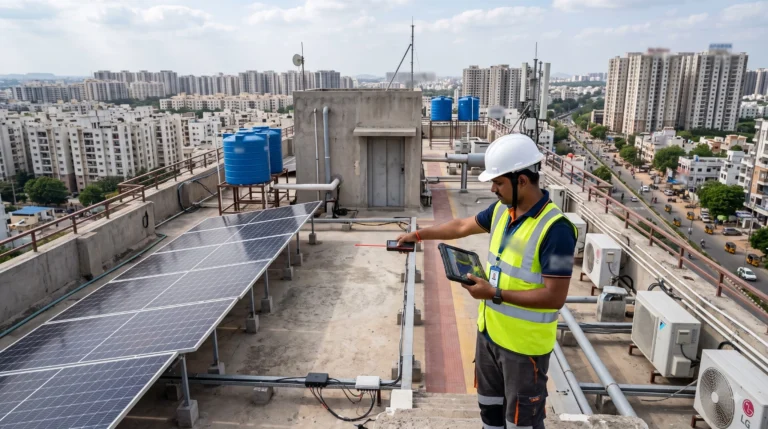
Solar for high-rise apartments requires more planning than simply putting panels on a terrace.
For solar for apartment residents in Hyderabad, the key factors are rooftop rights, individual versus common electricity connections, available roof area, shading, sanctioned load, building electrical infrastructure and the applicable metering arrangement.
Individual flat solar may be possible in certain circumstances, while society rooftop solar, Group Net Metering and Virtual Net Metering can provide other pathways for apartment communities where the relevant requirements are satisfied.
Before purchasing equipment, confirm who can use the rooftop, which electricity connection the system will serve, how generation will be accounted for and what approvals are required. This makes the solar project more practical, transparent and easier to manage over its operating life.
Book Your Free Site Survey Today
© 2025 Roof Rays Solar Solutions. All Rights Reserved. | Designed by MANI
Check whether your property qualifies for rooftop solar subsidy support.