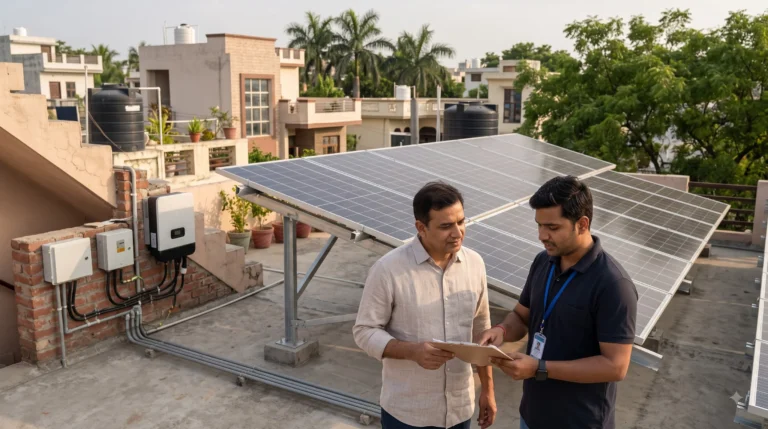
Imagine asking three solar installers for a quotation for the same 5 kW rooftop solar system.
One offers a significantly lower price, another quotes a moderate amount, and the third recommends a more expensive package. All three claim to provide a complete installation.
Which one should you choose?
The answer is not necessarily the cheapest or the most expensive.
Solar panel prices in 2026 depend on more than the panels themselves. The inverter, mounting structure, electrical protection, cable requirements, installation complexity, warranties and after-sales service can all influence the final quotation.
Two systems with the same advertised capacity may therefore differ considerably in equipment, installation scope and long-term ownership experience.
Before deciding, you need to understand what each quotation actually includes.
Solar installation quotes differ because installers may offer different equipment brands, component specifications, mounting structures, electrical protection, installation services and warranty support.
Other factors include roof accessibility, cable distance, structural requirements, system configuration, taxes and project-specific work.
To compare quotations fairly, ask every installer to quote for the same system capacity, comparable equipment specifications and clearly defined installation scope.
A lower price can represent a competitive offer, but it can also reflect missing components or a narrower scope of work. The itemised quotation is what helps you determine the difference.

Pricing Factor | Why It Matters |
Solar modules | Brand, technology, specifications and applicable compliance requirements |
Inverter | Capacity, features, warranty and compatibility |
Mounting structure | Material, design and roof-specific requirements |
Electrical components | Cables, protection devices, earthing and isolation |
Installation labour | Roof access, complexity and project size |
Engineering | Design, layout and site assessment |
Warranty and service | Coverage, support and potential service costs |
Metering and approvals | Applicable process and project-specific charges |
Taxes and logistics | Location, transport and applicable taxes |
Solar modules are one of the most visible parts of a rooftop system, but not all modules have identical specifications.
Prices can vary based on:
Two installers may quote the same system capacity using different module combinations.
For example, one quotation may use fewer higher-wattage modules, while another uses more modules with different specifications. Both may advertise the same total kilowatt capacity, but their equipment details may not be identical.
What should homeowners check?
Ask for the exact module manufacturer, model, rated wattage, quantity and relevant product documentation.
Also check whether the equipment meets the requirements applicable to your project, particularly if you intend to apply for government assistance or use a regulated grid-connected arrangement.
Do not compare solar panel prices using wattage alone. The complete product specification matters.
Solar panels generate electricity, but the inverter converts it into electricity suitable for the intended system.
Different inverters can vary in capacity, features, compatibility, monitoring and warranty.
A quotation may include:
The right option depends on the property’s requirements and the system architecture.
What should you ask?
An installer should explain why the selected inverter suits your system rather than simply offering the lowest-priced available model.
The mounting structure supports the solar panels and must suit the roof.
The structure required for one property may differ from that needed for another because of roof design, mounting height, wind exposure, access and installation constraints.
A quotation should clearly identify the proposed mounting structure and what is included.
Check:
A cheaper quotation may use a different structure or exclude certain mounting-related work. That does not automatically make it inferior, but the difference should be understood before comparing prices.
A rooftop solar system requires more than panels and an inverter.
Depending on the design, the installation may include DC and AC cables, isolation equipment, overcurrent protection, surge protection, earthing and other electrical components.
The required equipment and cable quantities depend on the system design and site conditions.
For example, a property with a long cable route between the rooftop and inverter location may require different materials and labour from a property with a short, straightforward route.
Why this matters
If one quotation includes all required electrical components and another excludes some items, comparing their headline prices is misleading.
Ask the installer to specify the included components and identify any exclusions or additional charges.
Electrical safety and compliance should never be compromised merely to obtain a lower quotation.
Not every rooftop installation is equally straightforward.
Two houses may both require a 5 kW system, but one may have an open, accessible terrace while the other has multiple roof levels, water tanks, shading and difficult access.
These differences can affect:
For this reason, a site survey is important before finalising the price.
In Hyderabad and across Telangana, properties can vary from compact independent houses to large villas and multi-floor buildings. A quotation based only on system capacity may not account for the actual work required.
A solar system is a long-term investment. The support available after installation can matter just as much as the initial price.
Two installers may offer different service commitments, even when their equipment appears similar.
Compare the following separately:
Item | What to Verify |
Module product warranty | What product defects are covered? |
Module performance warranty | What performance commitments apply? |
Inverter warranty | What is the coverage period and process? |
Installation workmanship | Is workmanship covered, and for how long? |
Service support | Who handles faults and warranty claims? |
Monitoring | Is monitoring included, and who supports it? |
Replacement costs | Are labour, transport or service visits excluded? |
Avoid assuming that every component has the same warranty period.
Ask for the relevant warranty documents and understand who is responsible for coordinating service if a component fails.
A quotation for a 3 kW system cannot be compared directly with a quotation for a 5 kW system.
Even when two quotations specify the same capacity, the design may differ.
For example, the installers may propose different:
The system should be designed around your electricity consumption, roof suitability and electrical connection—not simply around a standard package.
Ask the installer to explain the system design and why the proposed capacity is appropriate for your property.
A complete rooftop solar quotation can include labour, transportation, handling, site assessment and project coordination.
Some properties may require additional work, such as longer cable routes, special mounting arrangements or modifications to accommodate the installation.
These items can explain part of the difference between solar installation quotes.
When comparing offers, ask whether the quoted price includes:
Do not assume these items are included merely because the quotation says “complete installation.”
Homeowners comparing rooftop solar quotations should distinguish between the gross installation cost and the net cost after applicable financial assistance.
The PM Surya Ghar: Muft Bijli Yojana provides central financial assistance for eligible residential rooftop solar installations.
Under the commonly published central scheme structure, assistance is ₹30,000 per kW for the first 2 kW and ₹18,000 for the additional 1 kW, with the total central assistance capped at ₹78,000 for applicable residential systems of 3 kW or more. There is no additional central assistance for capacity beyond 3 kW under this structure. <Cite refs={[“turn400849search0″,”turn400849search35”]}/>
Eligibility and installation requirements must be verified for the individual project.
Compare quotations correctly
Ask every installer to provide:
This makes it easier to determine whether the price difference comes from the equipment, installation scope or subsidy assumptions.
Official scheme information is available through the PM Surya Ghar National Portal.
Online searches for solar panel cost in India can return different types of prices.
Some pages quote the cost of the panels alone. Others show an inverter-inclusive package, while some quote a complete rooftop installation.
These are not equivalent products.
A panel-only price does not necessarily include mounting, cabling, electrical protection, installation labour, commissioning or other project requirements.
Similarly, a headline price for a standard package may not apply to a property that requires additional work.
When researching solar panel prices in 2026, identify what the published price actually covers before using it as a benchmark for your own project.
Solar Quotation Comparison: A Practical Example
Imagine that two installers quote for a 5 kW rooftop system.
Item | Installer A | Installer B |
Advertised capacity | 5 kW | 5 kW |
Module specifications | Must be verified | Must be verified |
Inverter | Must be verified | Must be verified |
Mounting structure | Must be verified | Must be verified |
Electrical protection | Check itemised scope | Check itemised scope |
Installation labour | Confirm inclusion | Confirm inclusion |
Warranty and service | Compare documents | Compare documents |
Total installed price | Lower | Higher |
This comparison alone does not establish which installer offers better value.
If Installer A excludes work that Installer B includes, the price difference may narrow once both quotations are placed on the same basis. Conversely, Installer A may genuinely offer a better price for equivalent specifications.
The goal is to compare equivalent systems—not just two totals.
Solar Quotation Comparison Checklist
Use this checklist when requesting or reviewing solar installation quotes.
Equipment
Installation
Price and service
How to Negotiate a Solar Quotation Without Compromising Quality
Negotiation is useful when you understand what you are comparing.
Ask for a clear breakdown of the major components and installation work.
Request comparable modules, inverter capacity, mounting arrangements and protection equipment before deciding that one price is better.
Find out whether any civil work, cable extensions, meter-related work or additional equipment may cost extra.
Do not exchange meaningful warranty or support coverage for a small upfront saving without understanding the implications.
A professional installer should be able to explain how the proposed equipment and work justify the quoted price.
Before paying an advance, confirm the equipment, quantities, price, installation scope, warranties and payment milestones.
Hyderabad-Specific Considerations
For homeowners in Hyderabad and across Telangana, solar installation pricing should reflect the actual property and project requirements.
A straightforward terrace installation may involve different work from a multi-floor home with limited roof access or complicated cable routes.
Before selecting a quotation, check:
The most useful quotation is one that explains exactly what will be installed, what you will pay and what support you can expect.
Expert Tips Before Choosing a Solar Installer
Why do solar panel prices differ between installers in 2026?
Prices differ because installers may quote different modules, inverters, mounting structures, electrical components, installation work and warranty support. Roof complexity and exclusions can also affect the total.
What is included in a rooftop solar quotation?
A complete quotation may include modules, inverter, mounting structure, cables, electrical protection, earthing, installation labour, testing and commissioning. Always confirm the exact scope because not every quotation includes the same items.
Is a cheaper solar quotation always better?
No. A cheaper quotation may be competitive, but it could also exclude components or work included in a more expensive offer. Compare equipment specifications, installation scope, warranties and the complete price before deciding.
How do I compare solar installation quotes fairly?
Ask each installer to quote for the same capacity and comparable equipment. Compare the modules, inverter, structure, protection equipment, installation work, warranties, exclusions and total installed cost.
Does the solar panel brand determine the entire system price?
No. Modules are only one component. The inverter, mounting structure, cabling, protection equipment, labour, logistics and service commitments also affect the total.
Does PM Surya Ghar reduce the cost of every solar system?
The scheme provides central assistance to eligible residential consumers subject to applicable conditions. The commonly published central assistance is capped at ₹78,000 for eligible residential systems of 3 kW or more, with no additional central assistance beyond 3 kW under the cited structure. <Cite refs={[“turn400849search0″,”turn400849search35”]}/>
Should I choose the highest-wattage solar panels?
Not automatically. Panel wattage is only one consideration. The full system design, available roof space, module specifications, inverter compatibility and project economics should guide the choice.
Why can installation costs differ for two houses with the same system capacity?
Roof access, cable distance, mounting arrangements, shading, structural conditions and installation complexity can change the amount of work required.
What is the difference between solar panel cost and solar installation cost?
Solar panel cost refers to the modules themselves. Solar installation cost generally refers to the broader project, which may include the inverter, structure, cabling, protection equipment, labour and other applicable charges.
What should I ask before paying an advance?
Confirm the system specifications, itemised price, installation scope, payment milestones, warranties, expected timeline, exclusions and any applicable subsidy assumptions in writing.
At Roof Rays Solar, we are committed to delivering reliable rooftop solar solutions that combine quality products, professional installation, and long-term customer support. Whether you’re a homeowner, business owner, or industrial customer, our team works closely with you to design a solar system that matches your energy goals and budget.
Why Customers Trust Roof Rays Solar
Our experts design customized solar solutions based on your electricity consumption, roof space, and future energy goals—helping you maximize savings and achieve the best possible return on investment.
Phone
Address
📍 HUDA Complex, Tellapur, Hyderabad
Contact our solar experts today for a free consultation and personalized solar savings estimate.

Solar panel prices in 2026 differ because a solar installation is more than a set of panels. Equipment specifications, inverter selection, mounting structure, electrical protection, roof complexity, installation scope and after-sales service all contribute to the final price.
When comparing solar installation quotes, focus on what each installer is actually providing. Check the equipment, review exclusions, confirm warranty coverage and compare the complete installed cost.
The best quotation is not automatically the cheapest or the most expensive. It is the one that offers a technically suitable, clearly specified and properly installed system at a price you can justify.
© 2025 Roof Rays Solar Solutions. All Rights Reserved. | Designed by MANI
Check whether your property qualifies for rooftop solar subsidy support.