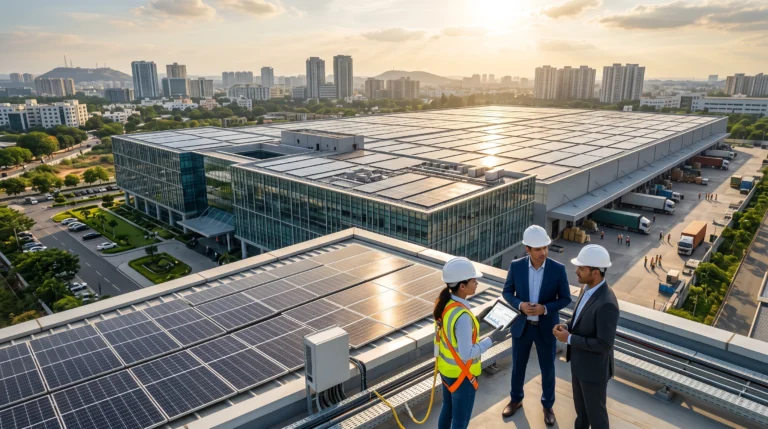
Electricity is one of the largest operating expenses for many businesses. Whether you manage a manufacturing unit, office building, warehouse, hotel, hospital, educational institution, shopping complex, or retail outlet, rising electricity tariffs directly affect your profitability. Installing commercial rooftop solar solutions is one of the most effective ways to reduce operational costs while making your business more sustainable.
Hyderabad’s excellent solar radiation and favorable climate make rooftop solar a smart investment for commercial properties. A professionally designed commercial solar system can generate clean electricity throughout the year, helping businesses reduce dependence on grid power, lower monthly electricity bills, and achieve a faster return on investment.
Unlike residential systems, commercial solar projects are designed to handle significantly higher energy demands. They can be customized based on available roof space, business operations, and future expansion plans. Modern commercial solar installations are reliable, require minimal maintenance, and continue producing electricity for over 25 years.
This comprehensive guide explains everything businesses need to know about commercial rooftop solar solutions, including system types, installation costs, suitable business sectors, roof requirements, expected savings, and the installation process.
Energy costs continue to increase every year, making electricity one of the highest recurring expenses for commercial establishments. Rooftop solar helps businesses control these expenses by generating their own electricity during working hours.
Some of the major reasons businesses are adopting commercial rooftop solar include:
For many businesses, rooftop solar is not only an environmental decision but also a strategic financial investment.
Commercial rooftop solar solutions are solar photovoltaic (PV) systems installed on commercial, industrial, institutional, or office rooftops to generate electricity for business operations.
A complete commercial solar system typically includes:
The electricity generated can be used to operate lighting, air conditioning systems, office equipment, machinery, elevators, refrigeration systems, pumps, computers, and other commercial electrical loads.
Installing rooftop solar offers businesses numerous operational and financial advantages.
Lower Electricity Bills
Generating electricity on-site significantly reduces dependence on utility power, helping businesses lower recurring electricity expenses.
Excellent Return on Investment
Commercial solar systems typically generate electricity for more than 25 years, allowing businesses to recover their investment while continuing to benefit from reduced energy costs.
Better Cash Flow
Lower monthly electricity expenses help improve operational cash flow, allowing businesses to allocate resources to growth and expansion.
Low Maintenance
Commercial solar systems require minimal maintenance. Routine inspections and occasional panel cleaning are generally sufficient to maintain high performance.
Environmental Sustainability
Using renewable energy demonstrates a company’s commitment to sustainability and helps reduce greenhouse gas emissions associated with conventional electricity generation.
Increased Property Value
Commercial buildings equipped with rooftop solar systems may become more attractive to investors, tenants, and buyers due to lower operating costs.
Commercial rooftop solar can benefit a wide range of industries and organizations.
Manufacturing Units
Factories often consume large amounts of electricity for machinery, production equipment, lighting, and utilities. Rooftop solar can significantly reduce operating costs.
Office Buildings
Corporate offices use electricity throughout the day for lighting, air conditioning, computers, elevators, and IT infrastructure, making solar a practical solution.
Warehouses & Logistics Centers
Large warehouse rooftops provide excellent space for solar installations while reducing electricity costs for lighting, HVAC systems, and warehouse operations.
Hotels & Restaurants
Hotels, resorts, restaurants, and banquet halls have high daytime electricity usage, making them ideal candidates for rooftop solar systems.
Hospitals & Healthcare Facilities
Hospitals require reliable electricity for medical equipment, lighting, air conditioning, laboratories, and administrative operations. Solar helps reduce operational costs while supporting sustainability initiatives.
Educational Institutions
Schools, colleges, universities, and training centers can lower electricity expenses while promoting environmental awareness among students.
Shopping Malls & Retail Stores
Retail establishments consume substantial electricity for lighting, escalators, HVAC systems, refrigeration, and digital displays. Rooftop solar helps improve long-term profitability.
Selecting the right commercial solar system depends on your business operations, electricity consumption, and backup power requirements.
On-Grid Commercial Solar System
On-grid systems are connected to the utility grid and are the most popular choice for commercial properties.
Advantages
Best For: Offices, factories, retail stores, schools, hospitals, warehouses, and commercial buildings with reliable grid connectivity.
Off-Grid Commercial Solar System
Off-grid systems include battery storage and operate independently of the electricity grid.
Advantages
Best For: Businesses located in areas with limited or unreliable grid connectivity.
Hybrid Commercial Solar System
Hybrid systems combine grid connectivity with battery storage, offering both electricity savings and backup power during outages.
Advantages
Best For: Businesses that require uninterrupted power for critical operations.
Recommended Commercial Solar System Sizes
The ideal system capacity depends on your monthly electricity consumption, available roof space, and business operations.
System Size | Suitable For | Average Monthly Generation |
10KW | Small offices & retail outlets | 1,200–1,500 Units |
20KW | Medium offices & schools | 2,400–3,000 Units |
30KW | Hotels & commercial buildings | 3,600–4,500 Units |
50KW | Manufacturing units & hospitals | 6,000–7,500 Units |
100KW | Large factories & warehouses | 12,000–15,000 Units |
250KW+ | Industrial facilities & large campuses | Custom-designed |
A professional energy audit ensures the system is correctly sized to maximize savings and support future business growth.
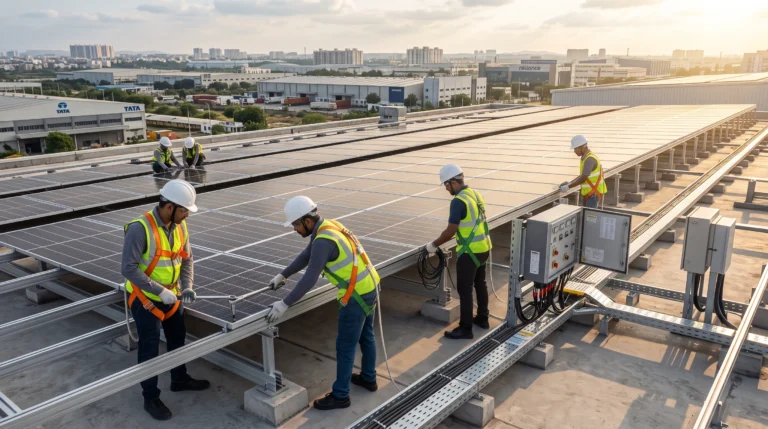
The cost of a commercial solar project depends on system size, solar panel technology, roof structure, inverter configuration, and installation complexity.
Estimated Commercial Solar System Price
System Size | Estimated Investment* |
10KW | ₹4.5 Lakhs – ₹6.5 Lakhs |
20KW | ₹8 Lakhs – ₹12 Lakhs |
30KW | ₹12 Lakhs – ₹17 Lakhs |
50KW | ₹18 Lakhs – ₹28 Lakhs |
100KW | ₹35 Lakhs – ₹55 Lakhs |
250KW+ | Customized Project Pricing |
Note: These are indicative estimates. Actual project costs vary based on equipment specifications, roof conditions, electrical infrastructure, project scope, and applicable government policies.
Commercial rooftops often provide sufficient space for medium and large-scale solar installations.
Solar Capacity | Approximate Roof Space Required |
10KW | 700–900 sq. ft. |
20KW | 1,400–1,800 sq. ft. |
30KW | 2,000–2,700 sq. ft. |
50KW | 3,300–4,500 sq. ft. |
100KW | 6,500–8,500 sq. ft. |
The actual space required depends on panel efficiency, mounting structure, roof layout, and shading conditions.
Several technical and business-specific factors influence the final investment.
Higher electricity demand typically requires a larger solar system, increasing the project cost while also providing greater long-term savings.
The usable rooftop area determines the maximum system capacity that can be installed.
High-efficiency monocrystalline and N-Type TOPCon panels may cost more initially but can generate more electricity over the system’s lifetime.
Roof material, structural strength, accessibility, and mounting requirements affect installation complexity and costs.
Commercial projects often use multiple inverters or string inverter configurations depending on system capacity and design.
Upgrading switchgear, cabling, protection devices, or transformers may be necessary for larger commercial installations.
Government policies and net metering make commercial rooftop solar solutions even more attractive for businesses looking to reduce long-term energy costs. While incentives and eligibility vary depending on applicable regulations, commercial establishments can still benefit significantly from lower electricity expenses and improved return on investment.
Government Incentives
Commercial solar policies may differ from residential subsidy programs and are subject to central and state government regulations. Businesses should consult experienced solar professionals to understand the latest applicable schemes, financing options, and regulatory requirements.
Advantages of Government Support
Net Metering
Net metering allows eligible commercial on-grid solar systems to export surplus electricity generated during non-peak usage periods back to the electricity grid. Depending on the applicable utility regulations, this exported energy is adjusted against the electricity consumed from the grid.
Benefits of Net Metering
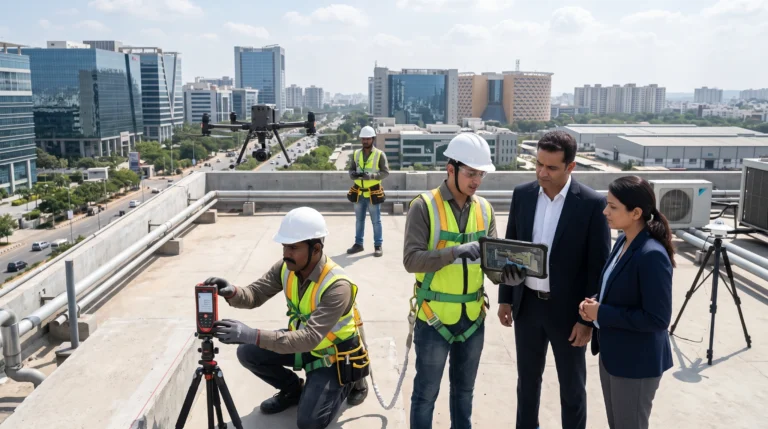
A commercial rooftop solar project requires careful planning to ensure maximum energy generation, operational safety, and long-term reliability.
Step 1: Site Survey & Energy Audit
A professional solar team evaluates:
This assessment helps determine the ideal system size and design.
Step 2: System Design & Proposal
Based on the survey findings, engineers prepare a customized solution that includes:
Step 3: Commercial Proposal & Approval
The business receives a detailed proposal covering:
Once approved, procurement and project planning begin.
Step 4: Installation
Experienced technicians install:
All work follows industry safety standards and engineering best practices.
Step 5: Testing & Commissioning
Before handover, the system undergoes:
The solar system is then commissioned and begins generating clean electricity for your business.
Commercial rooftop solar helps businesses significantly reduce recurring electricity expenses while improving long-term profitability.
Actual savings depend on:
Estimated Monthly Electricity Generation
Solar Capacity | Average Monthly Generation |
10KW | 1,200–1,500 Units |
20KW | 2,400–3,000 Units |
30KW | 3,600–4,500 Units |
50KW | 6,000–7,500 Units |
100KW | 12,000–15,000 Units |
Long-Term Business Benefits
A professionally designed commercial solar system can continue generating electricity for more than 25 years, providing substantial savings throughout its operational life.
Commercial solar is a strategic investment. Avoiding these mistakes helps maximize performance and financial returns.
Choosing the Lowest Quotation
The cheapest proposal may compromise on panel quality, inverter reliability, or installation standards. Evaluate the complete solution instead of price alone.
Installing the Wrong System Size
An undersized system may not deliver meaningful savings, while an oversized system may not provide the expected financial benefits. Proper energy analysis is essential.
Ignoring Structural Assessment
Commercial rooftops must be evaluated for load-bearing capacity before installation to ensure long-term safety and reliability.
Overlooking Future Expansion
Businesses planning to increase production, office space, or equipment should consider future electricity demand during system design.
Choosing an Inexperienced EPC Partner
Commercial solar projects require engineering expertise, regulatory knowledge, and quality execution. Working with an experienced installer reduces project risks and ensures reliable long-term performance.
A manufacturing unit in Patancheru, Hyderabad, was facing monthly electricity expenses of approximately ₹2.8 lakhs due to continuous production operations.
Following a comprehensive energy audit, a 100KW on-grid commercial rooftop solar system was recommended.
Why This Solution Worked
This example highlights how commercial rooftop solar can become a strategic investment by lowering operating costs while supporting business growth.
What are commercial rooftop solar solutions?
Commercial rooftop solar solutions are solar power systems installed on commercial buildings to generate electricity for business operations and reduce energy costs.
Which businesses benefit the most from commercial solar?
Factories, warehouses, offices, hospitals, hotels, educational institutions, retail stores, shopping malls, and commercial complexes can all benefit from rooftop solar installations.
How much does commercial rooftop solar cost?
Project costs depend on system capacity, equipment quality, roof conditions, electrical infrastructure, and installation complexity. Every commercial project is customized to meet business requirements.
How long does a commercial solar system last?
Quality commercial solar panels typically have a performance life of 25 years or more, while inverters and other components may have different warranty periods.
Can commercial solar reduce electricity bills?
Yes. A properly designed system can significantly reduce daytime electricity consumption from the grid, resulting in substantial long-term savings.
Does commercial solar require frequent maintenance?
No. Routine inspections, periodic cleaning, and preventive maintenance are generally sufficient to keep the system operating efficiently.
Can commercial solar systems be expanded later?
Yes. Many commercial systems can be upgraded if additional roof space and electrical infrastructure are available.
Is rooftop solar suitable for factories and warehouses?
Yes. Large industrial rooftops are often ideal for commercial solar because they provide extensive installation space and consume substantial daytime electricity.
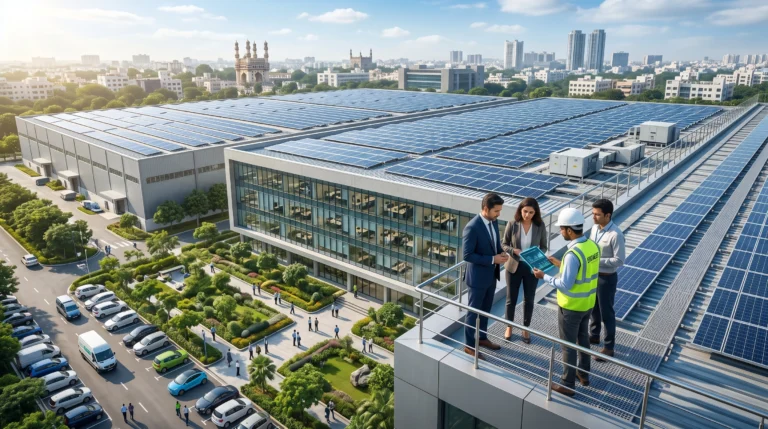
At Roof Rays Solar, we understand that every business has unique energy requirements. Our commercial rooftop solar solutions are designed to maximize energy generation, reduce operational costs, and deliver dependable performance for years to come.
Our experts design customized solar solutions based on your electricity consumption, roof space, and future energy goals—helping you maximize savings and achieve the best possible return on investment.
Phone
Address
📍 HUDA Complex, Tellapur, Hyderabad
Contact our solar experts today for a free consultation and personalized solar savings estimate.
Book Your Free Site Survey Today
Looking to reduce your business’s electricity costs with commercial rooftop solar solutions? Contact Roof Rays Solar today to schedule a free site survey and energy assessment. Our experts will evaluate your energy consumption, rooftop space, and business requirements to recommend a customized solar solution that maximizes savings and long-term return on investment.
Investing in commercial rooftop solar solutions is a strategic decision that helps businesses reduce operating costs, improve energy efficiency, and strengthen their sustainability goals. With Hyderabad’s excellent solar potential and modern high-efficiency solar technology, commercial establishments can generate reliable clean energy while protecting themselves from rising electricity costs.
Whether you operate an office, factory, warehouse, hospital, hotel, educational institution, or retail business, Roof Rays Solar provides customized commercial solar solutions backed by expert engineering, premium-quality equipment, and professional installation. Partner with our experienced team to transform your rooftop into a long-term energy asset that supports your business growth and financial success.
© 2025 Roof Rays Solar Solutions. All Rights Reserved. | Designed by MANI
Check whether your property qualifies for rooftop solar subsidy support.