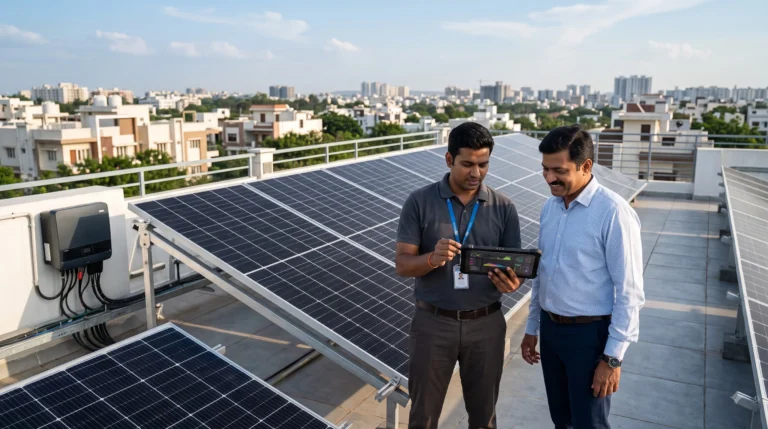
If you are planning rooftop solar under PM Surya Ghar: Muft Bijli Yojana, choosing the right solar module is more important than simply comparing wattage and price.
One term you will frequently encounter is DCR.
DCR stands for Domestic Content Requirement. In simple terms, it refers to requirements concerning domestically manufactured solar cells and modules for projects covered by specified government schemes and programmes.
For PM Surya Ghar, the scheme guidelines state that Central Financial Assistance (CFA) for residential installations is released only when the installation uses domestically manufactured modules with domestically manufactured cells.
DCR solar panels are solar PV modules that meet the applicable Domestic Content Requirement for the relevant government scheme.
For PM Surya Ghar residential CFA, the applicable guideline requires domestically manufactured solar PV modules using domestically manufactured solar PV cells.
DCR is therefore not simply a marketing label meaning “Made in India.”
The relevant manufacturing and compliance requirements need to be satisfied and verified through the applicable process.
For a homeowner, the practical takeaway is:
If you want PM Surya Ghar CFA, do not select the cheapest or highest-wattage module first. Confirm DCR eligibility and the required documentation before installation.
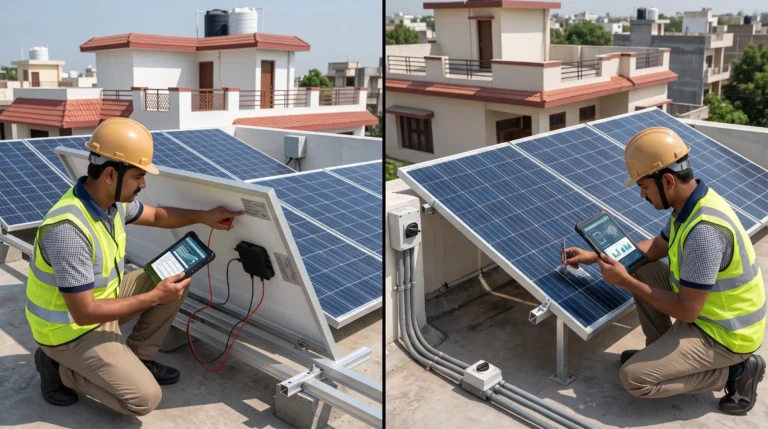
DCR = Domestic Content Requirement.
The requirement is intended to ensure that specified government-supported solar projects use qualifying domestically manufactured solar components.
MNRE’s March 2025 DCR clarification states that, under applicable MNRE schemes/programmes where DCR is mandatory, domestically manufactured solar PV cells and domestically manufactured solar PV modules are required.
For crystalline-silicon solar cells, MNRE’s 2025 clarification also defines domestic manufacturing based on manufacturing processes carried out in India using the specified undiffused silicon wafer starting material.
This distinction matters because a module can be assembled in India without necessarily satisfying every DCR requirement applicable to a government scheme.
Why Does DCR Matter for PM Surya Ghar?
PM Surya Ghar provides Central Financial Assistance (CFA) to eligible residential rooftop solar consumers.
The original scheme order states that the CFA is available for eligible residential rooftop solar installations and provides the applicable subsidy structure based on installed capacity. It also specifically covers common facilities of eligible Group Housing Societies/Residential Welfare Associations under the scheme’s conditions.
However, the PM Surya Ghar guidelines state that CFA is released only for residential installations using:
Domestic modules + domestic cells
In other words, installing a solar system is not by itself sufficient to establish subsidy eligibility.
The equipment used in the project must also meet the scheme’s requirements.
DCR Panels vs Non-DCR Panels
The easiest way to understand the difference is to look at the purpose of the installation.
Factor | DCR-Compliant Module | Non-DCR Module |
Domestic-content requirement | Meets applicable DCR requirement | Does not meet applicable DCR requirement |
PM Surya Ghar CFA | Can qualify when all other conditions are satisfied | Cannot be relied upon for CFA |
Domestic cells | Required for PM Surya Ghar CFA | May not be domestic |
Domestic module | Required | May not qualify |
Documentation | DCR evidence/undertaking may be required | DCR requirement not satisfied |
Price | Can differ by manufacturer/product | May be lower or higher depending on product |
Important: DCR compliance alone does not guarantee subsidy approval. The project must satisfy the other PM Surya Ghar and DISCOM requirements as well.
Is Every Indian-Made Solar Panel a DCR Panel?
No.
This is one of the most important points for homeowners.
A vendor saying:
“This panel is made in India.”
does not by itself prove that the module meets the DCR requirement applicable to your PM Surya Ghar installation.
DCR compliance concerns the relevant domestic manufacturing requirements for the solar cells and modules.
MNRE has issued specific DCR norms and operates a DCR verification framework.
Therefore, ask the vendor to provide the appropriate DCR documentation rather than relying on a verbal assurance.
What Is the Difference Between DCR and ALMM?
DCR and ALMM are related to solar-project compliance, but they are not the same requirement.
DCR
DCR stands for Domestic Content Requirement.
It concerns the required domestic manufacturing content for applicable projects.
ALMM
ALMM stands for Approved List of Models and Manufacturers.
MNRE’s ALMM framework identifies approved solar PV module models and manufacturers.
MNRE states that only models and manufacturers included in ALMM List-I for solar PV modules are eligible for use in government projects, government-assisted projects, projects under government schemes/programmes, open-access projects and net-metering projects installed in India, subject to the applicable rules.
So:
DCR asks whether the applicable domestic-content requirement is satisfied.
ALMM asks whether the relevant module model/manufacturer is included in the applicable approved list.
A subsidy project may therefore need to satisfy both applicable DCR and ALMM requirements, rather than treating one as a substitute for the other.
Are ALMM Solar Panels Automatically DCR?
No.
ALMM listing and DCR compliance should be treated as separate checks.
A module can be listed under the applicable ALMM framework, but that does not mean you should automatically assume it satisfies the DCR requirement for your PM Surya Ghar CFA.
Similarly, simply saying a module is DCR-compliant should not replace checking whether the exact model and manufacturer meet the applicable ALMM requirement.
MNRE maintains updated ALMM lists, and the list is revised periodically. The official MNRE page currently shows updated 2026 List-I publications, including an update dated 3 August 2026.
This is why the exact module model matters.
Why the Exact Solar Module Model Matters
Solar manufacturers can offer several module models with different:
Therefore, checking only the manufacturer name is not enough.
Before installation, verify:
Manufacturer → Exact module model → DCR status → ALMM status → Project eligibility
This creates a much stronger documentation trail than simply recording the brand name.
What Is a DCR Undertaking?
A DCR undertaking is part of the compliance/documentation process used to establish that the installed solar modules meet the applicable domestic-content requirement.
The PM Surya Ghar implementation documentation includes a DISCOM checklist requiring verification that:
This means DCR compliance is not merely something to discuss while choosing the equipment.
It can become part of the installation and subsidy verification process.
What Documents Should You Ask Your Solar Vendor For?
If you are applying for PM Surya Ghar CFA, ask your vendor to clearly identify the equipment being installed.
Depending on the applicable process, documentation can include:
The PM Surya Ghar implementation checklist includes module information, installed-system photographs, DCR verification and commissioning-related documentation.
Practical advice
Keep copies of your:
Quotation + Invoice + Module Model Details + Serial Numbers + DCR Documentation + Commissioning Documents
This can make future verification and warranty/service discussions easier.
Does DCR Affect the Solar Panel Price?
It can.
Domestic-content requirements can influence the available equipment and procurement options, so a DCR-compliant system may not have the same pricing as a non-DCR system.
However, DCR should not be viewed simply as an additional premium you pay for subsidy.
You should compare the complete project:
A lower quotation is not necessarily cheaper if it does not satisfy the requirements needed for the subsidy you are planning to claim.
Can I Use Non-DCR Panels and Still Get PM Surya Ghar Subsidy?
For the residential CFA covered by the PM Surya Ghar guidelines, the answer is no if the installation does not meet the applicable DCR requirement.
The scheme guideline specifically states that CFA shall be released only for residential installations using domestically manufactured modules with domestically manufactured cells.
Therefore, if subsidy is an important part of your financial calculation, DCR compliance should be verified before the system is installed, not after.
Does DCR Apply to the Inverter?
DCR is specifically concerned with the domestic-content requirement for the applicable solar PV cells and modules.
That does not mean every component in a rooftop solar system must necessarily be manufactured in India under the same DCR rule.
The system also has other technical and quality requirements, but DCR should not be interpreted as meaning:
“Every component must be Indian-made.”
Instead, understand which equipment the specific DCR requirement applies to and verify the applicable PM Surya Ghar guidelines.
DCR and the PM Surya Ghar Installation Process
For a residential consumer, a simplified process looks like this:
Step 1: Register for rooftop solar
Apply through the applicable PM Surya Ghar/National Portal process.
Step 2: Select an eligible vendor
Use the applicable empanelled/vendor process.
Step 3: Obtain the solar proposal
The quotation should identify the proposed module manufacturer and model.
Step 4: Verify DCR status
Do not wait until installation day.
Confirm that the proposed modules and cells meet the applicable DCR requirement.
Step 5: Verify applicable ALMM status
Check the exact module model against the applicable MNRE ALMM list where required.
Step 6: Install the system
The system should be installed using the approved equipment and according to the applicable technical requirements.
Step 7: Complete DISCOM verification
The implementation documentation includes checks relating to the electricity bill, geo-coordinates, installed-system photographs, net meter, commissioning inspection and DCR compliance.
Step 8: Complete subsidy processing
CFA is processed after the applicable installation, verification and documentation requirements are fulfilled.
What Happens If the Wrong Panels Are Installed?
This is one of the biggest risks of selecting equipment without checking the subsidy requirements.
Suppose a homeowner assumes:
“The installer said this is an Indian brand, so it must qualify.”
The system is installed, but the exact modules do not meet the applicable DCR requirement.
The homeowner may then face a problem during subsidy verification.
The practical lesson is simple:
Verify first. Install second.
Do not make the subsidy part of your financial calculation until the proposed equipment and project arrangement have been checked against the current scheme requirements.
DCR Solar Panels: Common Myths
Myth 1: DCR simply means “Made in India”
Not necessarily. DCR has specific domestic manufacturing requirements.
Myth 2: Every Indian solar module is DCR
No. The applicable domestic-content requirements must be verified.
Myth 3: ALMM and DCR are the same thing
No. They are separate compliance frameworks.
Myth 4: A DCR panel automatically guarantees subsidy
No. Other scheme, installation, metering, vendor and verification conditions also apply.
Myth 5: The brand name is enough
No. Verify the exact module model and relevant documentation.
Myth 6: DCR matters only after installation
It should be checked before equipment is purchased and installed.
How to Check If a Solar Panel Is Subsidy Eligible
Before paying an advance, ask your vendor for a written equipment list containing:
Solar module
Inverter
Installation
Documentation
If the vendor is unwilling or unable to identify the exact modules being supplied, treat that as a reason to pause before making a subsidy-dependent purchase.
Does DCR Apply to PM Surya Ghar in 2026?
Yes, DCR remains an important requirement for PM Surya Ghar residential CFA.
The current scheme documentation specifies domestically manufactured modules with domestically manufactured cells for CFA eligibility.
At the same time, MNRE’s ALMM framework continues to be updated during 2026. The Ministry’s official ALMM page shows multiple 2026 updates to List-I for solar PV modules.
Because both compliance lists and implementation requirements can change, homeowners should verify the current status of the exact equipment at the time of application and installation rather than relying on an old quotation or screenshot.
DCR vs ALMM: Simple Comparison
Requirement | What It Means | Why It Matters |
DCR | Domestic Content Requirement | Important for PM Surya Ghar CFA eligibility |
ALMM | Approved List of Models & Manufacturers | Relevant to module eligibility under specified government/net-metering projects |
DCR Documentation | Evidence/undertaking of DCR compliance | Supports verification |
Module Model | Exact equipment identity | Needed for proper compliance checking |
The safest approach is to verify both where applicable.
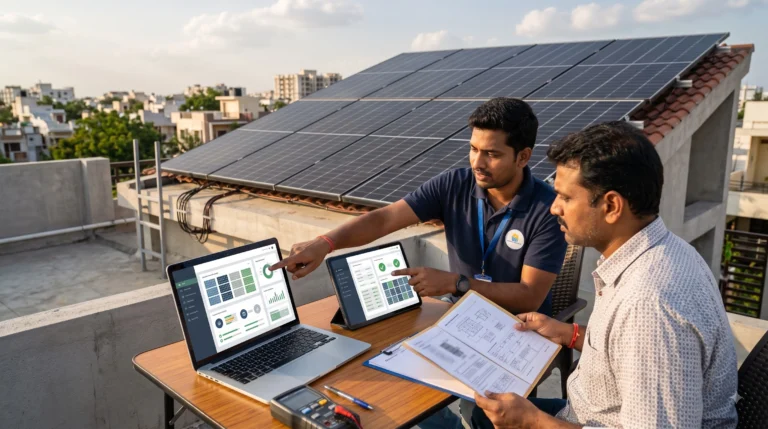
What does DCR mean in solar panels?
DCR means Domestic Content Requirement. It refers to requirements for domestic manufacturing of specified solar components under applicable government schemes and programmes.
What are DCR solar panels under PM Surya Ghar?
For PM Surya Ghar residential CFA, the applicable guideline requires rooftop solar installations to use domestically manufactured solar PV modules with domestically manufactured solar PV cells.
Are DCR panels mandatory for PM Surya Ghar subsidy?
Yes, the applicable PM Surya Ghar residential CFA guideline makes DCR compliance a condition for release of CFA.
Are all Indian solar panels DCR compliant?
No. “Made in India” or Indian-brand status alone should not be treated as proof of DCR compliance.
What is the difference between DCR and ALMM?
DCR concerns domestic-content requirements, while ALMM is MNRE’s approved-list framework for eligible solar PV models and manufacturers under specified projects and programmes.
Are ALMM solar panels automatically eligible for PM Surya Ghar subsidy?
Not automatically. ALMM status and DCR compliance are separate checks, and the project must satisfy all applicable PM Surya Ghar requirements.
Can I use a non-DCR panel and claim the PM Surya Ghar subsidy?
If the installation does not meet the applicable DCR requirement, it should not be treated as eligible for the residential CFA.
How can I verify a DCR panel before installation?
Ask for the exact manufacturer, module model, DCR documentation/undertaking and applicable ALMM information. Keep the documents with your project records.
Does DCR increase the cost of solar?
It can affect equipment selection and pricing, but the final project cost depends on the complete system, vendor, equipment and installation scope.
Can DCR rules change?
Yes. MNRE can issue amendments, clarifications and updated lists. Always verify the current requirements when applying for or commissioning a subsidised rooftop solar system.
At Roof Rays Solar, we are committed to delivering reliable rooftop solar solutions that combine quality products, professional installation, and long-term customer support. Whether you’re a homeowner, business owner, or industrial customer, our team works closely with you to design a solar system that matches your energy goals and budget.
Why Customers Trust Roof Rays Solar
Our experts design customized solar solutions based on your electricity consumption, roof space, and future energy goals—helping you maximize savings and achieve the best possible return on investment.
Phone
Address
📍 HUDA Complex, Tellapur, Hyderabad
Contact our solar experts today for a free consultation and personalized solar savings estimate.
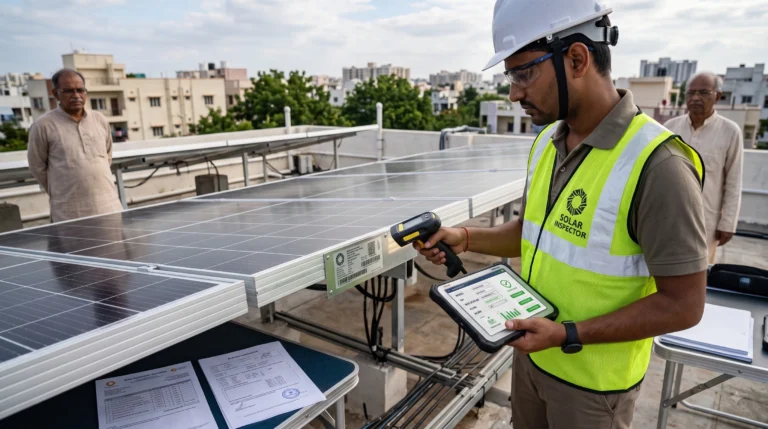
Understanding DCR solar panels under PM Surya Ghar is important if you are planning to claim residential rooftop solar CFA in 2026.
The key point is that DCR and ALMM are not interchangeable. PM Surya Ghar’s residential CFA requirements specify the use of domestically manufactured solar modules with domestically manufactured cells, while MNRE’s ALMM framework separately governs approved solar PV module models and manufacturers for specified projects.
Before installation, verify:
Most importantly, do not rely only on a vendor’s statement that a panel is “Indian” or “subsidy eligible.” Verify the exact equipment and documentation before installation.
That simple check can help prevent a situation where the solar system is installed but the expected subsidy cannot be processed because the equipment does not satisfy the applicable requirements.
Book Your Free Site Survey Today
© 2025 Roof Rays Solar Solutions. All Rights Reserved. | Designed by MANI
Check whether your property qualifies for rooftop solar subsidy support.
