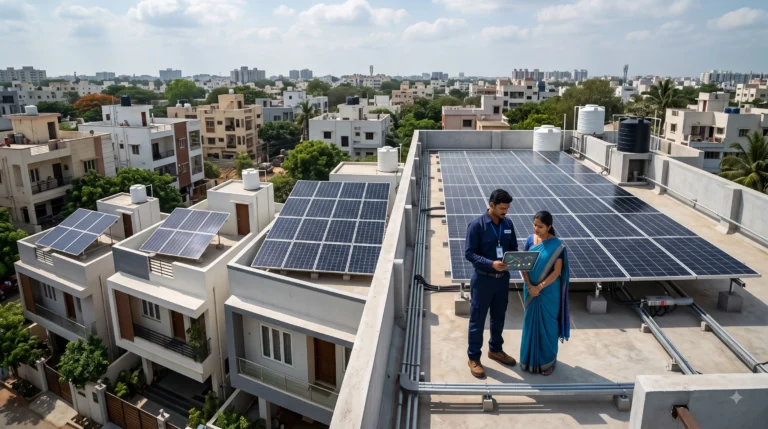
A 5kW solar system using 540W panels will require a different number of panels than a 5kW system using 580W panels. Higher-wattage modules can achieve the same overall system capacity with fewer physical panels, although the panel’s dimensions, efficiency, technology and available roof space also matter.
In 2026, high-power modules in the 540W–580W range are readily available in the Indian market. For example, current product ranges from major manufacturers include 540W and 580W-class modules.
This guide explains the 3kW solar panel quantity, 5kW solar panel quantity, 10kW solar panel quantity and 15kW solar panel quantity, along with how to compare 540W vs 580W panels.
The basic calculation is:
Number of panels = Required system capacity ÷ Panel wattage
Because you cannot install a fraction of a panel, the result is rounded up.
Solar System | 540W Panels | 580W Panels |
3kW | 6 panels | 6 panels |
5kW | 10 panels | 9 panels |
10kW | 19 panels | 18 panels |
15kW | 28 panels | 26 panels |
These are capacity-based calculations, not a recommendation to use a particular panel model.
The final design may vary depending on the selected module’s exact rated wattage, inverter configuration, electrical design, roof layout and applicable installation requirements.
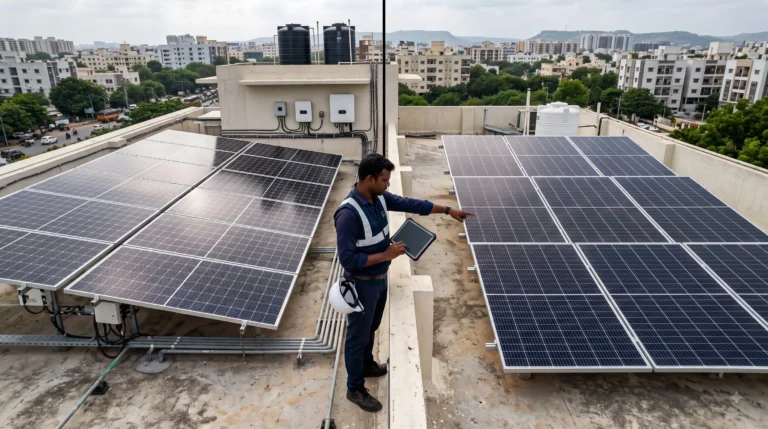
The calculation is straightforward.
Example: 5kW system with 540W panels
5,000W ÷ 540W = 9.26
Since you cannot install 9.26 panels, you need to round up:
10 × 540W = 5,400W
So, a 5kW-class system using 540W modules would typically require 10 panels to provide at least 5kW of DC module capacity.
Example: 5kW system with 580W panels
5,000W ÷ 580W = 8.62
Round up:
9 × 580W = 5,220W
So, using 580W modules reduces the panel count from 10 to 9 panels.
This is why the answer to “how many solar panels for 5kW?” cannot be given without knowing the panel wattage.
How Many Solar Panels for a 3kW System?
Using 540W panels
3,000W ÷ 540W = 5.56
You would need:
6 × 540W = 3,240W
Using 580W panels
3,000W ÷ 580W = 5.17
You would also need:
6 × 580W = 3,480W
Practical takeaway
For a 3kW system, both 540W and 580W options require 6 panels based on simple capacity calculations.
The higher-wattage module does not always reduce the panel count when the system is relatively small.
How Many Solar Panels for a 5kW System?
This is one of the most common residential solar questions.
With 540W panels
5,000W ÷ 540W = 9.26
Therefore:
10 panels × 540W = 5.40kW
With 580W panels
5,000W ÷ 580W = 8.62
Therefore:
9 panels × 580W = 5.22kW
So, how many solar panels for 5kW?
Approximately 9–10 panels, depending on the selected panel wattage.
If your installer proposes 540W modules, expect around 10 panels.
If 580W modules are used, around 9 panels may achieve the required module capacity.
How Many Solar Panels for a 10kW System?
With 540W panels
10,000W ÷ 540W = 18.52
Rounded up:
19 × 540W = 10.26kW
With 580W panels
10,000W ÷ 580W = 17.24
Rounded up:
18 × 580W = 10.44kW
Practical takeaway
A 10kW system would therefore typically require:
18–19 panels, depending on panel wattage.
For larger systems, the reduction in panel count can become more meaningful because every additional watt per module can reduce the number of modules required.
How Many Solar Panels for a 15kW System?
With 540W panels
15,000W ÷ 540W = 27.78
Rounded up:
28 × 540W = 15.12kW
With 580W panels
15,000W ÷ 580W = 25.86
Rounded up:
26 × 580W = 15.08kW
Practical takeaway
A 15kW system would require approximately:
26–28 panels, depending on the selected wattage.
For a larger rooftop, choosing higher-wattage modules can help reduce the total number of panels and simplify the physical layout.
540W vs 580W Panels: Which Is Better?
Choosing between 540W and 580W panels should not be based only on the number printed on the module.
Both can be suitable, but the better choice depends on the complete system design.
Factor | 540W Panel | 580W Panel |
Rated output per panel | Lower | Higher |
Panels required for same capacity | More | Fewer |
Roof layout | More modules | Fewer modules |
Installation count | Slightly higher | Slightly lower |
Module dimensions | Depends on model | Depends on model |
Technology | Depends on product | Depends on product |
Best choice | Depends on design | Depends on design |
Current Indian module ranges include both 540W-class and 580W-class products, while manufacturers also offer modules above 580W.
Important
A 580W panel is not automatically better than a 540W panel.
You should also compare:
Does Higher Panel Wattage Mean More Solar Generation?
Not necessarily in the way many homeowners assume.
A higher-wattage panel can produce more rated power per module, but the total system generation depends on the complete installed capacity and operating conditions.
For example:
10 × 540W = 5.40kW
while:
9 × 580W = 5.22kW
The first configuration actually has slightly higher total rated DC capacity despite using lower-wattage panels.
Therefore, do not compare panels simply by saying:
“580W is better than 540W.”
Compare the complete solar system, not only individual panel wattage.
Why Panel Quantity Is Not the Same as Solar Generation
The number of panels tells you the installed module capacity.
It does not tell you exactly how many units of electricity the system will generate each month.
Actual generation depends on:
Therefore:
Panel quantity → determines installed capacity
Site conditions + system design → influence actual generation
This distinction is important when estimating electricity savings.
How Much Roof Space Do Solar Panels Need?
Panel count is closely related to roof-space requirements.
Fewer panels can simplify the layout, but higher-wattage panels are not necessarily physically smaller.
For example, a 580W module may have a larger physical footprint than an older lower-wattage module.
So a roof survey should consider:
The objective is to determine usable shadow-free roof area, not simply calculate the number of panels.
Does a 5kW System Always Need 9 or 10 Panels?
Not necessarily.
The number depends on the exact module selected.
For example:
The actual system design also needs to account for inverter specifications and string configuration.
Therefore, panel count should be finalised after selecting the actual module and inverter combination.
Why Inverter Compatibility Matters
Solar panels do not operate independently from the inverter.
The installer must consider:
A technically correct panel-count calculation can still result in a poor system if the selected modules are not appropriately matched with the inverter.
This is especially important when using high-power modules.
3kW vs 5kW vs 10kW vs 15kW Panel Quantity
Here is the simplified comparison again:
System Size | 540W Configuration | 580W Configuration |
3kW | 6 panels / 3.24kW | 6 panels / 3.48kW |
5kW | 10 panels / 5.40kW | 9 panels / 5.22kW |
10kW | 19 panels / 10.26kW | 18 panels / 10.44kW |
15kW | 28 panels / 15.12kW | 26 panels / 15.08kW |
These figures are useful for understanding panel quantity, but they should not replace a site-specific system design.
How to Choose the Right Panel Wattage
Instead of asking only:
“Should I buy 540W or 580W?”
ask:
If space is limited, a configuration requiring fewer panels may be advantageous.
Higher wattage does not automatically mean better roof utilisation.
The electrical characteristics must work with the selected inverter.
Compare the actual module technology rather than wattage alone.
For certain government-linked, net-metering or other projects, applicable module eligibility requirements may matter. MNRE maintains the Approved List of Models and Manufacturers (ALMM), and its current guidance identifies ALMM-listed modules as eligible for specified government projects, schemes and net-metering projects.
Common Mistakes When Calculating Solar Panel Quantity
Mistake 1: Dividing by panel wattage and stopping there
The calculation is only the starting point.
The final array must also work with the inverter and electrical design.
Mistake 2: Assuming every 5kW system has the same number of panels
Panel wattage changes the quantity.
Mistake 3: Choosing the highest-wattage panel automatically
Higher wattage does not automatically mean better value or better roof utilisation.
Mistake 4: Ignoring panel dimensions
Two panels with different wattages may have significantly different physical dimensions.
Mistake 5: Ignoring shading
Adding more panels cannot compensate for a poorly designed, shaded rooftop.
Mistake 6: Estimating savings from panel count alone
Generation depends on the complete system and site conditions.
How to Calculate Your Solar Panel Requirement
Use this simple formula:
Required panels = Desired solar capacity in watts ÷ Panel wattage
Then:
Round the result up to the next whole panel.
Example
For a 10kW system with 580W panels:
10,000 ÷ 580 = 17.24
Round up:
18 panels
Total installed DC capacity:
18 × 580W = 10,440W = 10.44kW
The final system design should then verify whether the panel arrangement and inverter configuration are technically appropriate.
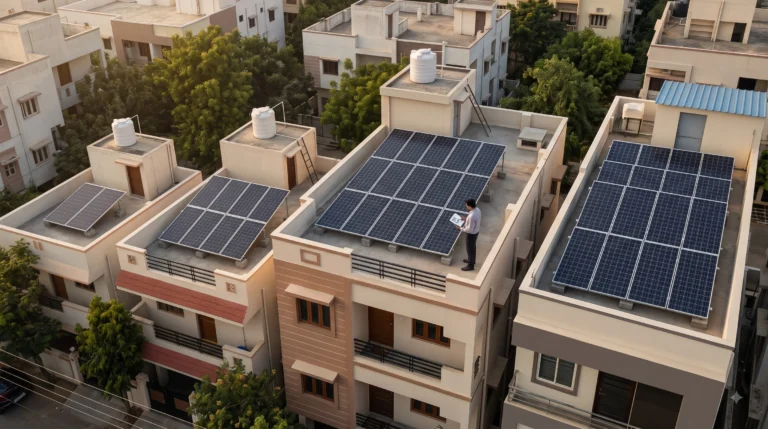
How many solar panels do I need for 5kW?
With 540W panels, approximately 10 panels are required. With 580W panels, approximately 9 panels are required based on rated capacity.
How many 540W panels are needed for 5kW?
10 panels. Ten 540W panels provide 5.40kW of total module capacity.
How many 580W panels are needed for 5kW?
9 panels. Nine 580W panels provide 5.22kW of total module capacity.
How many panels are needed for 3kW solar?
Using either 540W or 580W modules, the simple capacity calculation results in 6 panels.
How many panels are needed for 10kW solar?
Approximately 19 panels of 540W or 18 panels of 580W.
How many panels are needed for 15kW solar?
Approximately 28 panels of 540W or 26 panels of 580W.
Are 580W panels better than 540W panels?
Not automatically. A 580W panel produces more rated power per module, but panel dimensions, efficiency, technology, inverter compatibility, warranty and overall system cost should also be compared.
Does a higher-wattage panel require less roof space?
It can reduce the number of modules required for a given capacity, but the physical dimensions of the individual panel also matter. Fewer panels do not automatically mean proportionally less roof area.
Can I mix 540W and 580W panels?
It depends on the system design. Mixing different modules can create electrical and string-design considerations, so it should not be done simply to increase total wattage.
Does panel quantity determine monthly electricity generation?
No. Panel quantity determines installed module capacity, while actual generation depends on sunlight, shading, orientation, temperature, soiling, inverter performance and other system factors.
At Roof Rays Solar, we are committed to delivering reliable rooftop solar solutions that combine quality products, professional installation, and long-term customer support. Whether you’re a homeowner, business owner, or industrial customer, our team works closely with you to design a solar system that matches your energy goals and budget.
Why Customers Trust Roof Rays Solar
Our experts design customized solar solutions based on your electricity consumption, roof space, and future energy goals—helping you maximize savings and achieve the best possible return on investment.
Phone
Address
📍 HUDA Complex, Tellapur, Hyderabad
Contact our solar experts today for a free consultation and personalized solar savings estimate.
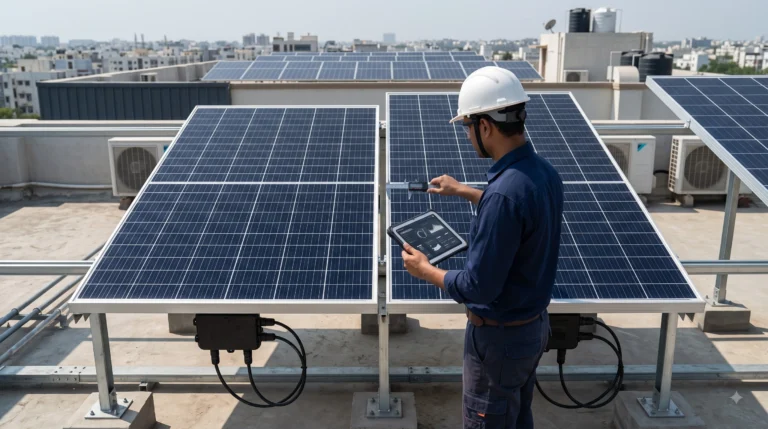
The answer to “how many solar panels for 5kW?” depends primarily on panel wattage.
As a simple 2026 reference:
But panel quantity is only one part of a good solar design.
The right system should also consider panel dimensions, roof area, shading, inverter compatibility, module technology, electrical configuration and actual electricity consumption.
So, when comparing a 540W vs 580W panel, do not focus only on the number of panels. Compare the complete system and choose the configuration that makes the best technical and practical sense for your roof.
Book Your Free Site Survey Today
© 2025 Roof Rays Solar Solutions. All Rights Reserved. | Designed by MANI
Check whether your property qualifies for rooftop solar subsidy support.
