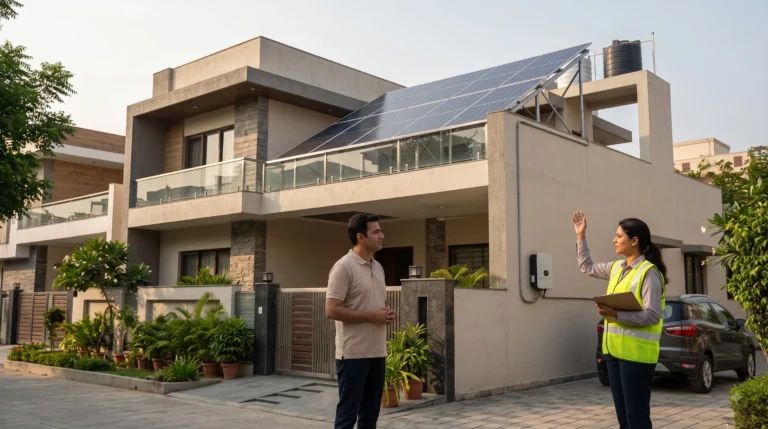
If you are thinking about installing rooftop solar in 2026, one question probably comes before everything else:
“Will I actually save enough money to make solar worth the investment?”
It is a reasonable question.
Rooftop solar requires an upfront investment, and the economics vary from one home to another. The system size, installation cost, electricity consumption, roof conditions and available incentives can all change the outcome.
At the same time, India’s rooftop-solar market has continued to expand. As of 31 August 2026, MNRE reported 32.59 GW of grid-connected solar rooftop capacity installed across India.
The government is also continuing to support residential rooftop solar through PM Surya Ghar: Muft Bijli Yojana, which aims to support rooftop solar adoption among one crore households.
So, is solar worth it in 2026?
For many households, it can be—but the right answer comes from the numbers for your home, not from a generic promise of “free electricity.”
Solar can still be a worthwhile long-term investment in 2026 if your home has suitable roof space, meaningful electricity consumption and a properly designed system at a reasonable installed cost.
The strongest financial case generally comes from homes that:
However, solar is not automatically financially attractive for every home. A low-consumption household, heavily shaded roof or poorly priced installation can produce a very different ROI.

Factor | Why It Matters |
Electricity bill | Higher consumption can create greater savings potential |
Solar system cost | Determines the initial investment |
Subsidy | Can reduce eligible residential upfront cost |
Roof space | Determines how much solar can practically be installed |
Shading | Can reduce generation |
Self-consumption | Influences how much generated electricity replaces grid electricity |
Net-metering arrangement | Can affect the value of exported electricity |
System quality | Influences long-term performance and maintenance |
Future electricity use | Can change the economics over time |
Payback period | Shows how long savings may take to recover the investment |
Why Are Homeowners Still Considering Solar in 2026?
The economics of rooftop solar are closely connected to one simple household reality:
Electricity is an ongoing expense.
A solar system requires a substantial payment upfront, but once installed it can generate electricity for many years.
That changes the nature of the expense.
Instead of treating solar only as a purchase, homeowners can evaluate it as an investment in reducing future electricity expenditure.
This is why solar savings, system cost and payback period should be evaluated together.
A rooftop solar system generates electricity at your property.
Depending on the system configuration and applicable metering arrangement, that electricity can be used by your home and, where permitted, surplus generation can be exported to the grid.
The more of your generated electricity that effectively offsets electricity you would otherwise purchase, the greater the potential financial benefit.
This is why understanding your consumption pattern matters.
A home using substantial electricity during daylight hours may have a different savings profile from a home whose largest loads occur at night.
One of the biggest factors in the solar worth it India 2026 discussion is residential financial assistance.
The PM Surya Ghar scheme provides Central Financial Assistance to eligible residential consumers.
Under the published scheme structure:
The commonly applicable maximum residential CFA is therefore ₹78,000.
That does not mean every homeowner automatically receives ₹78,000. Eligibility, installation requirements, approved vendors and the applicable process must be satisfied.
It also means homeowners should not assume that installing a 10 kW system produces a subsidy ten times larger than a 1 kW system.
One of the easiest mistakes is asking:
“How much does a 5 kW solar system cost?”
before asking:
“How much electricity does my home actually use?”
Suppose two households install identical systems.
Home A consumes a large amount of electricity and uses much of the solar generation.
Home B consumes considerably less electricity.
The financial outcome can be different even though the solar systems cost the same.
That is why a meaningful solar ROI calculation should consider:
The solar payback period is the approximate time required for cumulative financial savings to recover the net investment.
A simplified calculation is:
Payback Period = Net Solar Investment ÷ Annual Solar-Related Savings
For example, if:
Then:
₹3,00,000 ÷ ₹50,000 = 6 years
This is only a simplified illustration.
Real-world payback calculations should account for changes in electricity tariffs, system degradation, maintenance, financing costs, export arrangements and actual solar generation.
Therefore, a quotation promising a specific payback period should be checked against the assumptions behind the calculation.
A common mistake is thinking:
“Bigger solar system = bigger savings.”
That is not always true.
A solar system should be appropriately sized for the property.
MNRE’s PM Surya Ghar material provides indicative system-capacity guidance based on household monthly electricity consumption, illustrating that system sizing should be connected to consumption rather than simply roof size.
Before choosing capacity, review:
A system that is appropriately matched to the household can be more useful than simply maximising installed capacity.
When comparing rooftop solar cost, do not look only at the panel price.
A complete residential installation can involve:
Two quotations with the same system capacity can therefore have very different total prices.
Why Can Two Solar Quotations Be So Different?
Price differences can come from:
Solar Modules
Different manufacturers, technologies, efficiency levels and product specifications can affect cost.
Inverter
The inverter is a critical component of a grid-connected system, and specifications, warranty and monitoring capabilities can vary.
Mounting Structure
Material, design, corrosion protection and installation quality can affect both price and long-term performance.
Electrical Protection
Protection and safety equipment should be properly specified rather than removed simply to reduce the quotation.
Installation Quality
Workmanship can influence cable management, mounting quality, waterproofing practices and long-term maintenance.
After-Sales Support
Warranty handling, monitoring and service arrangements can affect the practical ownership experience.
There is no single savings figure that applies to every Indian household.
Solar savings depend on:
Solar generation × value of electricity offset/exported
Generation depends on:
Financial value depends on:
This is why a professional estimate should use the property’s actual location, roof and electricity data.
The financial calculation is important, but homeowners may also consider other solar installation benefits.
Reduced Grid Dependence
A portion of household electricity can be generated on-site.
Better Long-Term Energy Planning
Solar can make future electricity expenditure more predictable, although it does not eliminate every electricity-related cost.
Utilisation of Unused Roof Space
A suitable rooftop can become an electricity-generating asset.
Support for EV Charging
Homeowners with EVs can consider solar as part of their broader household energy strategy.
Renewable Electricity Generation
Rooftop solar allows homes to generate electricity from a renewable source.
A rooftop solar investment should be viewed over the long term rather than as a one- or two-year purchase.
Solar modules generally continue producing electricity for decades, although output gradually declines over time.
This makes system quality, installation workmanship and maintenance important parts of the investment decision.
A low upfront quotation that results in poor installation or difficult service can create costs later.
Not necessarily to the same degree as for a high-consumption home.
If your monthly electricity consumption is very low, the annual financial savings may also be relatively limited.
That does not make solar useless, but it changes the economics.
A homeowner should compare:
Upfront investment → expected annual savings → payback period → long-term benefits
rather than assuming every home should install the same capacity.
This is where future-proofing becomes important.
Your electricity consumption may rise because of:
If your consumption is expected to increase, that should be considered when evaluating solar capacity and roof utilisation.
However, future consumption should be estimated realistically rather than used to justify an unnecessarily oversized system.
An EV can significantly increase household electricity consumption.
This can make solar more relevant because the home is no longer planning only for traditional household appliances.
A homeowner considering solar + EV should evaluate:
The solar system should then be evaluated against the combined household electricity profile.
Solar Investment: What Can Make It Less Attractive?
Solar is not automatically a good financial decision in every situation.
The economics can become weaker when:
Electricity Consumption Is Very Low
There may be insufficient annual savings to justify a large system.
The Roof Is Heavily Shaded
Lower generation reduces potential savings.
The Installation Price Is Excessive
A high upfront cost increases the payback period.
The System Is Poorly Sized
Oversizing or undersizing can reduce the financial efficiency of the investment.
The Roof Requires Major Structural Work
Additional construction costs can change the project economics.
The Home May Be Sold Soon
A homeowner planning to move in a short period may have a different investment horizon from someone planning to stay for many years.
Solar Investment: What Can Improve the Economics?
A stronger financial case can result when several factors work together:
No single factor determines the outcome.
Solar ROI Example: How to Think About the Numbers
Consider this simplified example:
Item | Example |
Gross system cost | ₹3,80,000 |
Applicable subsidy | ₹78,000 |
Illustrative net investment | ₹3,02,000 |
Estimated annual savings | ₹50,000 |
Simple payback | ~6 years |
This is only an illustration, not a market quotation or guaranteed return.
The actual calculation should use your:
The purpose of a payback calculation is to understand the relationship between investment and savings—not to guarantee future returns.
A Simple Solar Investment Checklist
Before saying yes to rooftop solar, check:
Electricity
Roof
System
Financial
Vendor
How to Calculate Whether Solar Is Worth It for Your Home
Use this five-step approach.
Step 1: Collect 12 Months of Electricity Bills
This gives a better picture than using a single month’s bill.
Step 2: Estimate Future Consumption
Include likely additions such as EV charging and ACs.
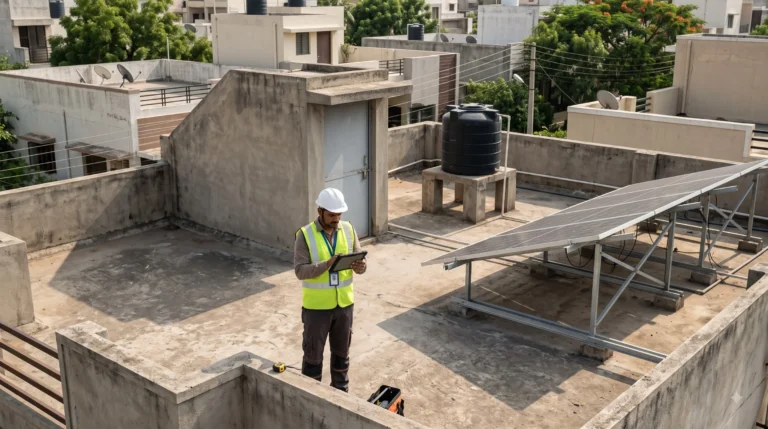
Step 3: Conduct a Roof Assessment
Check area, orientation and shading.
Step 4: Compare Complete Solar Quotations
Compare equipment, installation, warranty and scope—not just price.
Step 5: Calculate Net Investment and Payback
Subtract applicable subsidy from the eligible project cost and compare the remaining investment with realistic annual savings.
This produces a more meaningful answer to:
“Is solar worth it in 2026 for my home?”
India’s Rooftop Solar Market in 2026
The broader market context also matters.
As of 31 August 2026, MNRE reported:
These figures show that rooftop solar is now a substantial part of India’s installed solar capacity rather than a niche technology.
The PM Surya Ghar programme has also accelerated residential rooftop adoption. A 2025 MNRE release reported that nearly 14.43 lakh rooftop systems had been installed under the scheme during 2025 through 22 December, benefiting more than 18.14 lakh households.
What Homeowners Should Look for in 2026
The solar market is not simply about buying more panels.
Homeowners should increasingly evaluate:
System Quality
Look beyond the panel name and check the complete system.
Installation Quality
A good product still needs good installation.
Monitoring
Generation monitoring can help identify performance issues.
Documentation
Keep invoices, warranties, specifications and commissioning information.
Vendor Support
Solar is a long-term asset, so after-sales service matters.
Regulatory Compliance
Government-scheme and net-metering projects may have specific equipment and eligibility requirements. For example, MNRE’s current ALMM information states that eligible models/manufacturers are required for certain government-assisted and net-metering projects.
Common Mistakes Homeowners Make
Mistake 1: Choosing the Cheapest Quote
A low price may not represent the lowest long-term cost.
Mistake 2: Looking Only at Panel Wattage
The complete system matters.
Mistake 3: Ignoring Roof Shading
Even a large roof may have limited usable solar area.
Mistake 4: Assuming the Subsidy Covers Everything
The PM Surya Ghar residential CFA has defined limits and eligibility conditions.
Mistake 5: Using a Generic Payback Number
Your electricity consumption and tariff can produce a different result from another homeowner.
Mistake 6: Ignoring Future Electricity Loads
An EV or additional ACs can significantly change future consumption.
Mistake 7: Comparing Only the Total Price
Compare the equipment, warranties, installation scope, monitoring and service as well.
Expert Tips Before Making a Rooftop Solar Investment
Is solar worth it in 2026 in India?
It can be financially worthwhile for many households, particularly where electricity consumption is meaningful, the roof has good solar potential and the system is purchased and installed at a reasonable cost. The actual ROI depends on the individual property’s numbers.
How long is the solar payback period?
There is no universal payback period. It depends on the net investment, annual electricity savings, system generation, electricity tariff, subsidy, financing and other project-specific factors.
Is rooftop solar still profitable after the subsidy?
A subsidy can reduce the initial investment for eligible residential consumers, but the project’s economics should still be evaluated using the actual installed cost and expected annual savings. PM Surya Ghar’s central residential CFA is capped at the applicable 3 kW level under the cited scheme structure.
Does a higher electricity bill make solar more worthwhile?
Higher electricity consumption can create greater potential savings, but the relationship is not automatic. Roof conditions, system cost, tariff and solar generation also matter.
Is solar a good investment for a low-electricity-consumption home?
It may have a longer payback period because the annual savings potential is lower. The homeowner should compare the investment against actual consumption before selecting a system.
Does solar reduce the electricity bill to zero?
Not necessarily. The outcome depends on system size, consumption, generation, metering arrangements and fixed or other charges on the electricity bill.
Should I install a bigger solar system because my electricity consumption may increase?
Future consumption should be considered, but oversizing without a realistic basis can increase the upfront investment. System sizing should balance present and reasonably expected future demand.
Is solar worth it if I plan to buy an EV?
It can make solar more relevant because EV charging adds electricity consumption. The solar assessment should include the expected EV charging load rather than treating it separately.
What should I compare when reviewing solar quotations?
Compare system capacity, modules, inverter, mounting structure, protection equipment, installation scope, warranties, monitoring, service terms, total cost and the assumptions used for generation and savings.
How can I calculate my solar ROI?
Start with the net investment after applicable subsidy and divide it by realistic annual savings for a simple payback estimate. A detailed ROI model should also account for degradation, maintenance, financing and tariff changes.
At Roof Rays Solar, we are committed to delivering reliable rooftop solar solutions that combine quality products, professional installation, and long-term customer support. Whether you’re a homeowner, business owner, or industrial customer, our team works closely with you to design a solar system that matches your energy goals and budget.
Why Customers Trust Roof Rays Solar
Our experts design customized solar solutions based on your electricity consumption, roof space, and future energy goals—helping you maximize savings and achieve the best possible return on investment.
Phone
Address
📍 HUDA Complex, Tellapur, Hyderabad
Contact our solar experts today for a free consultation and personalized solar savings estimate.
So, is solar worth it in 2026?
For many Indian homeowners, rooftop solar can make financial sense—but there is no single ROI or payback period that applies to every property.
The decision depends on the relationship between your electricity consumption, rooftop solar cost, subsidy eligibility, solar generation, annual savings and expected ownership period.
India’s rooftop-solar capacity has continued to grow, while PM Surya Ghar is providing a significant policy push for residential adoption.
But the strongest solar investment decision is not necessarily the biggest system or the cheapest quotation.
It is the system that is appropriately sized, properly designed, correctly installed and financially justified by the numbers for your home.
Before investing, get your electricity usage and roof assessed, compare complete quotations and calculate the expected solar payback period using realistic assumptions.
© 2025 Roof Rays Solar Solutions. All Rights Reserved. | Designed by MANI
Check whether your property qualifies for rooftop solar subsidy support.