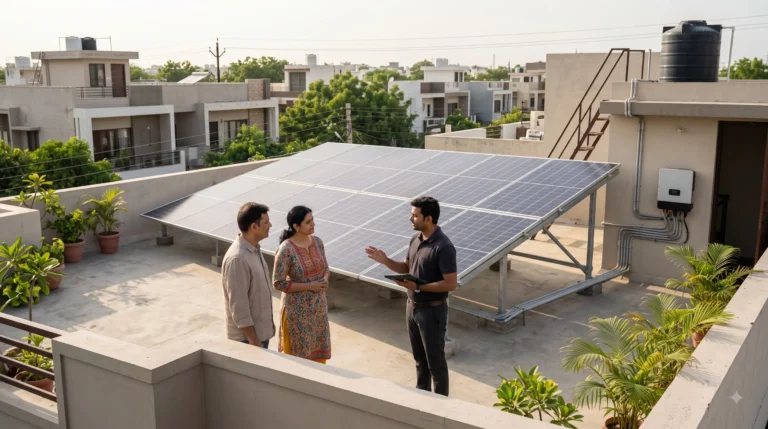
A few years ago, rooftop solar was something many homeowners considered only after receiving unusually high electricity bills. In 2026, it has become a much more visible option for households looking to manage electricity expenses and generate their own power.
Government support, greater awareness, easier access to solar installers and growing interest in long-term energy savings are helping drive this change.
The numbers reflect the momentum. In August 2026, the Ministry of New and Renewable Energy reported that the PM Surya Ghar: Muft Bijli Yojana had crossed 50 lakh beneficiary households, with 14.8 GW of rooftop solar capacity commissioned under the scheme at that point. <Cite refs={[“turn741126search4”]}/>
But the real question is not simply why solar is becoming popular. It is why homeowners are choosing to invest in it—and whether the same reasons apply to your property.
Here are seven important reasons behind the rooftop solar boom in India in 2026, along with practical considerations for homeowners.
Rooftop solar adoption in India is growing because households are looking for lower electricity bills, government financial assistance, greater control over electricity costs, long-term savings and more sustainable energy choices.
The PM Surya Ghar scheme has also made residential solar more accessible to eligible households by offering central financial assistance.
However, solar is not equally beneficial for every property. Actual savings depend on electricity consumption, roof suitability, installation cost, solar generation and the applicable electricity-metering arrangement.
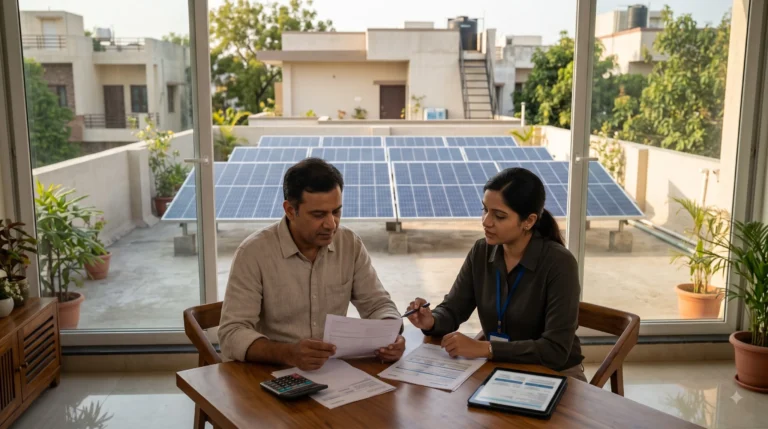
For many households, the biggest reason to consider rooftop solar is straightforward: electricity is a recurring expense.
Air conditioners, refrigerators, water heaters, washing machines, pumps and other appliances can contribute to substantial monthly consumption. Homes with multiple ACs or high daytime electricity use may have a particularly strong reason to evaluate solar.
A rooftop solar system generates electricity from sunlight, allowing a home to use some of its own generated power instead of purchasing all its electricity from the grid.
A June 2026 study by the Council on Energy, Environment and Water (CEEW) found that 81% of households interested in rooftop solar cited lower electricity bills as their primary motivation. The study also reported that surveyed adopters were generally satisfied with their bill savings. <Cite refs={[“turn741126search10”]}/>
Why this matters for homeowners
The potential savings depend on how much electricity your system generates and how much of that generation effectively replaces grid electricity.
Before choosing a system, review your recent electricity bills and identify your average monthly consumption. This provides a better starting point than selecting a solar capacity based only on your home’s size.
Practical tip: If your electricity bills are consistently high, request a solar assessment based on your actual consumption rather than relying on a generic savings estimate.
Another important reason for increasing solar adoption in India is the PM Surya Ghar: Muft Bijli Yojana.
The scheme aims to expand residential rooftop solar adoption by providing central financial assistance to eligible households.
Under the commonly published central assistance structure:
The subsidy is subject to the scheme’s eligibility and implementation requirements. Installing a larger system does not increase the central assistance proportionally beyond the applicable 3 kW level. <Cite refs={[“turn741126search3″,”turn741126search13”]}/>
How subsidy changes the decision
Suppose a homeowner is comparing the upfront cost of solar with the long-term electricity savings it could deliver. If the household qualifies for assistance, the effective investment may be lower, potentially improving the payback period.
However, homeowners should not assume that every installation automatically qualifies. Confirm eligibility, approved-vendor requirements and the latest application process through the official scheme portal.
Official resource: PM Surya Ghar National Portal.
Solar is not just about reducing the next electricity bill. It is also a way to evaluate future household energy expenses.
A properly designed rooftop system can generate electricity for many years. This gives homeowners an opportunity to compare an upfront investment with the potential value of the electricity generated over the system’s operating life.
The financial outcome depends on several factors:
A simple example
Suppose a hypothetical household invests ₹2,50,000 after applicable assistance and estimates that its solar system will save ₹40,000 annually.
Its simple payback calculation would be:
[
\text{Payback}=\frac{₹2,50,000}{₹40,000}
]
That gives a simple payback estimate of approximately 6.25 years.
This is an illustration, not a prediction for every home. Actual savings and payback can differ because of system performance, electricity rates, maintenance, financing and metering arrangements.
The important point is to evaluate solar as a long-term investment rather than judging it solely by the initial price.
Rooftop solar allows households to generate some of their electricity on-site.
This can reduce dependence on electricity purchased from the grid, although most ordinary grid-connected systems remain connected to the utility and do not automatically provide backup during a power cut.
For homeowners, the attraction is greater control over part of their electricity consumption.
This may be especially relevant for:
Does rooftop solar make a home energy independent?
Not completely in every configuration.
A standard grid-connected system may import electricity when solar generation is insufficient, such as at night. Battery storage and suitable backup equipment may be required for specific backup or greater energy-independence goals.
The right setup depends on whether your priority is reducing electricity bills, obtaining backup power or combining both objectives.
Solar adoption also depends on whether homeowners understand the technology and can find a reliable installation provider.
As rooftop solar becomes more visible in residential communities, homeowners can more easily compare installation approaches, ask neighbours about their experiences and learn about available schemes.
Government programmes and installer networks have also made residential solar a more familiar option.
The CEEW’s 2026 research examined household decision-making across 22 states and Union Territories, highlighting the importance of consumer awareness, trusted guidance, simpler processes and financing literacy in expanding residential adoption. <Cite refs={[“turn741126search7″,”turn741126search10”]}/>
What homeowners should do with this information
Growing demand does not mean every vendor or quotation is equally good.
Before committing, compare:
A detailed quotation helps you understand what you are paying for and makes comparisons more meaningful.
Household electricity consumption can change over time.
A family may add more air conditioners, upgrade appliances, work from home or purchase an electric vehicle. These changes can increase electricity demand and make rooftop solar worth evaluating as part of a broader home-energy plan.
Solar and EV charging
An EV can add a new electricity load to a home. If you are planning to buy one, consider its expected charging requirements when assessing your solar needs.
However, charging time matters. Solar generates electricity primarily during daylight hours, while many people charge vehicles overnight.
Your system design should therefore account for household consumption, expected EV usage, available roof space and the electrical arrangement.
Plan for realistic future demand
Future-proofing does not mean installing the largest possible system today.
Instead, estimate your likely electricity requirements and choose a system that balances current consumption, future demand and project economics.
Environmental considerations are another reason households explore solar.
Rooftop solar generates electricity from sunlight without fuel combustion at the point of generation. When it replaces electricity from more carbon-intensive sources, it can help reduce the associated emissions.
Solar also makes productive use of suitable rooftop space that might otherwise remain unused.
For homeowners who value renewable energy, this can be an additional benefit alongside the financial calculation.
However, the environmental and financial value of a system depends on its design, performance, equipment and how the generated electricity is used.
At-a-Glance: Why Are More Homes Installing Rooftop Solar?
Reason | Potential Household Benefit |
Lower electricity bills | Reduced grid-electricity purchases |
Government assistance | Lower upfront cost for eligible households |
Long-term savings | Potential to recover the investment over time |
Greater energy control | Generate some electricity at home |
Better awareness | More information for comparing solutions |
Future electricity needs | Plan for EVs and additional appliances |
Environmental considerations | Generate renewable electricity on-site |
These benefits are potential outcomes, not guarantees. Each household should evaluate its own electricity consumption, roof and financial circumstances.
Is Rooftop Solar Suitable for Every Indian Home?
No. Although residential solar is becoming more accessible, some homes are better suited to it than others.
Homes that may be good candidates
Homes that need closer evaluation
For apartments, rooftop rights and electricity-metering arrangements must be considered before assuming that an individual flat owner can install a private system on the common terrace.
Rooftop Solar in Hyderabad and Telangana
For homeowners in Hyderabad, the reasons for considering solar are similar to those elsewhere in India: electricity expenses, long-term savings, financial assistance and future electricity requirements.
However, the actual value of rooftop solar depends on the individual property.
A house with several air conditioners may have a different consumption profile from a smaller household. A villa with a large, open terrace may also have different installation options from a house surrounded by taller buildings.
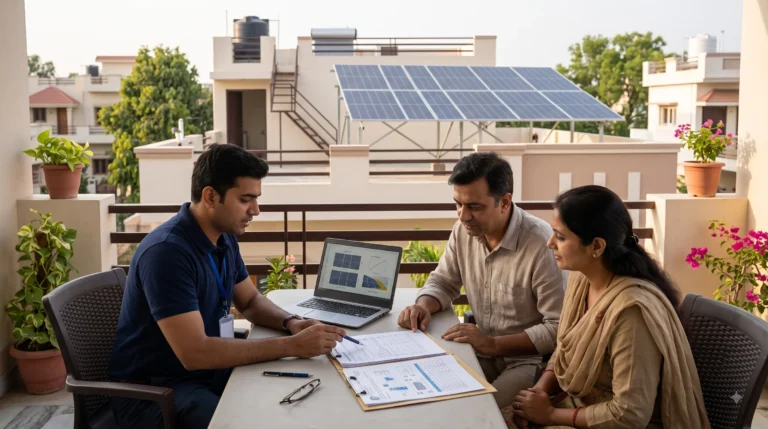
Before installation, homeowners should evaluate:
The goal is to select a system that fits the property—not simply follow a national trend.
What Should You Check Before Installing Solar?
Use this checklist before requesting a final quotation.
Expert Tips for Homeowners Considering Solar
Why is rooftop solar growing in India in 2026?
Residential solar adoption is being supported by interest in electricity-bill savings, government financial assistance, greater awareness and the availability of more installation options. PM Surya Ghar has become a major driver of residential adoption. <Cite refs={[“turn741126search4″,”turn741126search10”]}/>
What is the biggest reason homeowners install solar panels?
Reducing electricity bills is a major motivation. CEEW’s 2026 study found that 81% of households interested in rooftop solar cited lower electricity bills as their primary reason. <Cite refs={[“turn741126search10”]}/>
Does PM Surya Ghar make rooftop solar cheaper?
It can reduce the upfront cost for eligible residential consumers. The actual benefit depends on the applicable assistance, system configuration and scheme requirements.
How much subsidy can a homeowner receive?
Under the commonly published central assistance structure, eligible households can receive up to ₹78,000 for applicable residential systems of 3 kW or more. Confirm current eligibility and requirements before budgeting. <Cite refs={[“turn741126search3″,”turn741126search13”]}/>
Is rooftop solar worth it for a home with a high electricity bill?
It can be attractive because higher consumption may create more opportunities to offset grid electricity. The actual savings still depend on system cost, generation, self-consumption and metering rules.
Can rooftop solar provide electricity during a power cut?
A standard grid-connected solar system usually shuts down during a grid outage for safety. Backup during outages generally requires a suitable system configuration and compatible equipment.
Is rooftop solar suitable for apartments?
It depends on the building’s rooftop rights, available space, electrical infrastructure and metering arrangement. Common-rooftop or shared arrangements may be options where applicable requirements are met.
Does rooftop solar eliminate the electricity bill?
Not necessarily. Remaining grid consumption, fixed charges and the applicable billing arrangement can mean that a bill remains after installation.
Is 2026 a good time to install rooftop solar?
It may be a good time for a household with suitable roof conditions, meaningful electricity consumption and a financially reasonable quotation. Review your own circumstances rather than relying only on market growth.
At Roof Rays Solar, we are committed to delivering reliable rooftop solar solutions that combine quality products, professional installation, and long-term customer support. Whether you’re a homeowner, business owner, or industrial customer, our team works closely with you to design a solar system that matches your energy goals and budget.
Why Customers Trust Roof Rays Solar
Our experts design customized solar solutions based on your electricity consumption, roof space, and future energy goals—helping you maximize savings and achieve the best possible return on investment.
Phone
Address
📍 HUDA Complex, Tellapur, Hyderabad
Contact our solar experts today for a free consultation and personalized solar savings estimate.
The growing popularity of rooftop solar in India in 2026 reflects a combination of household financial priorities, government support, better awareness and interest in renewable electricity.
For many homeowners, solar offers an opportunity to reduce grid-electricity purchases and plan for long-term energy needs. But the benefits depend on the individual property, the quality and price of the installation, and how the generated electricity is used.
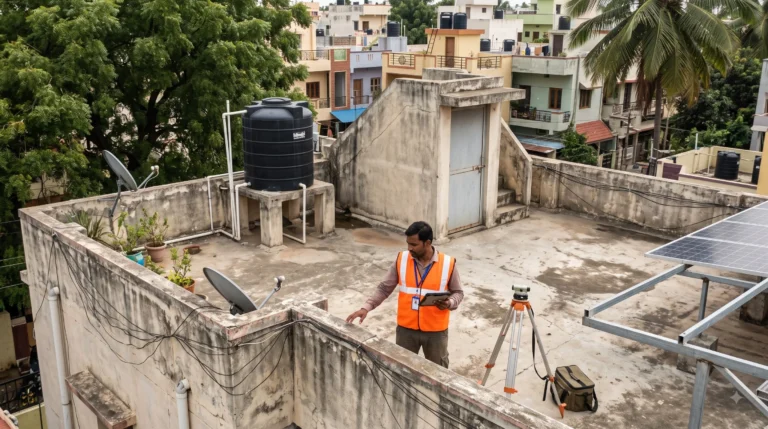
Before deciding, assess your electricity bills, check your roof, verify subsidy eligibility and compare complete quotations.
The smartest way to join India’s rooftop solar growth is to choose a system that makes sense for your home—not simply to follow the trend.
© 2025 Roof Rays Solar Solutions. All Rights Reserved. | Designed by MANI
Check whether your property qualifies for rooftop solar subsidy support.