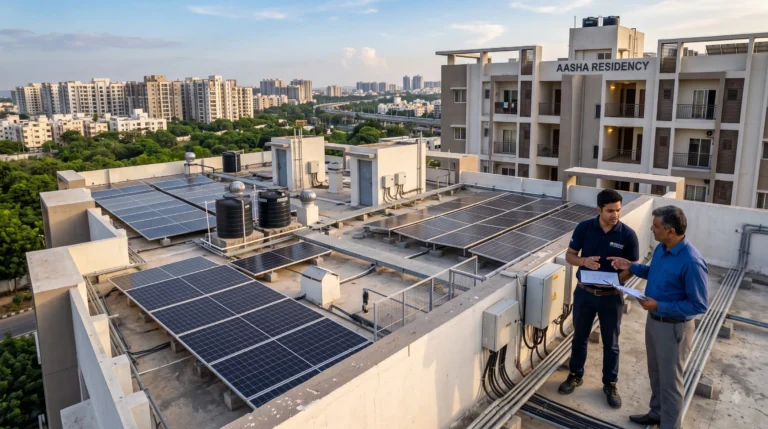
For a housing society, electricity is not just a household expense. The association also pays for lifts, water pumps, corridor lighting, parking lights, security systems, clubhouse facilities and other common services.
These recurring electricity expenses are ultimately part of the society’s operating budget and can influence monthly maintenance charges collected from residents.
This is where solar for apartment common areas can become relevant.
A rooftop solar system can generate electricity for eligible common facilities, potentially reducing the amount of electricity the society purchases from the grid. The resulting savings can contribute to lower or more stable common-area operating costs.
However, solar does not automatically reduce every component of an apartment’s maintenance bill. The financial benefit depends on the society’s electricity consumption, usable roof area, solar capacity, metering arrangement, project cost, maintenance and applicable subsidy.
For Hyderabad housing societies, the current Telangana rooftop-solar framework and PM Surya Ghar provisions also make it important to understand who owns the electricity connection, how the solar plant will be connected and whether the society qualifies for common-facility CFA.
Yes, solar can reduce the electricity component of common-area operating expenses when the system is appropriately sized and connected to eligible common facilities.
For example, solar can help offset electricity used by:
But solar does not eliminate expenses such as:
So the more accurate statement is:
Solar can reduce the electricity portion of apartment maintenance costs—not the entire maintenance bill.
The actual savings should be calculated from the society’s electricity bills and proposed solar design.
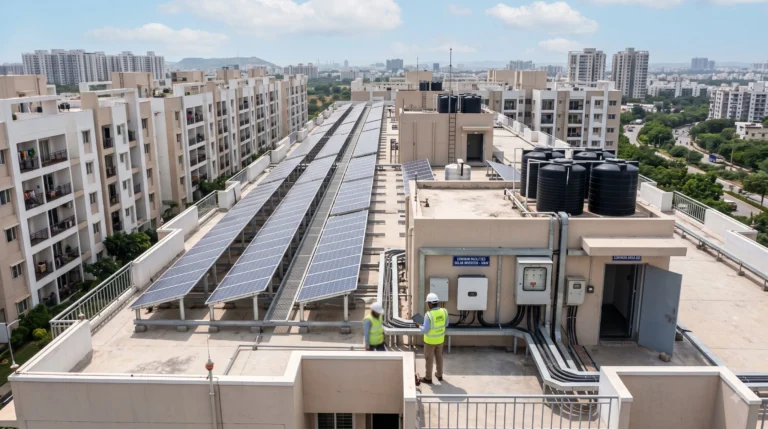
Common-area solar is a rooftop solar PV system installed by a housing society or eligible residential community to generate electricity for shared facilities.
Instead of installing a separate solar system for every flat, the society can use suitable rooftop space for a common solar plant.
A typical arrangement can look like:
Solar panels → Inverter → Society electrical system → Common-area loads
Depending on the approved metering arrangement, excess electricity may also be exported to the grid and accounted for according to applicable rules.
The important point is that the solar plant must be connected to an eligible electricity connection and approved metering arrangement.
Which Apartment Loads Can Solar Support?
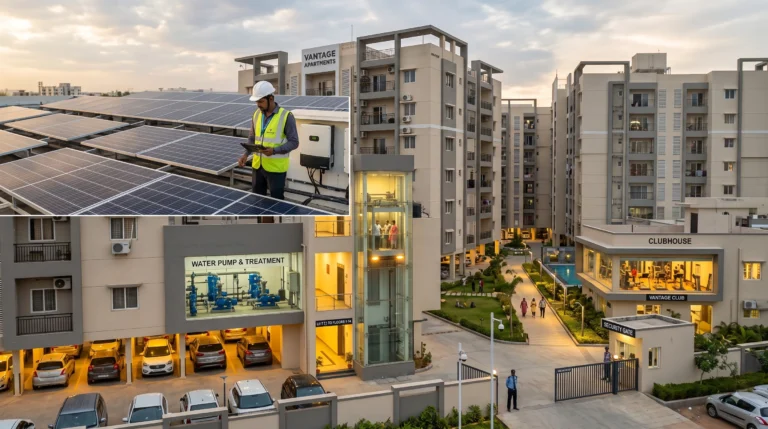
The exact electrical arrangement depends on the society, but common facilities can include:
Pumps used for overhead tanks, underground sumps and other water systems can create recurring electricity consumption.
Apartment buildings with multiple lifts can have significant common-area electricity usage.
Solar can help offset electricity used for:
Where applicable, clubhouse electrical loads can contribute to common-area consumption.
CCTV, access-control systems and other electrical equipment can also form part of the common load.
The actual solar capacity should be determined from electricity consumption data, not simply the number of apartments.
Why Common-Area Solar Can Make Sense for Housing Societies
Housing societies have an advantage that individual households may not: multiple shared loads operating throughout the year.
Consider a residential community with:
These loads create recurring electricity demand.
If the solar plant generates electricity during periods when common facilities are consuming power, the society can potentially reduce grid electricity purchases.
This is why the financial assessment should focus on:
Annual common-area electricity consumption + daytime load + solar generation + applicable billing arrangement
rather than simply asking how many panels can fit on the roof.
Can PM Surya Ghar Subsidy Apply to Apartment Common Areas?
Eligible Group Housing Societies (GHS) and Residential Welfare Associations (RWA) can receive CFA for common facilities under PM Surya Ghar, subject to the scheme’s conditions.
The scheme guidelines provide for common facilities, including EV charging, for GHS/RWAs up to 500kWp at 3kWp per house, with the upper limit also taking into account individual rooftop plants installed by residents within the GHS/RWA. (solarrooftop.pmsuryaghar.gov.in)
The scheme also specifies that the GHS/RWA electricity connection eligible under this provision is dedicated to common facilities and should not be used to supply electricity to residential consumers within the community. (solarrooftop.pmsuryaghar.gov.in)
Important
The society should not simply deduct the maximum possible subsidy from its quotation.
Eligibility depends on the community, connection, capacity, installation and scheme requirements.
The applicable CFA should be verified during project planning.
How Much Can a Housing Society Save With Solar?
There is no universal savings figure.
The savings depend on:
A simple example
Suppose a society spends ₹50,000 per month on eligible common-area electricity.
If the solar system offsets electricity worth an average of ₹20,000 per month, the annual gross electricity-cost reduction would be approximately:
₹20,000 × 12 = ₹2.4 lakh per year
This is only an illustration.
Actual savings must be calculated from the society’s bills, proposed solar generation and applicable tariff/metering rules.
Solar Savings vs Apartment Maintenance Charges
This distinction is important.
Suppose the society’s total monthly maintenance collection is:
₹10 lakh
and electricity for common facilities represents:
₹2 lakh
If solar reduces the common electricity expense by a portion of that amount, the society’s total operating cost may decrease.
But the association may choose to use the savings for:
Therefore, solar savings do not automatically mean maintenance charges will immediately decrease.
The association’s financial policy determines how the savings are used.
How Much Solar Does an Apartment Society Need?
The correct capacity depends on the society’s actual electricity consumption and available roof area.
Start by collecting:
Then assess:
For Telangana, the 2025 rooftop solar regulation provides specific rules for net, gross, group and virtual net-metering arrangements. The applicable capacity limit depends on the consumer category and arrangement. (tgerc.telangana.gov.in)
How Much Roof Space Is Required?
TGSPDCL’s published rooftop-solar FAQ gives an indicative requirement of approximately 10 square metres per kW for a grid-connected rooftop solar system. Actual apartment layouts can require more usable area because of water tanks, lift rooms, parapets, access pathways and other rooftop structures. (tgspdclwebportal.tgsouthernpower.org)
For example, a theoretical 50kW system based on the indicative figure would require around:
50 × 10 = 500 sq. metres
But this should not be treated as a final design requirement.
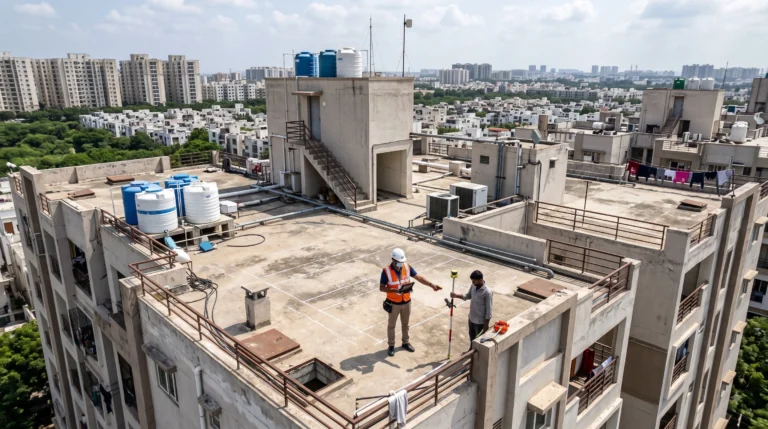
The usable roof area needs to account for:
Common-Area Net Metering
The simplest model for many societies can be a solar system connected to an eligible common-area electricity connection.
The basic flow is:
Solar generation → Common electrical loads → Grid
When solar generation is lower than consumption, the society continues drawing electricity from the grid.
When solar generation exceeds eligible consumption, surplus electricity may be exported according to the approved metering arrangement.
Telangana’s 2025 regulation provides net-metering arrangements for eligible consumers and establishes applicable capacity and connection requirements. (tgerc.telangana.gov.in)
For a society, this model can be easier to understand when the objective is specifically to reduce electricity purchased for common facilities.
Can Solar Benefits Be Shared With Individual Flats?
Potentially, but this is different from ordinary common-area solar.
Telangana’s 2025 rooftop solar regulation provides Group Net Metering and Virtual Net Metering arrangements for eligible consumers, subject to specified conditions and capacity limits. (tgerc.telangana.gov.in)
However, a society should not assume that electricity generated by a common rooftop plant can automatically be divided among individual apartment meters.
The arrangement depends on:
If the primary goal is simply to reduce the society’s common electricity bill, a dedicated common-area arrangement may be more straightforward than designing a system around individual flat consumption.
What About EV Charging in Apartment Societies?
EV charging is becoming an increasingly relevant common-area load.
PM Surya Ghar’s GHS/RWA provision explicitly includes common facilities including EV charging within its specified CFA framework. (solarrooftop.pmsuryaghar.gov.in)
However, EV charging introduces an additional design question:
When do residents charge their vehicles?
If charging occurs mainly during solar-generation hours, the society may be able to directly use more solar electricity.
If charging occurs mostly in the evening or overnight, the economics may be different unless suitable energy-storage or grid-supply arrangements are considered.
Therefore, EV charging should be included in the society’s future load planning rather than added to the solar system without analysis.
What Does Apartment Common-Area Solar Cost?
There is no single fixed price for a housing-society solar project.
The cost can depend on:
A larger apartment project may also require more detailed engineering than a small residential installation.
Compare quotations by complete scope
Ask each vendor to clearly specify:
System capacity + modules + inverters + mounting + electrical work + installation + monitoring + metering-related scope + taxes + subsidy/CFA assumptions
This prevents the society committee from comparing incomplete quotations.
How to Calculate the Society’s Solar ROI
A simple starting point is:
Annual electricity savings ÷ net project investment
But a proper commercial-style analysis should also consider:
Example
If:
Net solar investment = ₹20 lakh
and:
Expected annual electricity-cost reduction = ₹3 lakh
then the simple payback calculation would be approximately:
₹20 lakh ÷ ₹3 lakh = 6.67 years
This is an illustration, not a guaranteed payback period.
Actual ROI can differ considerably depending on the society’s electricity consumption and solar performance.
CAPEX vs Financing for Housing Societies
A society can consider different ways of funding the project.
Option 1: Society-funded CAPEX
Residents contribute through the society’s funds or a special capital contribution.
Potential advantage: The society owns the system and does not pay loan interest.
Consideration: Requires a larger upfront financial commitment.
Option 2: Solar loan/financing
The society finances the project and repays it over time.
Potential advantage: Reduces the immediate capital requirement.
Consideration: Interest and financing charges reduce the net financial benefit.
Option 3: Third-party/RESCO model
A third party may finance and operate the solar system under a contractual energy arrangement.
Potential advantage: Lower upfront investment.
Consideration: Contract duration, electricity pricing, maintenance responsibilities, ownership and end-of-term provisions require careful review.
The society should compare the total lifetime cost, not just the initial investment.
Does Solar Reduce Maintenance Costs Immediately?
Usually, the financial benefit should be viewed over time.
A newly installed solar plant requires an upfront investment. The society then receives savings from reduced grid electricity purchases.
So the financial sequence is generally:
Initial investment → Solar generation → Reduced electricity purchases → Cumulative savings → Payback → Long-term benefit
The system itself also requires some maintenance.
Therefore, the correct question is not:
“Will solar eliminate maintenance expenses?”
It is:
“Can the electricity savings from solar reduce the society’s recurring operating costs enough to justify the investment?”
That is a much more useful financial question.
What Maintenance Does Apartment Solar Need?
A common-area solar plant should have a defined maintenance plan.
It may include:
The society should also clarify:
A maintenance contract can make responsibilities clearer, especially for larger apartment systems.
Apartment Solar Installation Process
A practical process for a housing society can be:
Step 1: Collect electricity bills
Gather recent bills for all relevant common-area connections.
Step 2: Identify common loads
List lifts, pumps, lighting, clubhouse, security and other electrical facilities.
Step 3: Review the electrical connection
Check sanctioned load, consumer category and service-connection details.
Step 4: Survey the roof
Assess usable area, shading, structures and access.
Step 5: Determine the solar capacity
Match generation potential to actual electricity consumption and applicable regulatory limits.
Step 6: Determine the metering arrangement
Evaluate common-area net metering or, where relevant, group/virtual net-metering options.
Step 7: Check CFA eligibility
Confirm whether the GHS/RWA qualifies under the applicable PM Surya Ghar provision.
Step 8: Compare EPC proposals
Review technical specifications, warranties, cost and O&M scope.
Step 9: Complete approvals
Follow the applicable DISCOM and scheme procedures.
Step 10: Install and commission
Complete installation, testing, metering and commissioning.
Step 11: Monitor savings
Track generation and electricity bills after commissioning.
TGSPDCL currently provides an online solar net-meter registration facility and specifically asks applicants whether they intend to avail PM Surya Ghar subsidy/CFA. (webportal.tgsouthernpower.org)
Documents a Housing Society Should Prepare
The exact requirements depend on the project and metering arrangement, but commonly relevant information includes:
The association should maintain a central project file containing all quotations, approvals, invoices, equipment details, warranties and commissioning records.
Common Mistakes Housing Societies Should Avoid
Choosing solar capacity based only on the number of flats
Two societies with 100 apartments can have very different common-area electricity consumption.
Assuming the entire roof can be covered with panels
Water tanks, lift rooms, shading and access pathways reduce usable area.
Assuming all solar savings will automatically reduce maintenance charges
The association decides how savings are allocated within its operating budget.
Assuming residential subsidy rules apply automatically
GHS/RWA common-facility CFA has specific conditions.
Ignoring the existing electricity connection
Sanctioned load, consumer category and metering configuration matter.
Comparing only the cheapest quotation
A solar system is a long-term asset. Equipment quality, installation, warranty and O&M should be considered.
Not planning for future EV charging
Future electrical demand can influence the right solar capacity and infrastructure.
Is Solar Worth Installing for an Apartment Society?
The project can be financially meaningful when the society has:
The society should calculate the project using actual electricity bills, not generic savings claims.
A useful feasibility report should show:
Current annual electricity cost
Expected solar generation
Expected electricity-cost reduction
Project cost
Applicable CFA
Annual maintenance
Estimated payback
Long-term savings
This gives residents a much clearer basis for approving the project.
Can solar reduce apartment maintenance costs?
Yes, solar can reduce the electricity expense associated with eligible common facilities. However, it does not eliminate other maintenance expenses such as security, housekeeping, repairs or lift AMC.
What is solar for apartment common areas?
It is a rooftop solar system designed to generate electricity for shared facilities such as lifts, pumps, lighting, security and other eligible common loads.
Can a housing society get PM Surya Ghar subsidy?
Eligible GHS/RWAs can receive CFA for common facilities, including EV charging, subject to the scheme’s conditions and capacity limits. (solarrooftop.pmsuryaghar.gov.in)
Can solar power be used for apartment lifts?
Yes. Where the solar system is appropriately connected to the eligible common electrical system, solar generation can help offset electricity used by lifts.
Can solar run apartment water pumps?
Yes. Water pumps can form part of the common electrical load supplied by an appropriately designed rooftop solar system.
Can residents directly receive the common-area solar savings?
Not automatically. The society may use the savings to reduce common operating expenses, build reserves or otherwise manage its budget. Any allocation to individual electricity connections requires an applicable metering arrangement and regulatory eligibility.
Can apartment societies use virtual net metering?
Telangana’s 2025 rooftop solar regulation provides a Virtual Net Metering framework for eligible consumers subject to its conditions and capacity limits. The society should verify whether its particular connections qualify before designing the project around it. (tgerc.telangana.gov.in)
How much roof space does apartment solar need?
TGSPDCL gives an indicative requirement of about 10 square metres per kW for grid-connected rooftop solar, but the actual requirement depends on panel dimensions, shading, rooftop structures and maintenance access. (tgspdclwebportal.tgsouthernpower.org)
Does an apartment society need an AMC after installing solar?
The system needs appropriate maintenance, but a paid AMC is not automatically mandatory in every situation. The society should compare the installer warranty and service support with the proposed AMC scope.
How should a society calculate solar ROI?
Use actual common-area electricity consumption, expected solar generation, project cost, applicable CFA, maintenance costs and the applicable electricity billing arrangement. Avoid relying on generic savings percentages.
Can solar support EV charging in an apartment society?
Yes. EV charging can form part of the common facilities considered under the PM Surya Ghar GHS/RWA provision, subject to the scheme’s conditions. (solarrooftop.pmsuryaghar.gov.in)
At Roof Rays Solar, we are committed to delivering reliable rooftop solar solutions that combine quality products, professional installation, and long-term customer support. Whether you’re a homeowner, business owner, or industrial customer, our team works closely with you to design a solar system that matches your energy goals and budget.
Why Customers Trust Roof Rays Solar
Our experts design customized solar solutions based on your electricity consumption, roof space, and future energy goals—helping you maximize savings and achieve the best possible return on investment.
Phone
Address
📍 HUDA Complex, Tellapur, Hyderabad
Contact our solar experts today for a free consultation and personalized solar savings estimate.
Solar for apartment common areas can help housing societies reduce one important component of their recurring operating expenses: common-area electricity costs.
Lifts, water pumps, lighting, security systems, clubhouse facilities and EV charging can create substantial recurring electricity demand. A properly designed rooftop solar system can offset part of that consumption and potentially improve the society’s long-term operating economics.
For eligible GHS/RWAs, PM Surya Ghar also provides a specific CFA framework for common facilities, including EV charging, subject to scheme conditions. (solarrooftop.pmsuryaghar.gov.in)
But the project should not begin with a promised savings figure.
Start with the society’s actual electricity bills, common-area load, sanctioned load, usable roof area and applicable metering arrangement. Then compare the complete project cost with realistic annual electricity savings.
If the numbers work, solar can become more than a rooftop upgrade—it can be a long-term strategy for managing the society’s common electricity expenditure.
Book Your Free Site Survey Today
© 2025 Roof Rays Solar Solutions. All Rights Reserved. | Designed by MANI
Check whether your property qualifies for rooftop solar subsidy support.