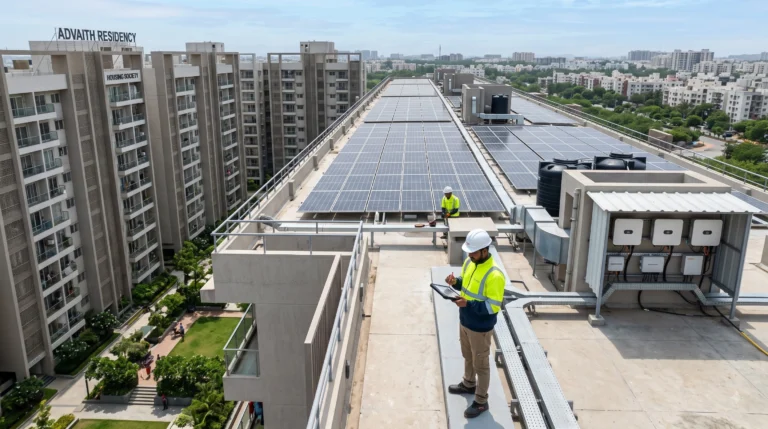
Installing solar on an independent house is relatively straightforward because one property generally has one electricity connection and one decision-maker. Solar for apartments in Hyderabad is different.
An apartment building may have dozens or hundreds of individual flats, separate electricity connections, lifts, water pumps, corridor lighting, security systems, clubhouse facilities, parking areas and other common-area loads.
This creates an important opportunity: instead of trying to install a separate solar plant for every apartment, the housing society can use rooftop solar to offset eligible common-area electricity consumption.
Telangana’s current rooftop-solar framework also provides specific arrangements for group and virtual net metering, making collective solar projects relevant for residential colonies and other eligible consumers.
The key is understanding which electricity connection the solar plant will serve, how the generated energy will be accounted for, whether subsidy applies, and how the society should structure the project.
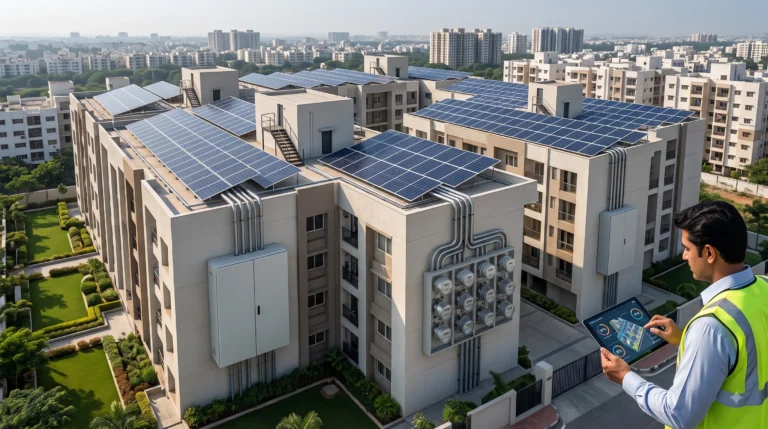
Yes. Apartment complexes and housing societies in Hyderabad can install rooftop solar for eligible electricity loads.
The most straightforward model is usually common-area solar, where the society installs solar on available rooftop space and uses the generated electricity to offset common facilities such as:
For qualifying residential Group Housing Societies (GHS) and Residential Welfare Associations (RWA), the PM Surya Ghar scheme also provides CFA for rooftop solar serving common facilities, including EV charging, subject to the scheme’s conditions and capacity limits.
Apartment common-area solar is a rooftop PV system installed on the building or society’s available roof space to generate electricity for shared facilities.
Instead of allocating solar generation to individual flats, the society can use the system to reduce the electricity purchased for common services.
Example
Imagine an apartment community has a separate common-area electricity connection.
The society pays for electricity used by:
A suitably designed rooftop solar system can generate electricity that is used to reduce the grid electricity requirement associated with that eligible common-area connection.
This can make solar particularly attractive for societies with substantial daytime common-area consumption.
Why Is Solar Attractive for Housing Societies?
Apartment societies often have electricity loads that operate regularly throughout the year.
Common examples include:
Water pumping
Water pumps can represent a significant recurring electrical load, depending on the size of the community and operating schedule.
Lifts
Lifts create recurring common-area electricity consumption throughout the day.
Lighting
Security, parking, staircase and outdoor lighting add to the society’s electricity requirement.
Clubhouse facilities
Where applicable, community facilities can add additional daytime electricity consumption.
The exact savings potential depends on the society’s actual electricity bills, load profile, available roof area and solar generation.
That means a common-area solar feasibility study should begin with electricity bills and roof assessment—not with a predetermined solar capacity.
What Is the Best Solar Model for an Apartment Society?
There are several possible structures, and they should not be treated as interchangeable.
This is generally the simplest concept to understand.
The society has an eligible electricity connection for common facilities, and the rooftop solar system is connected against that arrangement.
Solar generation can offset electricity consumption associated with the eligible connection under the applicable metering and billing rules.
For Hyderabad consumers, the applicable DISCOM and connection details need to be verified before finalising the system.
Telangana’s 2025 rooftop solar regulation specifically permits LT-I Domestic and HT-VI Townships and Residential Colonies to install rooftop solar under Group Net Metering for systems below 100kWp.
Group net metering is relevant where one solar installation is intended to serve multiple eligible electricity connections under the regulatory framework.
This can be useful in situations where the society wants a more structured collective arrangement rather than limiting solar benefits to one common-area connection.
Telangana’s 2025 regulation also provides for Virtual Net Metering for eligible consumers for systems below 100kWp, with a minimum system size of 10kWp for virtual net-metering arrangements.
The concept allows electricity generated by a shared rooftop solar plant to be accounted for across participating eligible connections according to the applicable arrangement.
However, virtual net metering is more complex than simply installing panels and dividing the savings among flats.
The participating connections, eligibility, allocation mechanism, metering configuration and DISCOM approval all need to be addressed.
Group Net Metering vs Virtual Net Metering
Feature | Common-Area Solar | Group Net Metering | Virtual Net Metering |
Primary purpose | Offset society/common load | Share generation among eligible connections | Virtually allocate generation among participating connections |
Complexity | Lower | Higher | Higher |
Suitable for common facilities | Yes | Potentially | Potentially |
Minimum solar size under 2025 Telangana regulation | 1kWp for net metering | 10kWp | 10kWp |
Telangana regulatory capacity | Net metering up to 500kWp | Below 100kWp | Below 100kWp |
Individual connection allocation | Usually not required | Required as applicable | Required as applicable |
These limits come from Telangana’s 2025 rooftop solar regulation and should be checked against the latest DISCOM procedure before application.
Does an Apartment Society Get Solar Subsidy?
Potentially, yes—but the subsidy rules need to be understood correctly.
Under PM Surya Ghar, the government scheme specifically includes Group Housing Societies/Residential Welfare Associations for common facilities, including EV charging, up to 500kW at 3kW per house, with the upper limit inclusive of individual rooftop plants installed by residents within the GHS/RWA.
This does not mean that every apartment solar project automatically receives the maximum subsidy.
Eligibility depends on:
Therefore, the society should verify its specific CFA eligibility before using subsidy as part of the project budget.
How Much Does Apartment Rooftop Solar Cost in Hyderabad?
There is no single fixed price for apartment rooftop solar.
The final cost depends on the project’s size and technical requirements.
Major cost factors include:
A 20kW system and a 100kW system should not be compared simply by multiplying a residential-house quotation because apartment projects can require different electrical and structural arrangements.
A better way to compare quotations
Ask every vendor to clearly separate:
Solar equipment + electrical work + mounting + installation + approvals/metering-related scope + taxes + applicable subsidy
This makes competing quotations much easier for the society committee to evaluate.
How to Estimate the Right Solar Capacity
Do not select the system size based only on available roof area.
Start with:
Common-area electricity consumption + daytime load + roof availability + sanctioned load + applicable metering arrangement
For example, a society may have enough roof space for a large solar plant but insufficient eligible daytime consumption to make the larger system economically useful under its chosen arrangement.
Conversely, a society with high common-area electricity consumption may benefit from using more of its usable roof for solar.
The electricity bills for the relevant common-area connection should therefore be reviewed before designing the plant.
How Much Roof Space Is Needed?
Roof space depends on the panel technology, layout, setbacks, maintenance pathways, shading and structural arrangement.
TGSPDCL’s published solar FAQ gives an indicative requirement of approximately 10 square metres per kW for a grid-connected rooftop system. Actual apartment layouts can require more or less usable area because of water tanks, lift rooms, parapets, access pathways and other rooftop obstacles.
For large apartment rooftops, a proper site survey is particularly important.
The design should account for:
What About Solar for Individual Flats?
Individual apartment owners can also explore rooftop solar where they have an eligible electricity connection and access to a suitable installation arrangement.
However, the biggest limitation in many apartment buildings is exclusive roof access.
A flat owner may own an apartment but not have exclusive rights over enough rooftop area to install a private solar plant.
The society’s governing documents, ownership structure, rooftop rights and association decisions should therefore be reviewed before treating the common roof as an individual installation area.
For eligible residential consumers, PM Surya Ghar CFA is generally associated with residential rooftop solar applications rather than simply being a blanket subsidy for every apartment owner.
How Does Net Metering Work for an Apartment Society?
The basic concept is:
Solar generation → Common/eligible electrical connection → Building consumption → Grid import/export accounting
When solar generation is available, it can supply eligible loads.
If generation exceeds instantaneous consumption, surplus electricity can flow to the grid according to the approved metering arrangement.
When the building needs more electricity than the solar system is producing, electricity can be imported from the grid.
The actual bill treatment depends on the approved metering arrangement and applicable Telangana regulations.
For net metering, Telangana’s 2025 regulation permits eligible consumers up to 500kWp, subject to the regulation’s conditions.
Apartment Solar Installation Process in Hyderabad
A practical society-level process is:
Step 1: Review common-area electricity bills
Collect recent bills for all relevant common facilities.
Step 2: Identify the electricity connections
List the service numbers, consumer categories, sanctioned loads and common-area connections.
Step 3: Conduct a rooftop survey
Measure usable area and identify shading, structures and access constraints.
Step 4: Estimate the solar capacity
Match the proposed system to electricity consumption, roof availability and applicable regulatory limits.
Step 5: Select the metering arrangement
Determine whether common-area net metering, group net metering or virtual net metering is appropriate and available for the society’s situation.
Step 6: Evaluate subsidy eligibility
Check whether the society qualifies under the PM Surya Ghar provisions for GHS/RWA common facilities.
Step 7: Compare technical proposals
The society committee should compare complete quotations rather than only the per-kW headline price.
Step 8: Complete DISCOM application
The applicable DISCOM process, documentation, metering and approvals must be completed before commissioning.
TGNPDCL’s rooftop-solar portal, for example, currently provides separate application resources for net metering, group net metering and virtual net metering.
TGSPDCL also provides an online solar net-meter registration facility and asks applicants whether they want to avail PM Surya Ghar subsidy/CFA.
Step 9: Install and commission
The system should be installed according to the approved technical design and applicable safety requirements.
Step 10: Track generation and savings
After commissioning, the society should monitor solar generation, common-area consumption and electricity bills.
Documents an Apartment Society May Need
The exact documentation depends on the chosen arrangement and DISCOM, but the society should be prepared to provide information such as:
TGNPDCL currently publishes separate application forms for net, gross, group net and virtual net metering, demonstrating that the documentation can differ according to the chosen arrangement.
What Should the Apartment Association Check Before Buying Solar?
Confirm that the society can legally use the proposed rooftop area.
A qualified professional should assess the roof where the project size or building conditions warrant it.
Check actual electricity consumption rather than estimating it from the number of flats.
Review the relevant electricity connection and sanctioned load before finalising plant capacity.
Do not assume ordinary net metering will automatically distribute solar credits to individual flats.
Confirm the society’s eligibility before deducting subsidy from the project cost.
Consider EV charging, additional lifts, clubhouse expansion or other planned common facilities.
Common Mistakes in Housing Society Solar Projects
Choosing solar capacity based only on roof size
A large roof does not automatically justify a large solar plant.
Assuming subsidy applies to every apartment
GHS/RWA common-facility CFA has specific conditions.
Treating virtual net metering like ordinary net metering
The accounting and participating connections require a specific approved arrangement.
Comparing quotations only by ₹/kW
A cheaper quotation may exclude important electrical, structural or installation components.
Ignoring the society’s sanctioned load
The proposed plant must be evaluated against the applicable regulatory and connection requirements.
Not deciding who owns and maintains the system
The association should establish responsibility for:
Is Solar Worth It for a Hyderabad Apartment Society?
It can be particularly attractive when a society has:
The financial case should be based on the society’s actual electricity bills and the final solar quotation.
The most useful calculation is:
Annual electricity cost that solar can offset − annual solar operating/maintenance costs
Then compare the resulting savings against the net project investment after applicable CFA.
This gives the society a more realistic view of payback and long-term savings.
Can apartments install solar in Hyderabad?
Yes. Apartment societies can install rooftop solar for eligible common facilities, and Telangana also provides group and virtual net-metering frameworks subject to eligibility and applicable conditions.
What is society common-area solar?
It is a rooftop solar system installed by a housing society to generate electricity for eligible shared facilities such as lifts, pumps, lighting and other common loads.
Can an apartment society get PM Surya Ghar subsidy?
Eligible Group Housing Societies and RWAs can receive CFA for common facilities, including EV charging, subject to the PM Surya Ghar scheme’s conditions and capacity limits.
What is the maximum subsidy for apartment common-area solar?
The GHS/RWA common-facility provision is structured differently from the individual residential subsidy. It allows CFA for common facilities up to 500kW at 3kW per house, with the scheme’s specified upper-limit conditions. The exact eligible amount should be calculated for the particular society rather than assuming the individual-house maximum applies directly.
Can solar electricity be shared among apartment owners?
Potentially, depending on the approved group or virtual net-metering arrangement and participating connections. Telangana’s 2025 regulation provides both Group Net Metering and Virtual Net Metering frameworks.
What is virtual net metering in Telangana?
It is a regulatory arrangement under which electricity generated by an eligible rooftop solar system can be accounted for across participating eligible connections according to the approved allocation mechanism. Telangana’s 2025 regulation permits virtual net metering for systems below 100kWp, with a minimum solar-system size of 10kWp.
Is common-area net metering simpler than virtual net metering?
Generally, a solar system serving one eligible common-area connection can be simpler to administer than a system requiring allocation across multiple participating connections. The appropriate structure depends on the society’s electrical connections and objectives.
How much does apartment rooftop solar cost in Hyderabad?
There is no single fixed cost. Capacity, panels, inverter, mounting, electrical infrastructure, roof conditions, installation complexity, metering requirements and applicable subsidy all affect the final quotation.
Can individual flat owners install solar on the apartment roof?
That depends on rooftop rights, society rules, available space, electrical connection arrangements and applicable regulations. Individual ownership of a flat does not automatically mean exclusive use of the common rooftop.
How much roof space is needed for apartment solar?
TGSPDCL gives an indicative requirement of about 10 square metres per kW, but the actual usable area depends on rooftop structures, shading, access and panel layout.
At Roof Rays Solar, we are committed to delivering reliable rooftop solar solutions that combine quality products, professional installation, and long-term customer support. Whether you’re a homeowner, business owner, or industrial customer, our team works closely with you to design a solar system that matches your energy goals and budget.
Why Customers Trust Roof Rays Solar
Our experts design customized solar solutions based on your electricity consumption, roof space, and future energy goals—helping you maximize savings and achieve the best possible return on investment.
Phone
Address
📍 HUDA Complex, Tellapur, Hyderabad
Contact our solar experts today for a free consultation and personalized solar savings estimate.
Solar for apartments in Hyderabad can be a practical way for housing societies to reduce recurring electricity costs for common facilities.
For many communities, the simplest starting point is a rooftop solar system connected to an eligible common-area electricity connection. Where the society wants to distribute solar benefits across multiple eligible connections, Group Net Metering or Virtual Net Metering may provide additional options under Telangana’s 2025 regulatory framework.
PM Surya Ghar also specifically recognises Group Housing Societies and RWAs for common-facility solar, including EV charging, subject to scheme conditions.
The best approach is to begin with the society’s actual electricity bills, rooftop assessment and electrical connections. From there, the association can determine the appropriate solar capacity, metering model, subsidy eligibility and project cost before making a long-term investment.
Book Your Free Site Survey Today
© 2025 Roof Rays Solar Solutions. All Rights Reserved. | Designed by MANI
Check whether your property qualifies for rooftop solar subsidy support.