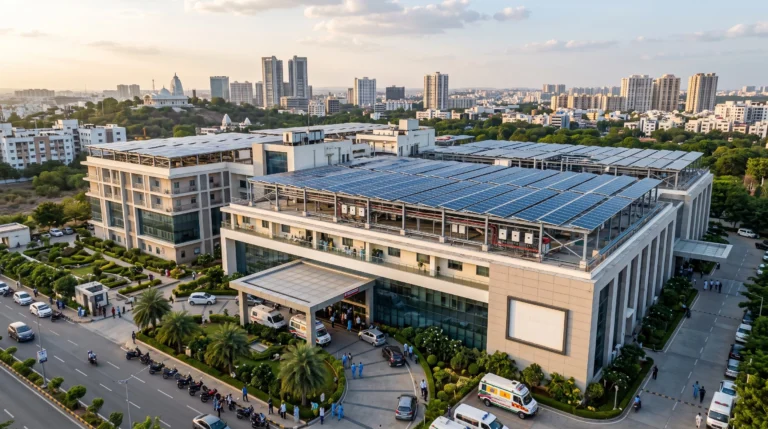
Hospitals and clinics have very different electricity requirements from ordinary commercial buildings.
Electricity is needed for air conditioning, lighting, medical equipment, refrigeration, laboratories, water pumps, elevators, ventilation, IT systems and other essential services. Larger hospitals may operate continuously, making electricity a significant operating expense.
This makes solar for hospitals worth evaluating, particularly where the property has suitable rooftop space and substantial electricity consumption.
However, hospital solar planning requires more than calculating how many panels can fit on a roof.
A healthcare facility must consider:
The most important principle is:
Solar should reduce electricity costs without compromising the reliability, safety or operation of critical healthcare services.
Yes. Hospitals and clinics can be suitable for rooftop solar, but the system must be designed around the facility’s electrical infrastructure and critical-load requirements.
Healthcare facilities can have substantial daytime electricity consumption from:
Solar generation can offset part of the electricity purchased from the grid during daylight hours.
However, hospitals also operate outside solar-generation hours, and some medical equipment requires uninterrupted power.
Therefore, rooftop solar and backup power should be treated as related but separate design considerations.
A grid-connected solar system is primarily intended to reduce grid electricity consumption. It should not be assumed to provide backup power during a grid outage unless the system has been specifically designed with suitable backup/hybrid equipment.
Key Takeaways
Telangana’s applicable rooftop-solar and metering rules should be confirmed before project approval.
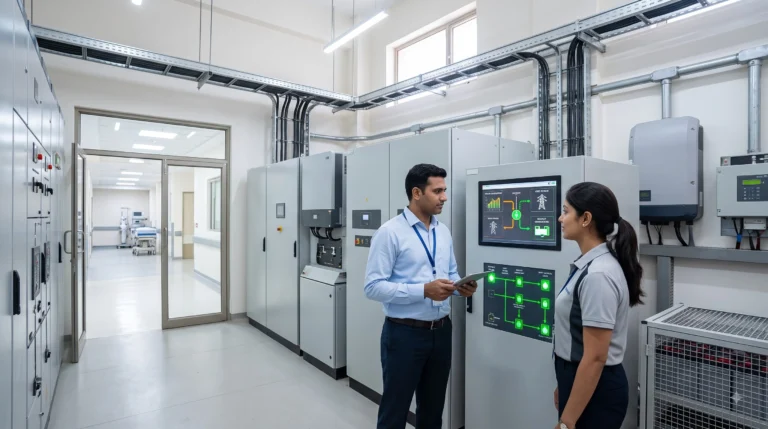
Hospitals operate very differently from ordinary offices.
A hospital may need electricity for:
HVAC Systems
Air conditioning can represent a major electricity load, particularly in large healthcare facilities.
Lighting
Hospitals require lighting across:
Medical Equipment
Depending on the facility, equipment may include:
Refrigeration
Medical facilities may require refrigeration for medicines, samples and other temperature-sensitive materials.
Pumps
Water supply and other building services can require continuous or scheduled pumping.
IT Infrastructure
Hospitals rely on computers, networking equipment, servers and digital patient-management systems.
This creates a substantial overall electricity requirement in many facilities.
Why Daytime Solar Can Help Hospitals
Solar panels generate electricity during daylight hours.
Hospitals can simultaneously consume electricity through:
This creates an opportunity for solar electricity to offset part of the facility’s daytime grid consumption.
The exact savings depend on:
Solar for Clinics
Smaller clinics generally have simpler electricity requirements than hospitals.
A clinic may use electricity for:
A clinic with a suitable rooftop may therefore consider a smaller rooftop solar system designed around its actual electricity consumption.
However, clinics should still distinguish between energy savings and backup power.
If uninterrupted operation of specific equipment is required, appropriate backup systems should be evaluated separately.
Solar for Large Hospitals
Large hospitals can have significantly more complex electrical infrastructure.
A hospital may have:
This means the solar project may need to be planned at a campus or facility level rather than simply as a single rooftop installation.
The assessment should consider:
Critical Loads: The Most Important Difference
A hospital cannot treat every electrical load in the same way.
Some equipment may be classified as critical, depending on the facility’s electrical design and healthcare requirements.
Examples can include:
Other loads may be less critical.
Solar planning should therefore work alongside the hospital’s existing electrical architecture.
Important
Do not connect critical medical equipment to a rooftop solar system or battery simply because the solar system has sufficient capacity.
The electrical design must be developed by appropriately qualified professionals and coordinated with the facility’s existing power and backup infrastructure.
Solar Does Not Automatically Mean Backup Power
This is one of the most important points for hospitals.
A conventional grid-connected rooftop solar system can reduce electricity purchased from the grid.
But if the grid goes down, a standard grid-tied inverter generally does not continue supplying the building because of anti-islanding and grid-safety requirements.
Therefore:
Grid-connected solar ≠ automatic emergency backup.
If a hospital needs solar-backed power during grid outages, it may require a specifically engineered solution involving suitable:
The hospital’s electrical engineer should determine the appropriate architecture.
Battery Storage for Hospitals
Battery storage can be considered when the facility has:
However, batteries add:
Therefore, battery storage should not be added simply because the project is a hospital.
Its purpose should be clearly defined.
How Much Solar Does a Hospital Need?
There is no standard solar capacity for every hospital.
The system should be sized using:
For example, a small clinic may require a relatively modest system, while a large multi-building hospital may have significantly greater potential.
Better Approach
Don’t start with:
“How many panels can fit on the hospital roof?”
Start with:
“How much electricity does the facility use, when does it use it, and how much suitable rooftop solar can be installed?”
Hospital Roof Assessment
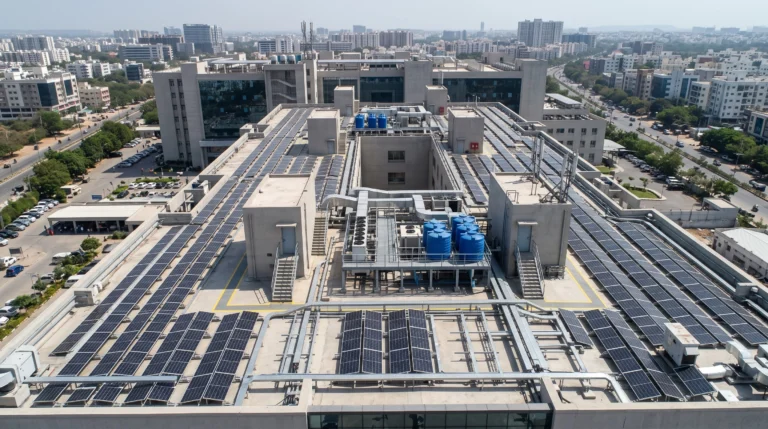
Hospital rooftops may contain:
These structures can affect:
The total physical roof area should therefore not be treated as the total usable solar area.
Solar Panels Around Water Tanks & HVAC
Water tanks and HVAC equipment are common obstacles on healthcare rooftops.
Panels can often be arranged around them, but the layout must preserve:
For HVAC equipment in particular, solar panels should not obstruct required airflow or service access.
A proper rooftop survey should map all existing equipment before finalizing the panel layout.
Solar Panel Shadow Analysis
Shading can reduce solar generation.
Potential sources include:
The shadow pattern changes with:
A proper shadow analysis helps identify the most suitable areas for panel installation.
Structural Safety for Hospital Rooftops
Structural assessment is particularly important for large healthcare buildings.
The evaluation should consider:
An RCC roof should not be assumed to have unlimited additional capacity.
Where structural suitability is uncertain, an appropriately qualified structural professional should assess the proposed installation.
Waterproofing & Drainage
Hospital buildings require strong protection against water ingress.
Solar installation should therefore account for:
Solar structures should not obstruct roof drainage.
Where mounting penetrations are necessary, they should be properly designed and sealed rather than treated as a minor installation detail.
Solar Installation Process for Hospitals
Review historical electricity consumption.
Understand daytime, evening and continuous loads.
Coordinate solar planning with the facility’s electrical and backup-power architecture.
Map usable roof areas and existing equipment.
Evaluate the proposed additional loads where appropriate.
Identify significant shading.
Determine suitable capacity.
Plan inverter locations, cable routes, protection and grid connection.
Compare CAPEX and OPEX/RESCO options where appropriate.
Complete applicable utility and regulatory procedures.
Install the system while coordinating with hospital operations.
Verify performance and electrical safety.
Track solar generation and system performance.
CAPEX vs OPEX Solar for Hospitals
Hospitals can evaluate both financing models.
CAPEX
The hospital or property owner purchases and owns the solar system.
Advantages
Considerations
OPEX
A third-party solar provider generally finances and owns the system while the hospital purchases solar electricity under an agreed contract.
Advantages
Considerations
The better model depends on the hospital’s capital position, property ownership, electricity consumption and long-term plans.
Solar ROI for Hospitals & Clinics
A proper solar ROI assessment should use actual facility data.
Important inputs include:
A simple preliminary CAPEX payback formula is:
Simple Payback = Solar Investment ÷ Annual Electricity Savings
However, this is not a complete investment model.
Hospitals should also consider:
Government & Telangana Regulatory Considerations
For grid-connected rooftop solar in Telangana, the current state framework is the Rooftop Solar PV Grid Interactive Systems Regulations, 2025 issued by TGERC. The regulations specify different arrangements and capacity provisions for eligible consumer categories.
Importantly, the 2025 regulations state that for industrial, commercial and other consumers, rooftop-solar capacity under net or gross metering can be up to 80% of sanctioned load/contracted demand, subject to the applicable provisions.
Hospitals and clinics should therefore confirm their specific consumer category, sanctioned load/contract demand and applicable metering arrangement before finalizing system capacity.
Also, MNRE’s current grid-connected rooftop solar programme describes Central Financial Assistance for residential electricity consumers. Commercial or institutional healthcare facilities should not automatically include residential subsidy benefits in their project calculations.
Solar Installation Cost for Hospitals
Commercial healthcare solar costs vary according to the project.
Factors include:
Large hospitals may have more complex electrical infrastructure than smaller clinics, potentially affecting installation design and cost.
A detailed site survey should therefore precede the final quotation.
Expert Tips for Hospitals & Clinics
Use actual consumption data rather than estimating from building size.
Solar reduces energy purchases; backup requires a specifically engineered power system.
Coordinate solar and storage planning with the hospital’s electrical engineer.
Map HVAC units, tanks, pipes and other equipment.
Especially important for older or heavily loaded buildings.
Do not compromise the roof while installing the mounting system.
Medical and building equipment must remain accessible.
Consider total financial impact rather than only initial cost.
Confirm the current requirements for the facility’s connection.
Generation data helps identify performance changes early.
At-a-Glance Hospital Solar Planning Guide
Factor | Clinic | Hospital |
Electricity demand | Moderate to high depending on facility | Often high |
HVAC | Important | Often substantial |
Medical equipment | Facility-dependent | Potentially extensive |
24/7 operation | Usually limited | Common |
Critical loads | Some | Often significant |
Battery requirement | Project-specific | Requires detailed assessment |
Roof obstacles | Tanks, stairs, HVAC | HVAC, tanks, equipment |
Multiple buildings | Less common | Common in larger facilities |
Best first step | Bill + roof survey | Energy + electrical + roof assessment |
Yes. Hospitals with suitable rooftops and substantial electricity consumption can potentially reduce grid electricity purchases through rooftop solar.
Solar electricity can offset electricity consumed by suitable loads during solar-generation hours. Critical equipment requires a properly engineered electrical arrangement.
A conventional grid-connected solar system generally does not provide backup power during a grid outage. Backup operation requires specifically designed equipment and controls.
Not necessarily. Batteries should be evaluated based on backup requirements, energy-shifting needs and financial feasibility.
Yes. System capacity can be sized according to the clinic’s electricity consumption, roof area and applicable electrical requirements.
Often yes, provided the design maintains equipment access, airflow requirements, safety clearances and minimizes shading.
Potentially. The roof and structural condition should be assessed before installation, especially if the building has visible deterioration or significant existing rooftop loads.
It depends on capital availability, electricity consumption, building ownership and long-term financial objectives.
A hospital should not assume residential subsidy eligibility. MNRE’s current rooftop-solar CFA programme is directed to eligible residential electricity consumers.
Roof Rays can assess electricity consumption, rooftop conditions, shading, system capacity, structural considerations and applicable installation requirements before developing a customized solar proposal.
Roof Rays Solar Solutions helps Hyderabad businesses and institutions evaluate rooftop solar based on actual electricity consumption and property conditions.
Roof Rays Can Help With:
For healthcare facilities, the objective is not simply to maximize solar capacity.
The system should be designed around the facility’s electricity consumption, critical-load requirements, roof conditions, safety and long-term operating needs.
Our experts design customized solar solutions based on your electricity consumption, roof space, and future energy goals—helping you maximize savings and achieve the best possible return on investment.
Phone
Address
📍 HUDA Complex, Tellapur, Hyderabad
Contact our solar experts today for a free consultation and personalized solar savings estimate.
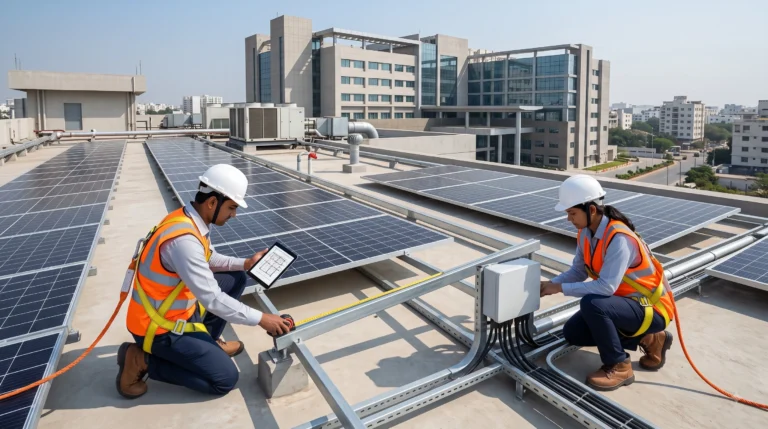
Solar for hospitals can be a practical way to reduce electricity costs when it is carefully integrated with the healthcare facility’s electrical infrastructure.
Hospitals and clinics can have substantial electricity requirements from HVAC, lighting, medical-support equipment, refrigeration, laboratories, IT systems, pumps and other services. During daylight hours, rooftop solar can offset part of the electricity that would otherwise be purchased from the grid.
However, healthcare facilities have an important additional consideration: reliability of critical electrical loads.
A standard grid-connected solar system should not be treated as emergency backup. If a hospital needs solar-backed operation during grid outages, the project may require a specifically engineered combination of batteries, hybrid equipment, backup generators, transfer systems and critical-load distribution.
The solar project should also account for:
For Telangana, the current TGERC rooftop-solar framework provides specific provisions for commercial and other consumer categories, including applicable capacity limits and metering arrangements.
Hospitals and clinics should therefore evaluate solar using actual electricity bills, load characteristics, rooftop conditions and the facility’s electrical architecture rather than relying on generic system sizes.
Book Your Free Site Survey Today
© 2025 Roof Rays Solar Solutions. All Rights Reserved. | Designed by MANI
Check whether your property qualifies for rooftop solar subsidy support.
