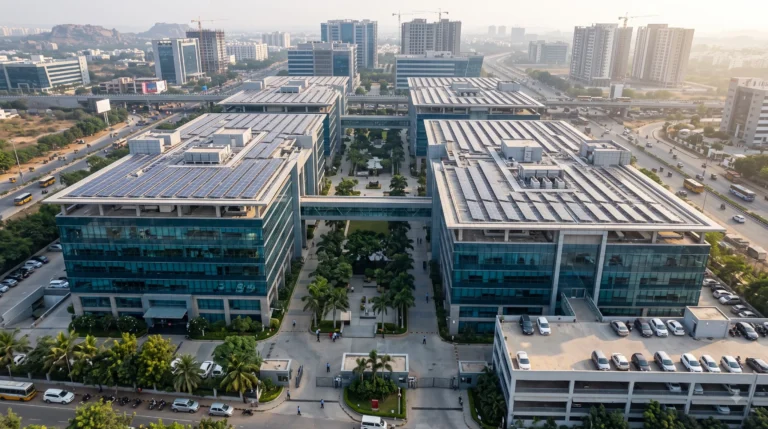
IT parks and technology offices rely on electricity to support workstations, air conditioning, lifts, lighting, networking equipment, meeting rooms and essential building infrastructure. For large campuses, these energy requirements can create a significant recurring operating expense.
Solar for IT parks in Hyderabad offers a practical way to use suitable rooftop space to generate electricity and reduce dependence on grid power during solar generation hours. With a well-planned commercial rooftop solar system, IT office owners, facility managers and commercial property developers can evaluate opportunities to improve energy-cost management while supporting their sustainability objectives.
However, technology buildings have different requirements from residential properties. Multiple tenants, large electrical loads, restricted roof access, existing power infrastructure and continuous IT operations must all be considered during planning.
This guide explains how rooftop solar can work for IT parks and tech offices, what influences project costs, how to estimate potential savings and which technical and regulatory considerations should be addressed before installation.
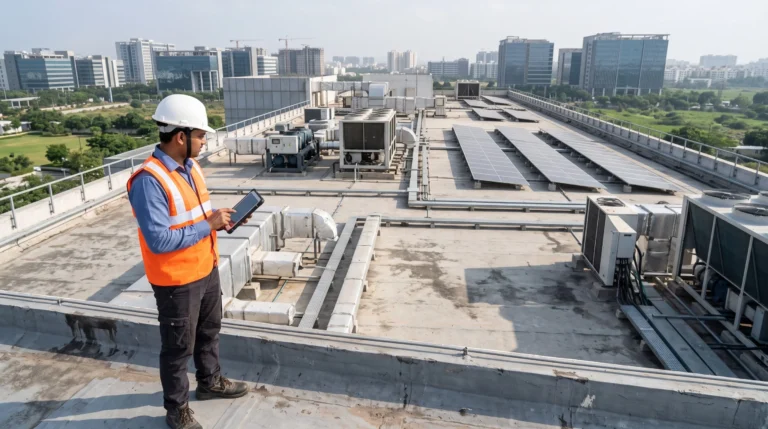
Commercial buildings often have substantial daytime electricity demand, which can create an opportunity to consume solar electricity directly.
Key advantages include:
The actual benefit depends on the building’s consumption, solar generation, electricity tariff, export arrangements and installed project cost. Solar should therefore be evaluated using the site’s electricity data rather than generic savings claims.
Which IT and Commercial Properties Can Benefit?
IT parks and technology campuses
Large IT parks may contain several office blocks, shared facilities, parking structures and common electrical infrastructure. Each building can have different roof conditions and electricity consumption patterns.
A campus-level assessment can identify suitable roofs, available electrical capacity and opportunities to phase the installation.
Corporate offices and software development centres
Software development offices often use electricity for air conditioning, computers, meeting rooms, lighting and networking equipment. Rooftop solar can offset part of this consumption when generation and demand overlap.
Tech office buildings with multiple tenants
Multi-tenant properties require clear arrangements for electricity metering, ownership, roof access and the allocation of solar benefits. The building owner and tenants should establish responsibilities before committing to the project.
Business parks and managed office spaces
Property operators may evaluate solar to support common-area electricity requirements, shared facilities or eligible tenant consumption under an approved arrangement.
Technology buildings with server rooms
Solar may reduce part of the building’s electricity demand, but critical IT loads require careful planning. A standard grid-connected rooftop solar system should not be treated as a replacement for UPS systems, backup generators or other critical-power infrastructure.
Important distinction: An IT office and a data centre are not the same type of facility. A data centre’s continuous, high-density electrical and cooling loads may require a broader energy strategy than rooftop solar alone can provide.
How Is a Commercial Solar System Designed for an IT Park?
A successful project starts with energy data and a site assessment.
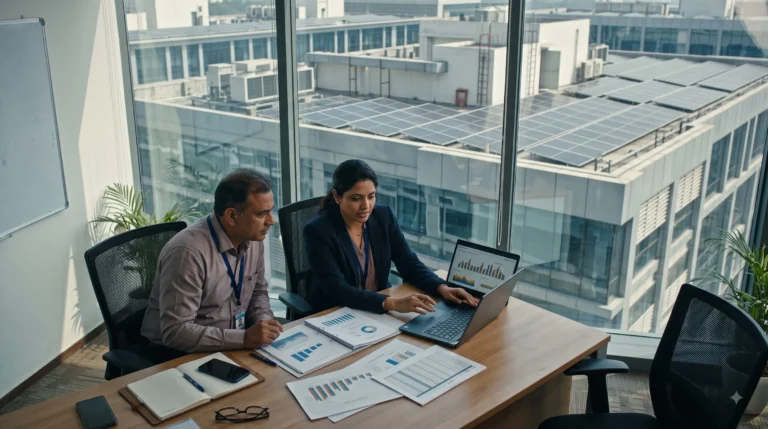
Review the previous 12 months of electricity bills, interval-meter data where available, sanctioned load or contracted demand, maximum demand, tariff category and operating schedule.
For a multi-building campus, collect data separately for each building and for common services where possible.
This helps identify how much electricity is consumed during solar generation hours and whether different buildings have different installation priorities.
Identify the main energy-consuming systems, including:
Solar generation can offset part of the building’s electricity demand, but the amount depends on actual load patterns and system output.
The site survey should evaluate:
Large office buildings should obtain structural engineering input wherever necessary. Roof capacity should be confirmed rather than assumed from the building’s appearance or age.
System sizing should consider annual consumption, daytime demand, roof area, sanctioned load or contracted demand, electrical infrastructure and permitted grid-connection capacity.
For large campuses, a phased installation may allow the property team to evaluate performance on one building before expanding to others.
The design should address inverter selection, AC and DC cabling, protection equipment, earthing, monitoring, grid connection and integration with the building’s electrical distribution system.
Critical equipment must retain its appropriate power-quality and backup arrangements. Any change to the building’s electrical infrastructure should be assessed by qualified professionals.
Commercial Rooftop Solar Cost for IT Parks in Hyderabad
The cost of solar for tech offices depends on project size, equipment specifications, mounting design, roof conditions, electrical work, metering requirements and installation scope.
As an initial budgeting reference, a published 2026 commercial rooftop solar guide gives an indicative range of approximately ₹38,000–₹55,000 per kW for many 10–100 kW commercial projects. Larger IT park projects may have different per-kW economics, and complex electrical or structural work can change the total cost. These are market estimates, not government-approved prices or a project quotation.
Indicative commercial solar budget
System capacity | Illustrative installed-cost range |
10 kW | ₹4.5–₹5.5 lakh |
25 kW | ₹9.5–₹13.75 lakh |
50 kW | ₹19–₹27.5 lakh |
100 kW | ₹38–₹55 lakh |
These are preliminary planning figures based on published commercial market guidance, not guaranteed Hyderabad prices. Actual quotations depend on equipment, scale, taxes, roof work, electrical modifications, metering and other project-specific requirements. Battery storage and major infrastructure upgrades may cost extra.
For a larger IT park, request a detailed engineering proposal rather than extrapolating a small-system rate directly to the entire campus.
What affects the final project cost?
Solar modules and inverters: Brand, specifications, efficiency, equipment capacity and warranty influence pricing.
Mounting structures: Roof type, wind-load requirements, material quality and corrosion protection affect design and installation costs.
Electrical infrastructure: Cable distances, protection systems, transformer or distribution-board modifications and inverter placement can change the scope.
Structural and waterproofing work: Roof reinforcement, repairs and access requirements can increase the project budget.
Grid connection and metering: Application requirements, approvals, inspections and any necessary electrical upgrades must be included.
Monitoring and maintenance: Monitoring systems, maintenance responsibilities and post-installation support should be clearly specified.
When comparing quotations, evaluate the total installed cost, equipment specifications, expected generation, exclusions and service arrangements—not just the price per kilowatt.
How Much Roof Space Is Required for IT Park Solar?
The required area depends on panel dimensions, layout, shading, roof obstructions, maintenance access and mounting configuration.
For preliminary planning, an allowance of approximately 80–110 square feet per kW can be used as an initial estimate. TGSPDCL’s published guidance gives an indicative requirement of about 10 square metres per kW. Actual space requirements must be confirmed through a site survey.
System capacity | Approximate initial roof-area allowance |
50 kW | 4,000–5,500 sq. ft. |
100 kW | 8,000–11,000 sq. ft. |
250 kW | 20,000–27,500 sq. ft. |
500 kW | 40,000–55,000 sq. ft. |
These are planning allowances, not a final layout. Large campuses may have substantial roof areas that are unsuitable because of shading, rooftop equipment, structural limitations or access requirements.
How Much Electricity Can IT Park Solar Generate?
Solar generation depends on system capacity, orientation, shading, weather, temperature, equipment performance and maintenance.
For illustration, a 100 kW rooftop solar system producing an assumed 1,300–1,500 units per kW annually would generate approximately 1,30,000–1,50,000 units per year.
This is a planning example, not a guaranteed generation estimate for Hyderabad. A site-specific assessment should account for the actual roof, shading, system losses and expected operating conditions.
For a campus with multiple buildings, the assessment should also determine where generated electricity can be used and whether the metering and electrical arrangements support the intended consumption pattern.
Remember: Solar generation is not the same as electricity bill savings. The financial value depends on the electricity consumed directly, the treatment of exported units and the applicable tariff.
How Much Can an IT Office Save With Solar?
Potential savings depend on how much solar electricity offsets grid purchases, the building’s electricity tariff, export-credit rules and the total installed cost.
A useful financial assessment should consider:
Illustrative savings calculation
Consider a hypothetical 100 kW system generating 1,40,000 units annually.
Assume, for illustration only:
The calculation would be:
This example is not a savings guarantee. It excludes fixed charges, demand charges, taxes, maintenance, financing and other costs. The assumed export value may not match the rules applicable to a particular connection.
For an IT park, a detailed financial model should use actual electricity bills, load profiles, approved metering arrangements and a site-specific generation estimate.
Commercial Solar Regulations in Telangana
Before installing solar for IT parks in Hyderabad, verify the requirements that apply to the property’s electricity connection and consumer category.
The Telangana Electricity Regulatory Commission’s Rooftop Solar PV Grid Interactive Systems Regulation, 2025, provides the current regulatory framework. Under the regulation, the maximum rooftop solar capacity for net-metering and gross-metering arrangements is generally capped at 80% of sanctioned load or contracted demand for industrial, commercial and other consumers, subject to the applicable provisions and approvals.
The relevant distribution company must confirm the permitted capacity, connection arrangement, technical requirements and approval process for the specific property.
For large IT parks, the project team should check:
Commercial subsidy note: Do not automatically apply residential PM Surya Ghar subsidy benefits to an IT park or commercial office connection. Any incentive for a commercial project must be verified under an applicable official programme.
Rooftop Solar Installation Process for IT Parks
A structured project process helps minimise disruption to normal office operations.
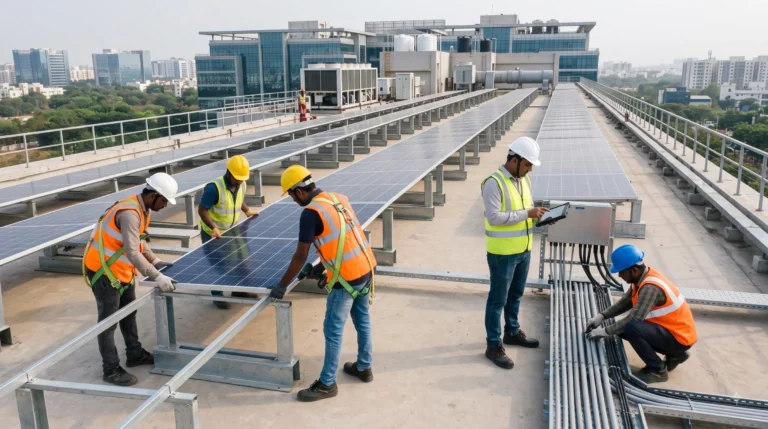
For occupied IT campuses, installation scheduling, worker access, safety controls and coordination with facility management should be planned before work begins.
How to Evaluate Solar ROI for an IT Park
A commercial solar investment should be evaluated using realistic assumptions rather than generic payback promises.
Consider:
A simple payback estimate divides the initial project cost by estimated annual net financial benefit. This can help with preliminary comparisons, but it does not account for every cost or the changing value of money over time.
For a large campus, compare conservative, expected and optimistic scenarios. If the project is planned in phases, evaluate each building separately before calculating the overall campus return.
Common Mistakes to Avoid
Failing to plan monitoring and long-term maintenance.
It may be suitable for IT parks with usable roof space, appropriate electrical infrastructure and sufficient electricity demand. A site survey and energy assessment are needed to determine feasibility and the appropriate capacity.
The cost depends on capacity, equipment, roof conditions, electrical work and project scale. Published commercial cost estimates can help establish a preliminary budget, but a detailed site-specific quotation is needed for a reliable price.
Solar electricity can supply part of the energy used by computers, lighting and air-conditioning systems when generation is available. The amount covered depends on system output and the building’s electricity demand.
Solar panels do not generate electricity at night. A grid-connected office generally draws power from the grid after solar generation stops. Batteries may provide stored energy for selected loads, depending on capacity and system design.
Do not assume that it does. PM Surya Ghar central assistance is intended for eligible residential connections. Commercial projects should verify any separately applicable official incentive.
The assessment should consider electricity bills, daytime demand, roof suitability, sanctioned load or contracted demand, electrical infrastructure and metering requirements.
The feasibility depends on the electrical arrangement, consumer connections, metering rules and approved capacity. Campus-level or multi-connection arrangements should be evaluated against the applicable regulations before design.
Not necessarily. Data centres often have continuous power requirements and specialised cooling and backup systems. Rooftop solar may contribute to energy supply, but a broader strategy may be required to address reliability and total electricity demand.
At Roof Rays Solar, we are committed to delivering reliable rooftop solar solutions that combine quality products, professional installation, and long-term customer support. Whether you’re a homeowner, business owner, or industrial customer, our team works closely with you to design a solar system that matches your energy goals and budget.
Why Customers Trust Roof Rays Solar
Our experts design customized solar solutions based on your electricity consumption, roof space, and future energy goals—helping you maximize savings and achieve the best possible return on investment.
Phone
Address
📍 HUDA Complex, Tellapur, Hyderabad
Contact our solar experts today for a free consultation and personalized solar savings estimate.
Rooftop solar can help IT parks and tech offices in Hyderabad reduce grid electricity purchases and make productive use of suitable roof space. However, the right system depends on energy consumption, daytime demand, roof suitability, electrical infrastructure, metering arrangements and total project cost.
Before investing, review the building’s electricity data, obtain a detailed site survey, compare complete quotations and evaluate savings using realistic assumptions. This helps property owners and facility managers determine whether commercial rooftop solar is a suitable long-term energy investment.
Book Your Free Site Survey Today
© 2025 Roof Rays Solar Solutions. All Rights Reserved. | Designed by MANI
Check whether your property qualifies for rooftop solar subsidy support.
