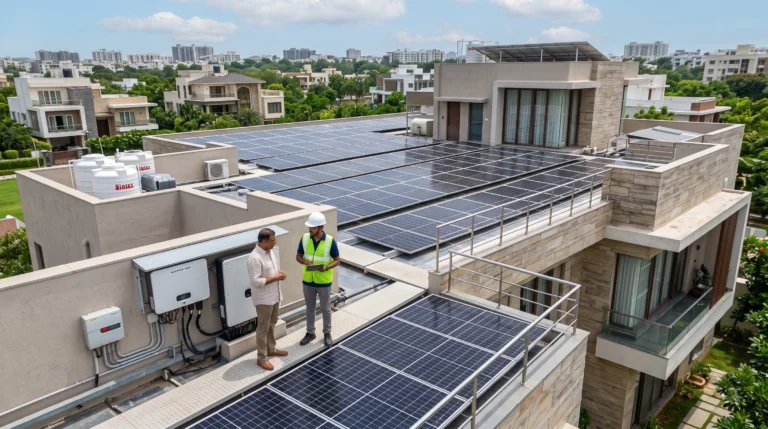
Large villas and independent homes in Hyderabad can have very different electricity requirements from a typical household.
Multiple air conditioners, large refrigerators and freezers, water pumps, geysers, home offices, EV charging, swimming pools and other high-consumption appliances can push monthly electricity usage significantly higher.
For these homes, a small rooftop solar system may not provide enough generation to meaningfully offset electricity consumption.
That is where solar for large homes in Hyderabad becomes a capacity-planning question.
Should you install 10kW, 15kW or 20kW? The answer should not be based on roof size alone. Electricity consumption, daytime load, sanctioned load, roof availability, shading, electrical infrastructure, expected generation and future requirements all need to be considered.
For residential consumers in Telangana, the current 2025 rooftop solar regulation permits rooftop solar capacity up to 100% of the consumer’s sanctioned load under net or gross metering.
There is no universal capacity for every large home.
As a starting point:
The final capacity should be determined from actual electricity bills and the home’s load profile, not simply the number of bedrooms or size of the house.
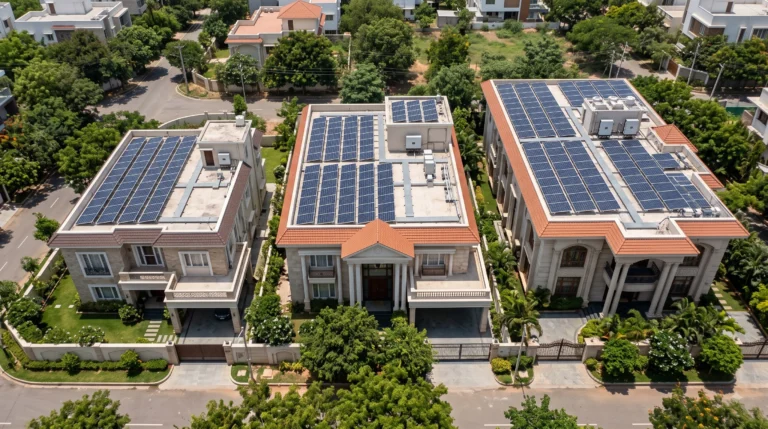
A large home can have substantially more electrical demand than a standard household.
Typical high-consumption loads may include:
The important question is not simply:
“How big is the house?”
It is:
“How much electricity does the house actually consume, and when is that electricity used?”
A large villa with relatively low electricity consumption may not need a 20kW system, while a smaller but highly electrified home could have a strong case for a larger system.
10kW vs 15kW vs 20kW Solar System
Factor | 10kW | 15kW | 20kW |
Typical positioning | Large home | High-consumption villa | Very high-consumption home |
Approx. roof area* | ~100 sq m | ~150 sq m | ~200 sq m |
Generation potential | Lower | Higher | Highest |
Investment | Lower than larger systems | Medium | Higher |
Suitable for | Significant household usage | Higher electricity consumption | Very high electricity demand |
Key consideration | Actual daytime load | Roof + electrical capacity | Consumption + roof + electrical capacity |
*Using TGSPDCL’s indicative figure of about 10 sq m per kW for grid-connected rooftop solar. Actual space requirements depend on module size, mounting configuration, setbacks, access and roof layout.
These are capacity-planning examples, not recommendations for every home.
10kW Solar for a Large Home
A 10kW solar system can be a practical starting point for a large home with substantial electricity consumption.
It may be worth evaluating when the property has:
A 10kW system also provides a useful balance between system size and installation footprint for homes that do not have extremely high annual consumption.
When 10kW may not be enough
If a home has very high electricity usage throughout the year, particularly from multiple ACs, EV charging, pumps and other loads, a 10kW system may leave a substantial portion of electricity demand supplied by the grid.
In that situation, a 15kW or 20kW assessment may be appropriate.
15kW Solar System for a Hyderabad Villa
A 15kW solar system can be considered for larger villas with higher electricity consumption.
This capacity becomes particularly relevant when a property has a combination of:
However, the property needs sufficient usable roof space and an electrical arrangement capable of supporting the proposed system.
A site survey should therefore be completed before assuming that 15kW is suitable.
20kW Solar System for a Hyderabad Home
A 20kW solar system represents a considerably larger residential rooftop installation.
It may be evaluated for homes with exceptionally high electricity consumption and sufficient usable roof space.
Before considering 20kW, the homeowner should check:
A 20kW system should not be selected simply because the roof can accommodate it.
The additional generation needs to provide meaningful value relative to the home’s electricity requirements.
How to Choose Between 10kW, 15kW and 20kW
The most reliable approach is to work through five questions.
Review at least several months of electricity bills, preferably a full year’s history.
Look for:
If electricity usage is increasing because of a new EV, additional ACs or home expansion, that should be considered.
Solar generates electricity during daylight hours.
Therefore, a home that operates multiple ACs, pumps, appliances and EV charging during the day may directly consume more of its solar generation.
For example, a villa with:
AC + pool pump + home office + EV charging during daytime
has a different solar-use profile from a home where most occupants are away during working hours.
Total roof area and usable solar area are not the same.
A large villa roof may contain:
TGSPDCL’s indicative requirement of approximately 10 sq m per kW means that, as a rough planning reference:
10kW → ~100 sq m
15kW → ~150 sq m
20kW → ~200 sq m
Actual layouts can differ considerably.
This is an important regulatory check.
Under Telangana’s 2025 rooftop solar regulation, residential consumers can generally install rooftop solar up to 100% of sanctioned load under net/gross metering.
For example, if a home’s sanctioned load is 15kW, the applicable regulatory ceiling would generally need to be considered before proposing a 20kW rooftop system.
That does not mean every home with a 15kW sanctioned load should install 15kW.
It simply establishes an important upper constraint that must be considered alongside consumption and site feasibility.
Large homes often add electrical loads over time.
Consider whether you are planning:
A solar system should be evaluated with realistic future consumption in mind.
How Much Electricity Can 10kW, 15kW and 20kW Generate?
Actual solar generation depends on site-specific conditions.
These include:
TGSPDCL provides an indicative reference of around 1,000–1,200 units per kW per year for south-facing systems, with lower generation expected for east- or west-facing systems. This is an indicative benchmark, not a guaranteed output for an individual property.
Using that broad reference only for illustration:
System Size | Indicative Annual Generation Range* |
10kW | ~10,000–12,000 units/year |
15kW | ~15,000–18,000 units/year |
20kW | ~20,000–24,000 units/year |
*Illustrative multiplication of the TGSPDCL’s broad 1,000–1,200 units/kW/year reference. Actual generation should be calculated from the property’s specific design and site conditions.
Does a 20kW Home Solar System Get More PM Surya Ghar Subsidy?
This is an important point for homeowners considering a larger system.
PM Surya Ghar’s residential Central Financial Assistance is structured around the first 3kW of eligible residential capacity, with the scheme information indicating a maximum subsidy of ₹78,000 for residential systems.
Therefore, installing 10kW, 15kW or 20kW does not mean that the entire system receives a proportionally larger central subsidy.
For a large home, the decision to install a higher-capacity system should primarily be based on:
Electricity consumption + generation requirement + site feasibility + applicable regulations + project economics
rather than assuming that a larger system automatically receives a larger subsidy.
Large Villa Solar Installation: Important Site Checks
Before installing high-capacity residential solar, the site assessment should examine:
Roof structure
Larger installations require appropriate structural consideration.
Shading
Trees, neighbouring buildings, parapets and rooftop equipment can affect productive area.
Panel layout
The installer should plan sufficient spacing, access and maintenance pathways.
Inverter location
The inverter should have an appropriate installation environment and practical cable routing.
Electrical infrastructure
The proposed system should be compatible with the home’s electrical arrangement.
Earthing and protection
The installation should include appropriate electrical protection and earthing based on the system design and applicable requirements.
Solar for Large Homes With EV Charging
EV ownership can significantly increase household electricity consumption.
A large villa with:
may have a substantially different load profile from a conventional home.
Solar can help generate electricity for daytime EV charging where the vehicle and charging schedule allow it.
However, EV charging should be included in the electricity-consumption analysis rather than automatically adding a fixed amount of solar capacity.
Solar Capacity for High Electricity Consumption Homes
A high electricity bill does not automatically mean that the largest available solar system is the right solution.
Instead, examine:
Annual electricity consumption
Daytime consumption
Solar generation potential
Sanctioned load
Roof feasibility
Future electricity demand
This approach helps determine whether 10kW, 15kW or 20kW is more appropriate.
Common Mistakes Large Homeowners Should Avoid
Choosing 20kW because the roof is large
Roof space is only one part of the decision.
Choosing capacity from one electricity bill
Seasonal consumption can make one month’s usage misleading.
Ignoring daytime consumption
Solar generation occurs during daylight hours, so usage timing matters.
Assuming bigger means better
A larger system means greater generation potential and a larger investment. Its value depends on actual consumption and the applicable billing arrangement.
Ignoring sanctioned load
The proposed capacity should be checked against the current regulatory framework.
Assuming subsidy scales with system size
PM Surya Ghar’s residential CFA does not increase proportionally across 10kW, 15kW or 20kW systems.
Forgetting future loads
EV charging and additional ACs can materially change household electricity consumption.
10kW vs 15kW vs 20kW: Which One Should You Consider?
There is no universal “best” capacity.
Home Situation | Capacity Worth Evaluating |
Large home with substantial but moderate consumption | 10kW |
Large villa with high electricity usage | 15kW |
Very high-consumption villa with substantial usable roof | 20kW |
Home with future EV + multiple ACs | Compare multiple capacity scenarios |
Limited roof space | Evaluate highest practical output per available area |
Lower daytime consumption | Analyze self-consumption and applicable export/billing arrangements before oversizing |
The right approach is to compare the expected generation and financial outcome of multiple system sizes.
How Much Roof Space Does a Large Home Need?
Using TGSPDCL’s approximate planning reference of 10 sq m per kW:
But the actual usable area may be higher or lower depending on:
Therefore, a physical site survey is essential before finalizing a high-capacity residential system. TGSPDCL also notes that larger systems may warrant a qualified structural engineer’s opinion.
Solar for Large Homes in Hyderabad: Practical Checklist
Before choosing 10kW, 15kW or 20kW, check:
Electricity
Roof
Electrical
Solar
Financial
Consider future electricity consumption
Is 10kW solar enough for a large house in Hyderabad?
It can be suitable for some large homes, but the correct capacity depends on electricity consumption, daytime load, roof space, sanctioned load and expected solar generation.
How much roof space is required for a 15kW solar system?
As a broad planning reference, around 150 sq m may be required using TGSPDCL’s approximately 10 sq m per kW guideline. Actual requirements depend on the panels and layout.
Can I install a 20kW solar system on my residential property in Telangana?
Residential rooftop solar capacity under Telangana’s current regulation can generally be up to 100% of sanctioned load under net/gross metering, subject to applicable requirements. The property’s actual sanctioned load and technical feasibility therefore need to be checked.
Does a 20kW solar system receive more PM Surya Ghar subsidy?
Not proportionally. The residential CFA structure is capped at the applicable 3kW level, with the scheme providing up to ₹78,000 for eligible residential installations.
Is 15kW solar suitable for a villa with multiple ACs?
It may be worth evaluating if the home has substantial electricity consumption and adequate roof and electrical capacity. The final size should be based on electricity bills and load analysis.
Should EV charging be included when calculating solar capacity?
Yes. If an EV is regularly charged at the property, its electricity consumption should be included in the overall load assessment.
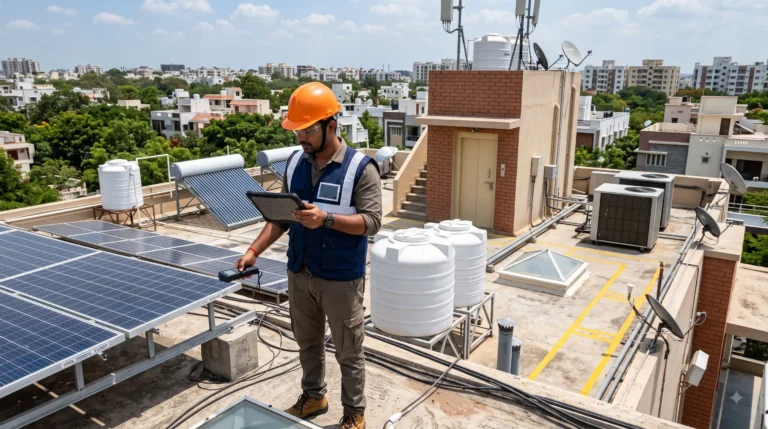
Can a large house install solar if the roof has water tanks and other obstacles?
Yes, potentially. The usable roof area needs to be measured around the obstacles, and the panel layout should account for shading, access and maintenance.
Is a bigger solar system always better for a high-electricity home?
No. The appropriate capacity depends on consumption, generation potential, roof space, regulatory limits and project economics.
At Roof Rays Solar, we are committed to delivering reliable rooftop solar solutions that combine quality products, professional installation, and long-term customer support. Whether you’re a homeowner, business owner, or industrial customer, our team works closely with you to design a solar system that matches your energy goals and budget.
Why Customers Trust Roof Rays Solar
Our experts design customized solar solutions based on your electricity consumption, roof space, and future energy goals—helping you maximize savings and achieve the best possible return on investment.
Phone
Address
📍 HUDA Complex, Tellapur, Hyderabad
Contact our solar experts today for a free consultation and personalized solar savings estimate.
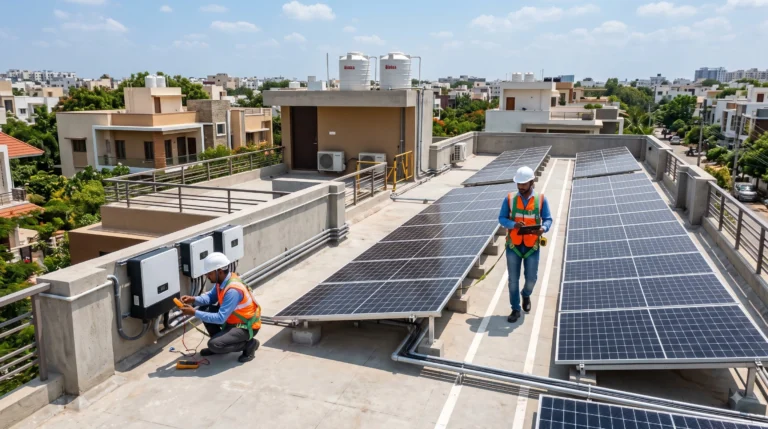
Choosing solar for large homes in Hyderabad is primarily a capacity-planning exercise.
A 10kW system may suit one large home, while another may need to evaluate 15kW or 20kW because of higher electricity consumption, EV charging, multiple ACs and other major loads.
The decision should be based on:
Electricity consumption + daytime load + roof space + shading + sanctioned load + electrical infrastructure + solar generation + future requirements + project economics.
For Telangana residential consumers, the current rooftop solar framework permits capacity up to 100% of sanctioned load under net/gross metering, subject to the applicable rules and project requirements.
Book Your Free Site Survey Today
© 2025 Roof Rays Solar Solutions. All Rights Reserved. | Designed by MANI
Check whether your property qualifies for rooftop solar subsidy support.
