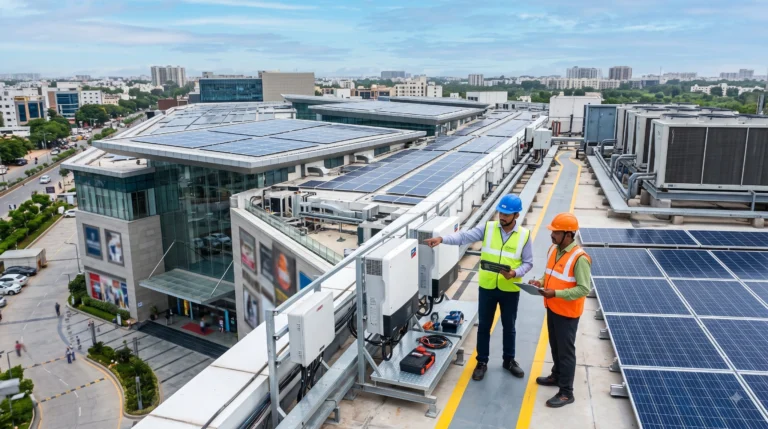
Shopping malls and retail stores have a very different electricity profile from typical homes.
Lighting, air-conditioning, elevators, escalators, refrigeration, signage, ventilation, security systems, pumps, parking facilities and tenant operations can create substantial electricity demand. For a large mall, electricity can also be one of the most significant recurring operating expenses.
This makes solar for shopping malls worth evaluating as part of a broader commercial energy strategy.
A rooftop solar plant can use otherwise underutilised roof space to generate electricity on-site. Depending on the property’s electricity connection, sanctioned load, solar capacity and applicable Telangana regulations, the generated power can be used to offset eligible grid consumption and, where permitted, surplus generation can be handled through the approved metering arrangement.
For Hyderabad businesses, however, commercial solar should not be approached as simply “install panels and reduce the bill.”
The project needs to consider load profile, rooftop area, sanctioned load, structural conditions, electrical infrastructure, metering, financing, maintenance and long-term energy economics.
Solar can be a strong option to evaluate for shopping malls and retail properties with suitable roof space and significant electricity consumption.
The strongest commercial-solar cases generally have:
In Telangana, the 2025 rooftop solar regulation allows net and gross metering for eligible consumers, with the maximum rooftop capacity for industrial, commercial and other consumers generally capped at 80% of sanctioned load/contract demand.
That makes the property’s existing electricity connection an important starting point for commercial solar planning.
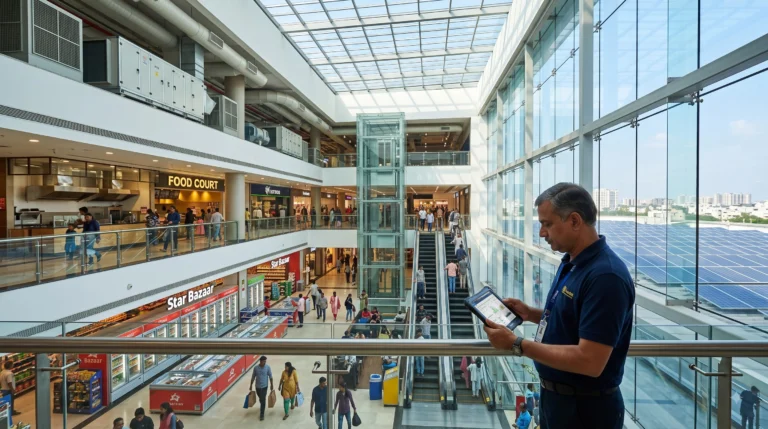
A residential solar system is usually designed around household electricity consumption.
A mall may have multiple electrical loads operating simultaneously, including:
HVAC and air-conditioning
Cooling can represent a major portion of electricity consumption, particularly during Hyderabad’s hotter months.
Lighting
Retail lighting, common-area lighting, parking illumination and signage can operate for extended periods.
Escalators and elevators
These create recurring electrical demand throughout the mall’s operating hours.
Refrigeration
Supermarkets, food courts and certain retail businesses may have continuous refrigeration requirements.
Pumps and ventilation
Water pumps, ventilation systems and other building services add further demand.
Tenant operations
A shopping centre may also have multiple tenants with different electricity requirements and metering arrangements.
This means a mall’s solar design should be based on actual electricity data, not a generic per-square-foot assumption.
What Is Commercial Rooftop Solar for a Shopping Mall?
Commercial rooftop solar is a grid-connected PV system installed on a commercial property’s available roof or other suitable area.
A typical system consists of:
Solar modules → DC electrical system → Inverters → AC electrical system → Mall’s internal electrical network → Grid connection
During periods when solar generation is available, the electricity can serve eligible loads within the facility.
If generation exceeds the property’s instantaneous consumption, the treatment of surplus depends on the approved metering arrangement and applicable regulations.
The objective is generally to maximise the value of solar electricity by matching generation with the property’s electricity consumption.
What Solar Capacity Does a Shopping Mall Need?
There is no standard solar capacity for every mall.
A suitable system size depends on:
For Telangana’s current rooftop solar framework, commercial and other consumers using net or gross metering are generally limited to rooftop solar capacity of up to 80% of sanctioned load/contract demand.
Therefore, a mall should check its electricity connection before assuming that its entire roof can be covered with solar.
Example
If a commercial property’s applicable sanctioned load or contract demand is 1,000kW, the regulatory capacity calculation may limit the rooftop solar proposal to the applicable percentage rather than allowing unlimited installation simply because sufficient roof area exists.
The final design should be verified against the current DISCOM and regulatory requirements.
How to Determine the Right Solar Size for a Retail Store
For a smaller retail outlet, start with:
Electricity bills + operating hours + daytime load + roof availability
A store operating primarily during daylight hours may have a useful opportunity to consume a significant portion of its solar generation directly.
For example, a retail store with:
may have substantial daytime electricity consumption.
The solar system should be designed around the actual load rather than simply selecting a capacity because another store installed it.
Why Daytime Consumption Matters
Solar panels generate electricity primarily during daylight hours.
Shopping malls and retail stores often operate during those same hours.
This can create a useful relationship:
Solar generation → daytime mall consumption
The more solar electricity that can be consumed on-site, the less electricity the property may need to purchase from the grid during those periods, subject to the applicable tariff and metering arrangement.
This is why a commercial solar feasibility study should examine hourly or interval consumption data where available, rather than relying only on the total monthly units shown on the bill.
Solar for Shopping Malls: Key Loads to Analyse
Before designing the system, divide the mall’s electricity consumption into major categories.
Load | Solar Planning Relevance |
HVAC | High daytime relevance |
Lighting | Strong daytime and evening relevance |
Escalators | Operating-hours dependent |
Elevators | Operating-hours dependent |
Refrigeration | Potentially high |
Pumps | Operating schedule matters |
Signage | Often evening-heavy |
Parking | Time-dependent |
Food court | Operating-hours dependent |
Tenant loads | Depends on metering arrangement |
This analysis helps determine whether the proposed solar capacity aligns with the mall’s actual consumption.
How Much Rooftop Area Is Needed?
The required roof area depends on:
A mall may have a large roof, but not all of it is necessarily usable.
Potential obstructions include:
A proper rooftop survey should therefore be completed before finalising capacity.
Does PM Surya Ghar Subsidy Apply to Shopping Malls?
Do not treat PM Surya Ghar residential subsidy as a commercial-mall subsidy.
The Ministry of New and Renewable Energy’s current rooftop-solar programme identifies CFA/subsidy under the residential component for residential electricity consumers.
Shopping malls and ordinary retail stores are commercial consumers, so their solar project economics should generally be evaluated without assuming the residential PM Surya Ghar CFA.
This is an important distinction when preparing a commercial solar ROI calculation.
A mall should instead evaluate the applicable commercial tariff, solar generation, metering arrangement, project cost, financing and available state/other incentives if any.
What About Net Metering for Commercial Solar in Telangana?
Telangana’s 2025 Rooftop Solar PV Grid Interactive Systems Regulation provides net metering, gross metering, group net metering and virtual net metering arrangements subject to eligibility and conditions.
For industrial, commercial and other consumers, the regulation generally limits rooftop solar capacity under net/gross metering to 80% of sanctioned load or contracted demand.
The applicable arrangement should be selected after reviewing:
A commercial solar project should therefore be planned together with the property’s electricity connection—not separately from it.
Solar Cost for Shopping Malls: What Determines the Price?
There is no single ₹/kW price that accurately represents every mall project.
Commercial solar pricing can be influenced by:
Solar module selection
Module technology, wattage, manufacturer and applicable compliance requirements affect the equipment cost.
Inverter configuration
Larger commercial systems may require multiple inverters or different system architectures.
Mounting structure
The roof type, height, loading conditions and installation arrangement influence structural requirements.
Electrical infrastructure
Large systems can require substantial DC and AC cabling, protection equipment and electrical integration.
Roof accessibility
Material movement and installation logistics become more complicated on large commercial buildings.
Structural requirements
The roof must be suitable for the proposed mounting arrangement and equipment loading.
Metering and grid interconnection
The applicable DISCOM requirements can affect project scope.
Monitoring
Commercial projects benefit from detailed generation and performance monitoring.
Therefore, a shopping mall should compare complete EPC scope and specifications, not just the quoted price per kW.
CAPEX vs OPEX Models for Shopping Mall Solar
Commercial properties can consider different ownership structures.
CAPEX Model
The mall or property owner funds the solar installation.
Advantages
Considerations
OPEX / RESCO Model
A third-party developer may finance, own and operate the solar plant, with the customer purchasing generated electricity under the agreed commercial structure.
Advantages
Considerations
The right model depends on the mall owner’s capital strategy and commercial objectives.
How to Calculate Solar ROI for a Shopping Mall
A basic commercial solar ROI analysis should include:
Annual solar generation × value of offset electricity
minus
Annual operating and maintenance costs
Then compare the resulting annual benefit with:
Net project investment
A more complete financial model should also consider:
Example structure
Suppose a mall’s proposed solar system is expected to generate a certain amount of electricity annually.
Instead of asking only:
“How many units will solar generate?”
ask:
“How much of that generation will offset electricity that the mall would otherwise purchase, and at what applicable value?”
That distinction can materially affect the project’s financial outcome.
Solar Generation vs Solar Savings
These are not the same thing.
A solar system may generate electricity, but the financial value depends on how that electricity interacts with the mall’s consumption and billing arrangement.
For example:
Solar generation
→ Directly consumed on site
→ Reduces grid purchase
versus
Solar generation
→ Exported to grid
→ Accounted for under the applicable metering/billing mechanism
Therefore, the financial model should use the actual commercial tariff and applicable export treatment, rather than assuming every solar unit has the same monetary value.
What About Battery Storage for Shopping Malls?
Battery storage is not automatically necessary for every commercial rooftop solar project.
It becomes more relevant when the property has specific requirements such as:
However, battery storage adds:
For a grid-connected mall, the first step should usually be understanding the economics of rooftop solar without assuming battery storage is automatically required.
Solar for Retail Stores: Small Commercial Applications
Solar is not limited to large shopping malls.
It can also be considered for:
A retail store with a smaller roof may have limited solar capacity, but the project can still be evaluated if electricity consumption and available roof area support it.
Shopping Mall Solar Installation Process
A practical commercial project can follow these stages:
Step 1: Collect electricity data
Review at least recent electricity bills and, where possible, interval or load data.
Step 2: Review the electricity connection
Identify:
Step 3: Conduct a rooftop survey
Map usable area, shading and existing rooftop equipment.
Step 4: Determine solar capacity
Match the system to consumption, roof area and applicable regulatory limits.
Step 5: Prepare the technical design
Select modules, inverters, mounting systems and electrical protection.
Step 6: Evaluate the financial model
Compare CAPEX, OPEX/RESCO and financing options where available.
Step 7: Select the metering arrangement
Confirm the appropriate arrangement with the applicable DISCOM.
Step 8: Complete approvals and interconnection
Follow the applicable Telangana/DISCOM procedures.
Step 9: Install and commission
Complete construction, testing and commissioning.
Step 10: Monitor performance
Track generation, availability, faults and electricity savings after commissioning.
What Should a Commercial Solar Proposal Include?
A shopping mall should request a detailed proposal covering:
Technical
Commercial
Regulatory
A detailed proposal makes it easier to compare different EPC providers on a like-for-like basis.
Solar Maintenance for Shopping Malls
Commercial rooftop systems require an organised maintenance programme.
Maintenance can include:
For a large mall, the O&M agreement should clearly define:
The goal is not simply to keep panels clean. It is to maintain system availability and predictable energy production.
Common Mistakes When Installing Solar for Shopping Malls
Choosing capacity based only on roof size
A large roof does not automatically mean the largest possible solar system is financially appropriate.
Ignoring contract demand
Commercial solar capacity is linked to the applicable sanctioned load/contract demand rules in Telangana.
Assuming residential subsidy applies
Shopping malls are commercial consumers; do not include PM Surya Ghar residential CFA in the business case without confirming specific eligibility.
Comparing only ₹/kW
Equipment quality, engineering, electrical integration, warranties and O&M can materially affect the project.
Ignoring daytime load
Solar economics are strongly influenced by how generated electricity is consumed and accounted for.
Not assessing the roof structurally
Large commercial rooftop systems require appropriate structural consideration.
Treating tenant electricity and common-area electricity as one load
The property’s metering and ownership structure can significantly affect the solar design.
Failing to plan maintenance
A large system needs a clear O&M strategy from the beginning.
How to Choose a Commercial Solar Partner
Before selecting an EPC company for solar for shopping malls, evaluate:
Technical capability
Can the provider design a system around the mall’s actual electrical load and roof?
Commercial experience
Has the provider handled projects with similar electrical and rooftop complexity?
Documentation
Does the proposal clearly identify equipment, warranties and scope?
Monitoring
Will the mall have access to meaningful generation and performance data?
O&M
Is post-installation maintenance clearly defined?
Regulatory support
Will the provider assist with the applicable DISCOM and metering process?
Financial transparency
Are generation and ROI assumptions clearly stated rather than presented as guaranteed savings?
Is solar suitable for shopping malls?
It can be suitable when a mall has sufficient usable roof area, significant electricity consumption and an electrical connection compatible with the proposed system.
How much solar capacity can a commercial mall install in Telangana?
Under Telangana’s 2025 rooftop solar regulation, net/gross-metered rooftop solar for industrial, commercial and other consumers is generally limited to 80% of sanctioned load/contract demand, subject to the regulation and applicable conditions.
Do shopping malls get PM Surya Ghar subsidy?
PM Surya Ghar’s residential CFA component is for residential electricity consumers. A normal commercial shopping mall should not assume it qualifies for the residential subsidy.
Can a retail store install rooftop solar?
Yes, an eligible commercial retail property can evaluate rooftop solar subject to its electricity connection, roof conditions, applicable regulations and DISCOM requirements.
Is net metering available for commercial solar in Telangana?
Telangana’s 2025 rooftop solar regulation provides net-metering and other metering arrangements for eligible consumers, subject to the applicable conditions and capacity limits.
Should a shopping mall use batteries with solar?
Not automatically. Battery storage should be evaluated separately based on backup requirements, load profile, evening consumption and project economics.
How much does solar for a shopping mall cost?
There is no universal price. Capacity, equipment, roof conditions, electrical integration, structural work, metering requirements and installation complexity all affect the final cost.
How long does commercial solar take to pay back?
There is no single payback period. It depends on system cost, generation, electricity tariff, self-consumption, export treatment, financing, maintenance and other project-specific factors.
Can solar power be used for mall air-conditioning?
Yes. Electricity generated by a grid-connected rooftop system can supply eligible electrical loads within the facility, including HVAC equipment, subject to the electrical system configuration.
Does a mall need a large roof for solar?
A larger roof generally provides more installation potential, but the usable area depends on shading, equipment, access pathways, structural conditions and other rooftop constraints.
At Roof Rays Solar, we are committed to delivering reliable rooftop solar solutions that combine quality products, professional installation, and long-term customer support. Whether you’re a homeowner, business owner, or industrial customer, our team works closely with you to design a solar system that matches your energy goals and budget.
Why Customers Trust Roof Rays Solar
Our experts design customized solar solutions based on your electricity consumption, roof space, and future energy goals—helping you maximize savings and achieve the best possible return on investment.
Phone
Address
📍 HUDA Complex, Tellapur, Hyderabad
Contact our solar experts today for a free consultation and personalized solar savings estimate.
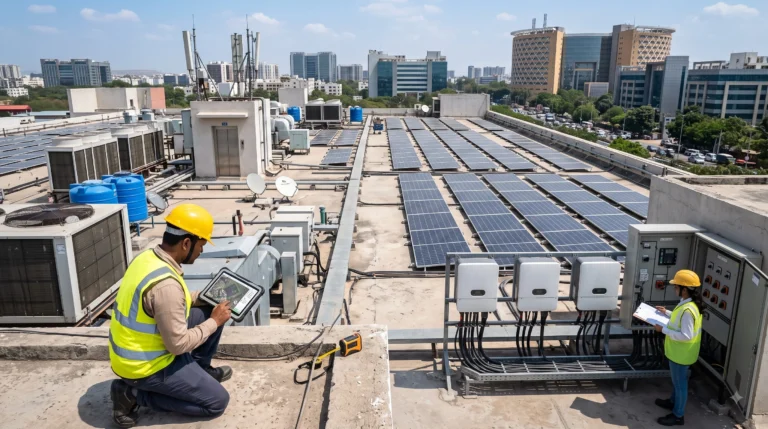
Solar for shopping malls can turn otherwise underutilised rooftop space into an on-site electricity-generation asset.
For Hyderabad commercial properties, the strongest starting point is not a generic system-size recommendation. It is an assessment of electricity consumption, daytime load, roof area, sanctioned load or contract demand, electrical infrastructure and applicable metering rules.
Telangana’s current rooftop solar framework allows eligible commercial consumers to use rooftop solar under specified metering arrangements, while generally limiting net/gross-metered rooftop capacity for commercial consumers to 80% of sanctioned load or contract demand.
Shopping malls should also distinguish commercial solar economics from residential subsidy programmes. The PM Surya Ghar CFA component is structured for residential electricity consumers, so a normal commercial mall should not build its ROI calculation around residential subsidy assumptions.
Book Your Free Site Survey Today
© 2025 Roof Rays Solar Solutions. All Rights Reserved. | Designed by MANI
Check whether your property qualifies for rooftop solar subsidy support.