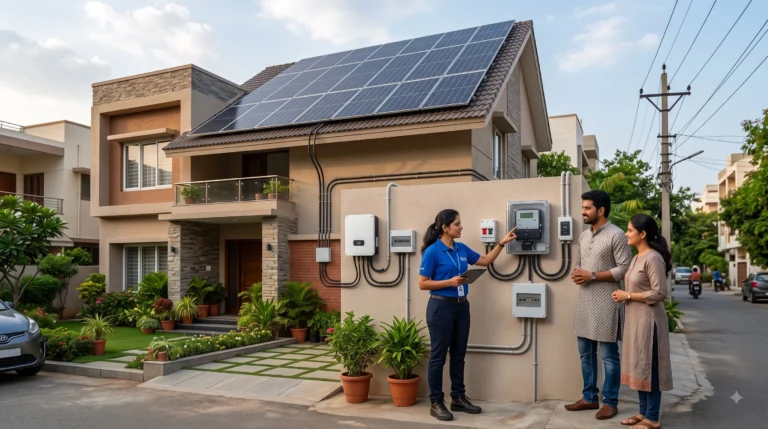
Installing rooftop solar can reduce the amount of electricity you purchase from the grid, but what happens when your solar system produces more electricity than your home or business is using?
This is where solar net metering in Hyderabad becomes important. Under a net-metering arrangement, electricity generated by your rooftop solar system can be used by your property first, while surplus generation can be exported to the distribution grid according to the applicable Telangana regulations and billing arrangement.
For Hyderabad consumers, the process involves the relevant electricity distribution licensee, commonly TGSPDCL for southern Telangana areas. Consumers in northern Telangana areas may deal with TGNPDCL. The application, technical feasibility, processing fee, documentation and meter replacement must be completed according to the applicable procedure.
This guide explains the 2026 net metering process, eligibility, documents, application charges, bidirectional meter requirements and important points to check before installing rooftop solar.
Solar net metering allows a rooftop solar consumer to exchange electricity with the distribution grid. During periods when solar generation is greater than the property’s immediate consumption, surplus electricity can flow into the grid. When consumption is higher than solar generation, electricity can be drawn from the grid.
A bidirectional meter records electricity flowing in both directions.
For Telangana, the 2025 TGERC rooftop-solar regulation provides for net metering for eligible consumers, with a minimum rooftop solar capacity of 1 kWp and a net-metering ceiling of 500 kWp, subject to the applicable conditions and network feasibility.
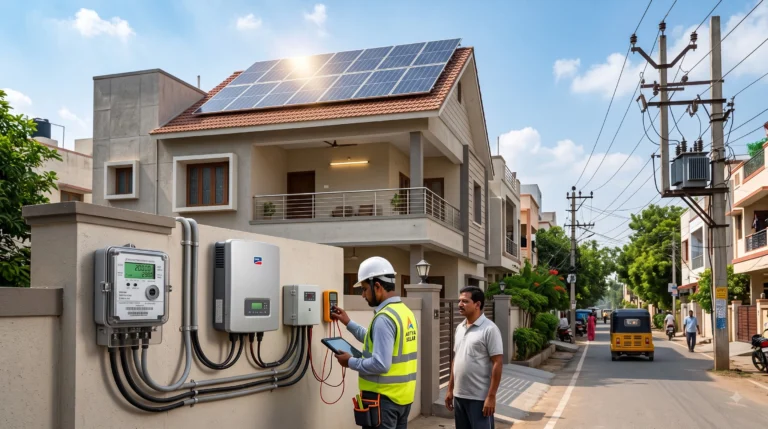
The basic flow is:
Solar panels → Home/Business → Surplus to Grid → Bidirectional Meter → Electricity Billing
For example, during a sunny afternoon, your rooftop system may generate more electricity than your property is consuming. The excess can be exported to the grid.
At another time, such as evening or early morning, your property may consume more electricity than the solar system is producing. Electricity is then imported from the grid.
The meter records these flows so that the applicable billing mechanism can be applied.
Who Is Eligible for Solar Net Metering in Telangana?
The current Telangana rooftop-solar regulation permits eligible consumers, other than temporary-supply consumers, to install rooftop solar under net metering, subject to the applicable technical and regulatory conditions. The 2025 regulation specifies a minimum system size of 1 kWp and permits net-metering systems up to 500 kWp.
Eligibility is not determined by roof size alone. The DISCOM also considers factors such as:
TGSPDCL’s current online solar registration portal requires the consumer’s unique service number and provides an option to indicate whether PM Surya Ghar subsidy/CFA is being sought.
Important: Solar Capacity Is Not Automatically Approved
Installing a particular solar capacity does not automatically mean that the same capacity will be approved for grid interconnection.
The DISCOM assesses the proposed connection and relevant network capacity before approval. The current Telangana regulation specifically requires feasibility assessment of the interconnection point and relevant distribution-transformer or feeder capacity.
TGSPDCL Net Metering vs TGNPDCL Net Metering
The basic regulatory framework is statewide, but your application is handled by the distribution licensee serving your electricity connection.
TGSPDCL Net Metering
TGSPDCL serves its designated southern Telangana distribution area. Its current portal provides an online Solar Net Meter Registration facility for LT and HT consumers.
TGNPDCL Net Metering
TGNPDCL provides its own Solar Rooftop registration portal, including application submission, payment, application-status tracking, work-completion reporting and access to the applicable rooftop-solar regulations and forms.
The correct DISCOM depends on your electricity service connection, not simply the fact that your property is located in Hyderabad.
Solar Net Meter Application: What Documents Are Required?
The exact document checklist can vary with the consumer category and current DISCOM procedure. The current Telangana net-metering application form includes information such as:
The DISCOM may also require supporting documents such as the latest electricity bill, prescribed application, applicable processing fee and other documents specified for the connection.
TGNPDCL’s published application checklist also references the latest electricity bill, applicable fee, self-addressed envelopes and bank-account information for settlement purposes.
Always verify the current checklist with the applicable DISCOM before submission.
Solar Net Metering Process in Telangana
The process can be broadly understood in the following stages.
Step 1: Analyse Your Electricity Consumption
Review recent electricity bills and determine your typical monthly and annual consumption.
This helps establish a sensible solar-system size instead of choosing capacity based only on available roof area.
Step 2: Conduct a Rooftop Assessment
The roof should be evaluated for:
Step 3: Finalize the Solar System Design
The solar installer prepares a system design based on the property’s electricity requirements, roof conditions and proposed capacity.
Step 4: Submit the Solar Net Meter Application
The consumer submits the prescribed application to the relevant DISCOM along with the required documents and processing fee.
The 2025 Telangana regulation states that applications are processed in chronological order after acknowledgement and registration.
Step 5: DISCOM Checks the Application
The distribution licensee checks whether the application is complete. Under the 2025 regulation, the DISCOM is required to notify the consumer within 7 working days if required documents are missing or incomplete.
Step 6: Technical Feasibility Assessment
The DISCOM evaluates the proposed interconnection and available network capacity.
Under the 2025 regulation, feasibility is to be communicated within 15 working days from receipt of a proper application.
Step 7: Install the Rooftop Solar System
Once the applicable approval/feasibility process is completed, the solar system can be installed according to the approved requirements and applicable technical standards.
Step 8: Testing & Work Completion
The completed installation is inspected/tested as required, and the required completion documentation is submitted.
Step 9: Bidirectional Meter Installation
The existing electricity meter is replaced or modified with the appropriate bidirectional meter as required for the approved arrangement.
TGSPDCL specifically states that an existing energy meter is not sufficient for net metering and that a separate bidirectional meter is required.
Step 10: Commissioning & Net Meter Billing
After the required checks and commissioning, the system begins operating under the approved net-metering arrangement and the applicable billing mechanism.
Solar Meter Charges in Hyderabad
One of the most important points when estimating solar meter charges in Hyderabad is to distinguish the DISCOM’s application/processing fee from the total cost of the solar project.
The 2025 Telangana regulation specifies processing fees of:
Consumer Type | Processing Fee |
LT consumers | ₹2,500 |
HT consumers | ₹15,000 |
These are the processing fees specified in the regulation.
However, the actual amount payable can include applicable taxes or DISCOM-specific published charges.
For example, TGNPDCL currently publishes its solar rooftop net-meter application fee including GST as:
Therefore, do not assume that the regulatory base fee is necessarily the final amount payable at the time of application.
What About the Cost of the Bidirectional Meter?
The meter-related cost and any other applicable charges should be confirmed with the relevant DISCOM at the time of application and installation.
Do not use an old online fee table as a guaranteed 2026 price.
Does Net Metering Mean Your Electricity Bill Will Always Be Zero?
No.
Your final electricity bill depends on factors including:
Net metering should therefore be understood as a mechanism for accounting for electricity imported from and exported to the grid—not as a guarantee of a zero bill.
Net Metering vs Solar Battery Storage
Net metering and battery storage solve different problems.
Net Metering
Useful when you want to export eligible surplus solar electricity to the grid and use the grid as part of your energy system.
Battery Storage
Stores surplus electricity for later use.
A battery may be useful when backup power, evening consumption or greater energy independence is important.
The right choice depends on your electricity usage, budget, backup requirements and applicable regulations.
Common Solar Net Metering Mistakes to Avoid
Installing Solar Before Checking Approval Requirements
Do not assume that installing panels first and applying for net metering later will always be acceptable.
Choosing Solar Capacity Only by Roof Size
A large roof does not automatically mean you should install the largest possible system.
Using Outdated Charges
DISCOM fees and procedures can change. Verify current charges before making payment.
Ignoring Your Sanctioned Load
The proposed solar capacity and electricity connection should be evaluated together.
Missing Documents
Incomplete applications can delay the process.
Treating Net Metering as a Guaranteed Zero Bill
Fixed charges and other billing components may remain applicable.
Choosing an Installer Who Ignores DISCOM Procedures
A good solar installer should understand the technical and documentation requirements involved in grid-connected rooftop solar.
How Roof Rays Solar Can Help
Roof Rays Solar Solutions can help customers understand the solar installation and net-metering journey from system planning through commissioning.
Our support can include:
The exact approval, fee and meter process remains subject to the applicable DISCOM and Telangana regulations.
Real Hyderabad Customer Planning Example
Consider a Hyderabad homeowner who wants rooftop solar primarily to reduce grid electricity consumption.
Instead of selecting a system solely based on roof size, the better approach is to:
This approach reduces the risk of designing a system without considering the property’s actual electricity requirements or grid-interconnection conditions.
Solar net metering allows eligible rooftop-solar consumers to exchange electricity with the distribution grid, with electricity imported and exported accounted for through the applicable metering and billing arrangement.
The 2025 Telangana rooftop-solar regulation specifies a minimum net-metering system size of 1 kWp.
The 2025 regulation permits eligible consumers to install rooftop solar under net metering up to 500 kWp, subject to applicable conditions and network feasibility.
The 2025 regulation specifies ₹2,500 for LT and ₹15,000 for HT processing fees. The final amount payable may include applicable taxes or current DISCOM charges.
TGNPDCL currently publishes ₹2,950 including GST for LT and ₹17,700 including GST for HT solar rooftop net-meter applications.
Yes. A bidirectional meter is required for the net-metering arrangement rather than simply continuing with the existing one-way energy meter.
Under the 2025 Telangana regulation, the DISCOM should communicate application deficiencies within 7 working days and technical feasibility within 15 working days after receiving a proper application. Actual project completion can take longer depending on documentation, installation, inspection and meter-related activities.
The approval and interconnection process should be followed as prescribed by the relevant DISCOM. Customers should not assume that installing the system first is equivalent to obtaining net-metering approval.
Not necessarily. Billing depends on electricity imports, solar exports, tariffs and applicable fixed or other charges.
It depends on the distribution licensee serving your electricity connection. TGSPDCL and TGNPDCL have their own solar-rooftop application systems.
At Roof Rays Solar, we are committed to delivering reliable rooftop solar solutions that combine quality products, professional installation, and long-term customer support. Whether you’re a homeowner, business owner, or industrial customer, our team works closely with you to design a solar system that matches your energy goals and budget.
Why Customers Trust Roof Rays Solar
Our experts design customized solar solutions based on your electricity consumption, roof space, and future energy goals—helping you maximize savings and achieve the best possible return on investment.
Phone
Address
📍 HUDA Complex, Tellapur, Hyderabad
Contact our solar experts today for a free consultation and personalized solar savings estimate.

Solar net metering can make grid-connected rooftop solar more practical by allowing eligible consumers to manage electricity generated on their property alongside electricity imported from the grid.
However, the process involves more than installing panels and replacing a meter. Your solar capacity, electricity connection, technical feasibility, documentation, application, processing fee, inspection and commissioning all need to be considered.
For Hyderabad consumers, the first step is to identify the correct DISCOM and check the current applicable requirements. TGSPDCL and TGNPDCL provide dedicated solar-rooftop application systems, while the Telangana Electricity Regulatory Commission’s 2025 regulation provides the current regulatory framework for rooftop-solar connectivity and metering.
With proper planning and professional installation, rooftop solar can become a practical long-term solution for reducing dependence on grid electricity while making productive use of available roof space.
Book Your Free Site Survey Today
© 2025 Roof Rays Solar Solutions. All Rights Reserved. | Designed by MANI
Check whether your property qualifies for rooftop solar subsidy support.