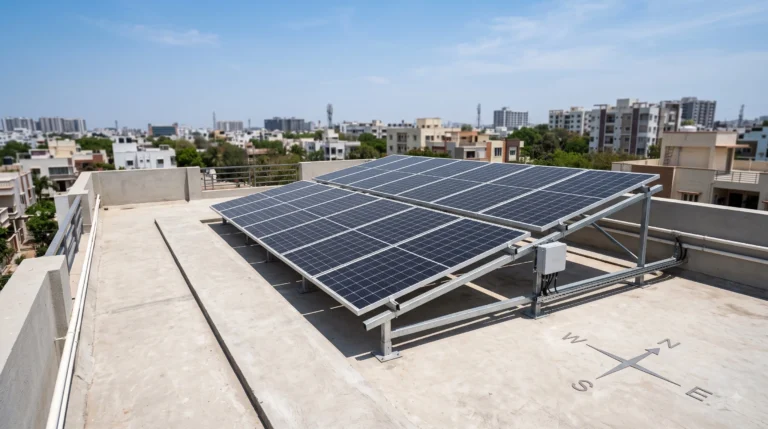
When installing rooftop solar, choosing the right solar panel direction and tilt in Hyderabad is an important part of system design. Solar panels generate electricity by converting sunlight into electrical energy, so their position can influence how much solar radiation reaches the panel surface throughout the day and year.
However, choosing the direction and tilt is not as simple as selecting one angle and applying it to every rooftop. Hyderabad homes and businesses have different roof types, available spaces, surrounding buildings, trees, water tanks, parapet walls and electrical requirements.
For a fixed rooftop installation, a south-facing orientation is generally a strong starting point for annual solar exposure in Hyderabad because the city is in the Northern Hemisphere. But east- or west-facing installations can also be practical when roof conditions or electricity-use patterns make them appropriate.
Tilt also needs to be selected according to the location, roof structure, shading, mounting arrangement, row spacing, drainage and maintenance requirements.
This guide explains how direction and tilt influence rooftop solar, what homeowners and businesses in Hyderabad should consider, and why a site-specific solar layout is more useful than blindly following one “ideal” angle.
Best Direction
For a fixed rooftop solar installation in Hyderabad, south-facing orientation is generally a strong starting point for maximizing annual solar exposure, provided the roof and site conditions allow it.
However, east- and west-facing panels can also be effective depending on the available roof area, shading and when electricity is consumed.
Best Tilt
Hyderabad is located at approximately 17.4° north latitude, making latitude a useful starting reference when considering fixed-panel tilt.
However, there is no single exact tilt angle that should be applied to every Hyderabad rooftop.
The final tilt should consider:
A professional solar installer should optimize the final orientation and tilt for the specific property.
Key Takeaways
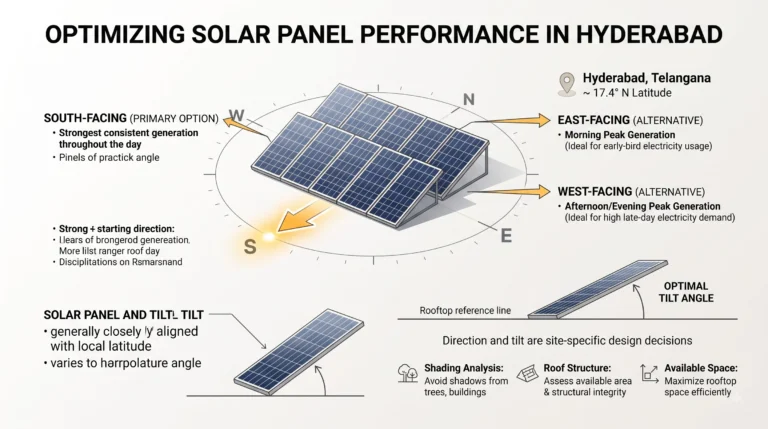
The direction a solar panel faces influences the amount and timing of sunlight it receives.
Solar radiation changes throughout the day as the sun moves across the sky. The objective of panel orientation is to position the modules so they receive useful sunlight over the desired period.
South-Facing Solar Panels
For Hyderabad, south-facing panels are generally a strong option for maximizing annual solar exposure on a fixed installation.
This can be particularly suitable when:
However, a south-facing panel with substantial shading may perform worse than a less ideally oriented panel installed in a clear, shade-free area.
East-Facing Solar Panels
East-facing panels receive stronger sunlight earlier in the day.
They can be useful for properties with significant morning electricity consumption, such as homes where people start their day early or businesses that begin operations in the morning.
An east-facing roof can also be a practical choice when:
West-Facing Solar Panels
West-facing panels receive more sunlight later in the day.
This can be relevant for homes or businesses with greater afternoon electricity consumption.
For example, a property with significant afternoon air-conditioning or business activity may benefit from considering west-facing roof areas.
Again, the final decision should consider the complete site rather than direction alone.
North-Facing Solar Panels
For fixed installations in Hyderabad, north-facing panels generally have less favorable annual solar exposure than south-facing panels.
That does not mean every north-facing roof is automatically unusable. The actual result depends on the roof slope, mounting arrangement, shading and overall site conditions.
A professional assessment should determine whether a particular north-facing section is practical.
What Is Solar Panel Tilt?
Solar panel tilt is the angle between the panel surface and the horizontal plane.
Imagine placing a solar panel completely flat on a rooftop. Its tilt is approximately 0°.
If the panel is raised at an angle, its tilt increases.
Tilt influences how directly sunlight strikes the panel surface and can therefore affect energy generation.
But tilt isn’t only about maximizing sunlight.
The mounting design must also consider:
What Is the Best Tilt Angle in Hyderabad?
Hyderabad is located at approximately 17.4° north latitude, so latitude provides a useful starting reference for thinking about fixed solar panel tilt.
However, the practical optimum for a specific rooftop can differ.
For example, the installer may need to adjust the design because of:
Therefore, homeowners should be cautious of claims that one exact tilt angle is the universally best angle for every Hyderabad installation.
The objective should be to find a practical orientation and tilt that provides strong solar exposure while maintaining a safe, durable and maintainable installation.
Direction vs Tilt: Which Is More Important?
Both factors matter, but their importance depends on the property.
Direction
Direction determines the general orientation of the panel toward the sun’s path.
Tilt
Tilt determines the angle at which the panel surface meets incoming sunlight.
Shading
Shading can have a significant effect on solar production.
This creates an important practical rule:
A well-designed, shade-free installation with a practical orientation can be more useful than a theoretically perfect orientation with significant shading.
For this reason, an installer should assess the entire rooftop rather than deciding direction and tilt from a single rule.
How Roof Type Changes Solar Panel Tilt
Flat Roofs
Many residential and commercial rooftops in Hyderabad are relatively flat.
Solar panels on flat roofs normally require mounting structures to create the desired tilt.
The design should account for:
Increasing the tilt is not automatically better if it creates excessive inter-row shading or uses too much roof area.
Sloped Roofs
On a sloped roof, panels may follow the existing roof angle.
The installer should evaluate:
If the existing roof orientation and slope are already suitable, additional tilt structures may not always be necessary.
Complex or Multi-Level Roofs
Some houses and commercial properties have multiple roof sections with different orientations and elevations.
In these situations, the installer may need to evaluate each section separately.
The final design should prioritize usable, relatively shade-free areas while maintaining safe access and practical electrical routing.
Direction & Tilt for Hyderabad Homes
Independent Houses
Independent houses often provide greater flexibility in rooftop layout.
A site survey should identify:
The solar layout can then be designed around the property’s actual conditions.
Villas
Villas may have larger rooftops but can also have multiple roof levels and structures.
The installer should consider all usable sections rather than assuming that the largest roof area is automatically the best location.
Apartment Rooftops
Apartment and community rooftops can have additional considerations such as:
A detailed layout is especially important where several users or common facilities share the rooftop.
Solar Panel Direction & Tilt in Hyderabad: What Is the Best Orientation? (2026) — Part 2
Direction & Tilt for Commercial Rooftops in Hyderabad
Commercial and office rooftops often have large flat areas, making them suitable for planned solar layouts. However, the best layout isn’t determined by panel direction alone.
Commercial solar design should consider:
For businesses, electricity-use timing is also important. An east-facing layout may provide more morning generation, while a west-facing layout can provide relatively more afternoon generation. The right choice depends on the property’s roof and consumption pattern.
How Shading Affects Direction & Tilt
Shading is one of the most important factors to evaluate before deciding the final panel layout.
Potential shading sources include:
A professional shading assessment should consider how shadows move during different times of the day and across relevant seasons.
Why This Matters
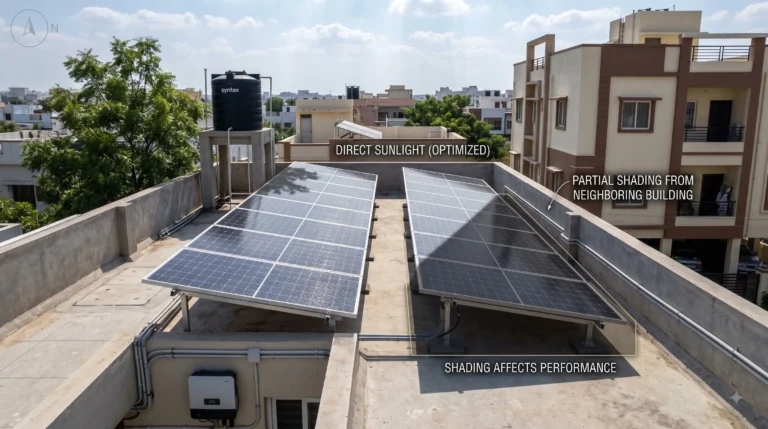
A theoretically ideal south-facing panel can still lose significant production if it is regularly shaded.
Therefore, shade-free usable area should be prioritized alongside direction and tilt.
Does East or West-Facing Solar Make Sense in Hyderabad?
Yes.
South-facing panels are generally a strong option for annual solar exposure, but that doesn’t mean every rooftop should be forced into a south-facing layout.
East-Facing May Make Sense When:
West-Facing May Make Sense When:
The best solution is therefore site-specific, rather than simply choosing one compass direction for every installation.
Common Solar Direction & Tilt Mistakes
A tilt that works well in one design may not be practical for another rooftop.
Even a small rooftop structure can create recurring shadows depending on its position.
The most visually convenient direction isn’t necessarily the best energy-producing orientation.
On flat roofs, panels installed too close together can shade one another.
Maximizing panel count shouldn’t compromise safe access for inspection and maintenance.
Mounting structures should not obstruct normal water drainage.
Tilted structures can experience wind forces. Structural suitability must therefore be evaluated before installation.
More panels do not automatically mean better system performance.
A larger system isn’t automatically better if it doesn’t match electricity consumption, roof conditions or project economics.
A professional installer should be able to explain the proposed direction, tilt and panel layout.
How Professionals Optimize Direction & Tilt
A proper rooftop design generally follows these steps:
Solar Installation Process in Hyderabad
The direction and tilt assessment forms part of the broader solar installation process:
Understand current and future electricity requirements.
Assess the roof, orientation, shading and available space.
Check structural and practical installation conditions.
Determine an appropriate panel orientation and mounting arrangement.
Select suitable solar capacity based on electricity consumption and site potential.
Review equipment, layout, generation estimate, pricing and project scope.
Complete applicable utility procedures.
Install mounting structures, panels, inverter and electrical components.
Verify system operation.
Monitor generation and provide maintenance and technical assistance.
What Affects Solar Installation Cost?
The direction and tilt themselves are only part of the overall project cost.
Other factors include:
Flat-roof installations may require additional mounting structures to establish the desired tilt. Complex rooftops can also require more detailed design and installation work.
For an accurate quotation, a site survey is recommended.
Government Subsidy & Net Metering
Eligible residential consumers may qualify for applicable government rooftop solar financial assistance. Current eligibility, subsidy structure, documentation and installation requirements should be verified before proceeding.
For grid-connected rooftop solar, surplus electricity may be eligible for net metering or another applicable export arrangement depending on current utility rules and the property’s electricity connection.
Important: Do not rely on outdated subsidy amounts or older net-metering procedures when calculating project economics.
Expert Tips for Hyderabad Homeowners & Businesses
At-a-Glance Guide
Factor | Why It Matters |
Direction | Influences overall solar exposure |
Tilt | Influences sunlight incidence |
Shading | Can significantly reduce generation |
Roof Type | Determines mounting approach |
Row Spacing | Helps prevent inter-row shading |
Drainage | Protects rooftop functionality |
Access | Enables maintenance |
Usage Pattern | Can influence east/west suitability |
Illustrative Hyderabad Rooftop Example
Consider a Hyderabad homeowner with a flat rooftop. The roof has sufficient area for solar panels, but a water tank and nearby structure create partial shading.
Instead of installing panels across the entire roof without analysis, the installer evaluates:
The final layout prioritizes usable, relatively shade-free space and selects a practical panel direction and tilt.
Key Lesson
The best solar layout isn’t determined by direction and tilt alone. Shading, roof conditions, electricity consumption, structural safety and maintenance access all contribute to a good rooftop design.
For a fixed rooftop installation, south-facing orientation is generally a strong starting point for annual solar exposure. However, east or west can also be practical depending on roof conditions, shading and electricity-use timing.
Hyderabad’s latitude provides a useful starting reference, but the final tilt should be selected based on the specific rooftop, shading, mounting structure, row spacing and installation requirements.
Yes. East-facing panels can be practical, particularly where morning generation is valuable or the east-facing roof provides better usable, shade-free space.
Yes. West-facing panels can be useful where afternoon electricity consumption is important or where the west-facing roof offers better installation conditions.
They can be technically possible, but fixed north-facing panels generally have less favorable annual solar exposure than south-facing panels in Hyderabad. Site-specific conditions should be assessed before deciding.
Yes. Tilt influences the angle at which sunlight reaches the panel surface. The practical effect depends on location, orientation, shading and other site conditions.
Solar panels can be installed on flat roofs using suitable mounting structures that provide the required orientation and tilt while considering row spacing, wind, drainage and maintenance.
Shading reduces sunlight reaching the affected panels and can reduce energy production. The impact depends on the location, extent and timing of the shade.
No. South-facing is generally a strong fixed orientation for annual solar exposure, but an east- or west-facing installation can be more practical for some properties.
Roof Rays can assess your rooftop, shading, available space, electricity consumption and installation conditions before recommending a practical solar layout.
Roof Rays Solar Solutions helps homeowners and businesses across Hyderabad and Telangana plan rooftop solar according to their electricity requirements and property conditions.
Why Customers Choose Roof Rays
The approach is to understand the property first and develop a solar layout that balances energy generation, rooftop conditions, safety and long-term maintenance.
Our experts design customized solar solutions based on your electricity consumption, roof space, and future energy goals—helping you maximize savings and achieve the best possible return on investment.
Phone
Address
📍 HUDA Complex, Tellapur, Hyderabad
Contact our solar experts today for a free consultation and personalized solar savings estimate.
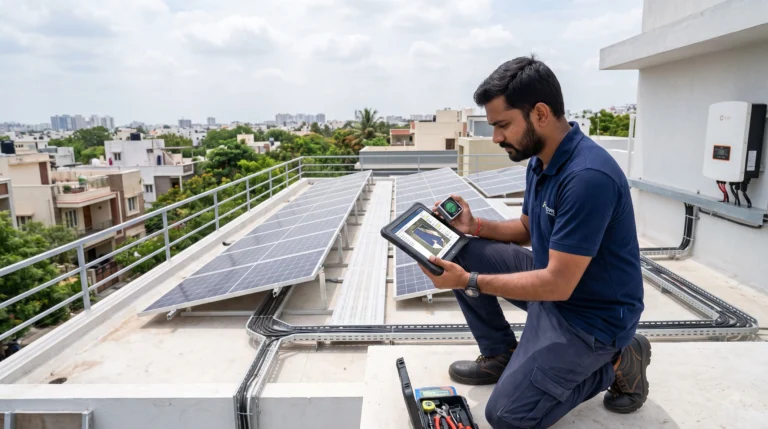
Choosing the right solar panel direction and tilt in Hyderabad is an important part of designing an efficient rooftop solar system, but there is no single configuration that should be blindly applied to every property.
South-facing panels are generally a strong starting point for annual solar exposure in Hyderabad, while east- and west-facing layouts can also make sense depending on electricity-use timing, shading and available rooftop space. Tilt should similarly be selected based on the property’s location, roof structure, mounting arrangement, shading, row spacing and practical maintenance requirements.
Most importantly, shading, roof safety, drainage and usable space should be considered alongside direction and tilt. A professionally designed, shade-aware and maintainable rooftop layout can provide more practical value than simply chasing a theoretical optimum angle.
Roof Rays Solar Solutions provides electricity bill analysis, rooftop assessment, shading evaluation, direction and tilt planning, customized system design, professional installation and ongoing support for homeowners and businesses across Hyderabad and Telangana.
Book Your Free Site Survey Today
© 2025 Roof Rays Solar Solutions. All Rights Reserved. | Designed by MANI
Check whether your property qualifies for rooftop solar subsidy support.