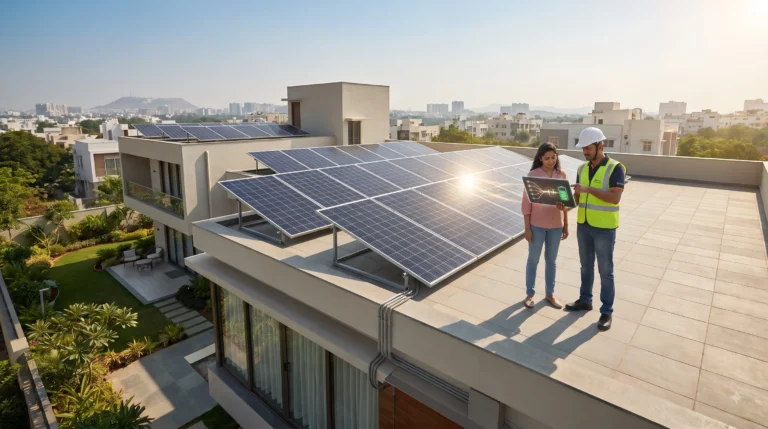
One of the most common questions homeowners ask before installing rooftop solar is: “How much electricity can one solar panel generate?”
Understanding solar panel electricity generation in Hyderabad starts with knowing that a panel’s wattage is not the same as its daily electricity production. A panel rated at 550 W does not produce 550 W continuously throughout the day.
Actual generation depends on several factors, including the panel’s rated capacity, available sunlight, peak sun hours, temperature, shading, orientation, tilt, dust and system losses.
Hyderabad has good solar potential, but generation is not identical every day. Clear summer days, cloudy monsoon conditions, dust accumulation and high panel temperatures can all influence actual output.
Therefore, the most useful approach is to estimate generation using realistic assumptions and then evaluate the complete rooftop system rather than relying on a fixed number of units per panel.
A typical modern residential solar panel can generate a few units of electricity per day under favorable conditions, but the exact amount depends on its wattage and site conditions.
For example, consider a 550 W panel.
Assume:
The simplified calculation is:
0.55 × 5 × 0.80 = 2.2 kWh/day
So, under these illustrative assumptions, one 550 W panel could produce approximately 2.2 units per day.
Annual estimate:
2.2 × 365 = 803 kWh/year
or approximately 803 units per year.
Important: This is an illustrative calculation, not a guaranteed Hyderabad generation figure. Actual output will vary with weather, shading, orientation, temperature, soiling, equipment and system availability.
Key Takeaways
Understanding Solar Panel Wattage
Before calculating solar panel electricity generation in Hyderabad, it is important to understand what the wattage printed on a panel actually means.
Solar panels are commonly available in ratings such as:
The wattage represents the panel’s rated power under standardized testing conditions.
It does not mean the panel will generate that amount of electricity every hour of every day.
The Important Difference
W = Power
Wh/kWh = Energy
For example, a 550 W panel has a rated capacity of:
550 W = 0.55 kW
If it produces electricity over several hours, the total energy generated is measured in kWh.
This distinction is essential when comparing solar generation with your household electricity bill.
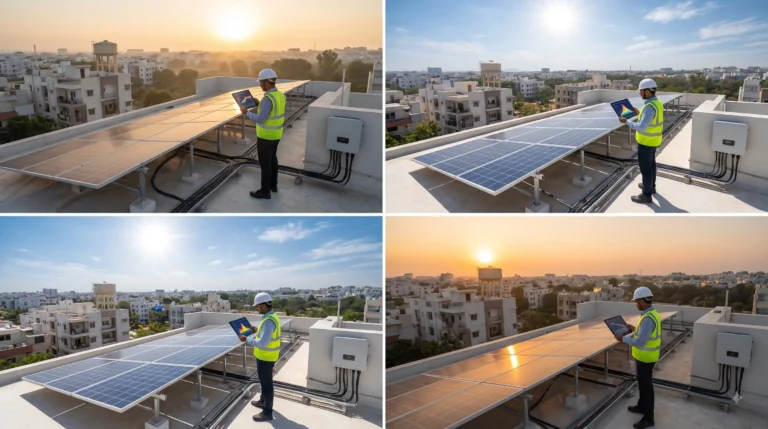
A simplified formula is:
Daily Solar Generation
Panel Generation ≈ Panel Capacity (kW) × Peak Sun Hours × Performance Ratio
For annual generation:
Annual Solar Generation
Annual Generation ≈ Panel Capacity × Peak Sun Hours × 365 × Performance Ratio
Let’s understand each factor.
The first input is the panel’s rated capacity.
For example:
550 W = 0.55 kW
A higher-wattage panel generally has greater generation potential under comparable sunlight and system conditions.
However, wattage should not be the only factor considered when selecting panels.
Other specifications such as efficiency, physical dimensions, temperature coefficient, warranty, degradation characteristics and manufacturer quality also matter.
Peak sun hours are one of the most important inputs in a solar-generation calculation.
They are not the same as the total number of daylight hours.
Instead, peak sun hours represent the equivalent number of hours during which the solar resource is available at a standardized strong intensity.
For example, sunlight may be available from morning until evening, but its intensity changes throughout the day.
Peak sun hours account for this variation in solar resource.
Peak Sun Hours Can Change Because of:
For Hyderabad, using a value such as 5 peak sun hours can be useful for an illustrative calculation, but it should not be treated as a guaranteed daily value for every month.
A solar panel’s theoretical output is not the same as the electricity ultimately available from the complete system.
The performance ratio (PR) accounts for various real-world losses.
These can include:
For an educational example, an 80% performance ratio can be used.
Actual performance depends on the specific system and installation.
Example: 550 W Solar Panel
Let’s calculate an illustrative output for one 550 W panel.
Assumptions
Daily Generation
0.55 × 5 × 0.80 = 2.2 kWh
Therefore, the illustrative daily generation is:
2.2 units/day
Annual Generation
2.2 × 365 = 803 kWh/year
Therefore:
Approximate illustrative annual generation = 803 units
Again, this calculation is intended to explain the method. It should not be interpreted as a guaranteed output for every 550 W panel installed in Hyderabad.
Illustrative Generation by Panel Wattage
Using the same assumptions of 5 peak sun hours and an 80% performance ratio:
Panel Rating | Capacity | Assumed PSH | Assumed PR | Approx. Daily Generation |
400 W | 0.40 kW | 5 | 80% | 1.6 kWh |
450 W | 0.45 kW | 5 | 80% | 1.8 kWh |
550 W | 0.55 kW | 5 | 80% | 2.2 kWh |
These are mathematical illustrations, not guaranteed production figures.
The actual generation of each panel can differ depending on the rooftop environment and operating conditions.
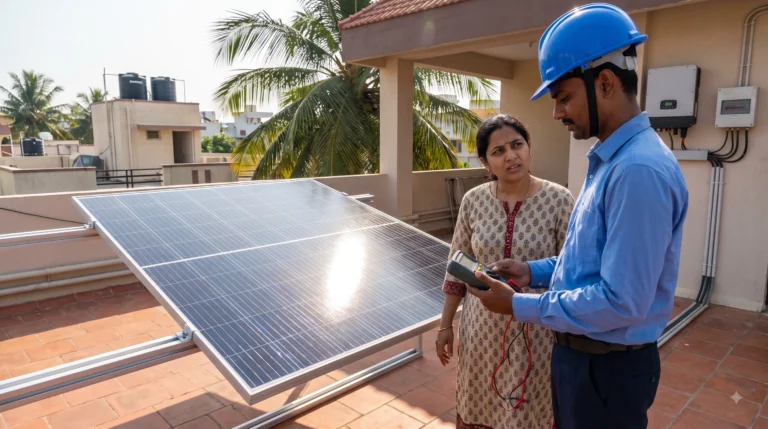
Solar generation naturally changes throughout the day and year.
Cloud Cover
Cloudy conditions reduce the solar radiation reaching the panels and can lower electricity production.
Rain and Monsoon Weather
Rain itself does not mean solar panels stop working, but cloudy conditions associated with rainy weather can reduce generation.
Temperature
Solar panels operate differently as their temperature changes. Higher module temperatures can reduce electrical output relative to their rated performance under standard test conditions.
This is particularly relevant during Hyderabad’s hotter periods.
Dust and Soiling
Dust accumulation can reduce the sunlight reaching the solar cells.
Regular inspection and appropriate cleaning can help maintain performance.
Shading
Shadows from:
can reduce production.
Orientation and Tilt
The direction and angle of the panel influence how much solar radiation reaches its surface.
System Losses
Electricity also experiences losses through wiring, inverter conversion and other components of the complete system.
How Hyderabad’s Climate Affects Solar Generation
Hyderabad generally has good solar potential, but the output of a solar panel changes with local weather and seasonal conditions.
Summer
Longer periods of strong sunlight can support substantial solar generation, although high module temperatures can affect panel output.
Monsoon
Cloud cover and rainy weather can reduce solar irradiation and therefore lower generation on some days.
Winter
Clear conditions can still provide good generation, although the amount and duration of available sunlight differ from summer.
Dust & Soiling
Dry periods can result in dust accumulation, making appropriate panel maintenance important.
The key point is that solar generation should be evaluated over longer periods rather than expecting exactly the same number of units every day.
Does a Higher-Wattage Panel Generate More Electricity?
Generally, yes, under comparable conditions.
A 550 W panel has a higher rated capacity than a 400 W panel. If both receive similar sunlight and operate under similar conditions, the 550 W panel has greater electricity-generation potential.
However, panel wattage should not be the only purchasing consideration.
Also compare:
A professional installer should select panels based on the complete system rather than wattage alone.
How Many Panels Do You Need for a 5 kW System?
A simplified calculation is:
Number of Panels ≈ Required System Capacity ÷ Panel Wattage
For example, with 550 W panels:
5,000 ÷ 550 = 9.09
Since panels cannot normally be installed as a fraction, the final system design would use a practical number of modules that meets the required configuration.
For example, 10 × 550 W panels = 5.5 kW DC capacity.
However, the final number of panels should be determined based on the inverter configuration, electricity requirements, roof space, electrical design and applicable project requirements.
One Panel vs the Complete Solar System
While calculating one panel’s generation is useful for understanding the basics, homeowners should ultimately evaluate the complete solar system.
A rooftop installation includes:
The complete system’s output is more important than the theoretical production of an individual panel.
How Shading Can Affect One Panel
Even a high-wattage panel cannot generate its expected output if sunlight is significantly obstructed.
For example, shading from a nearby water tank during part of the day can reduce the energy reaching affected modules.
The impact depends on:
This is why a professional shading assessment should be part of rooftop solar planning.
Solar Panel Electricity Generation vs Your Electricity Bill
The electricity generated by one solar panel is useful for understanding system output, but solar generation is not automatically equal to electricity-bill savings.
Your home’s final electricity cost depends on how much solar electricity is generated, how much you consume directly, how much electricity you import from the grid, and the applicable utility arrangement.
Direct Solar Consumption
Electricity generated during the day can be consumed by appliances operating at that time.
Grid Import
When household demand is higher than available solar generation, electricity may be drawn from the grid.
Surplus Generation
If solar generation exceeds immediate household consumption, eligible surplus electricity may be exported to the grid according to the applicable arrangement.
Fixed & Other Charges
Even with substantial solar generation, electricity bills may still contain applicable fixed charges and other charges.
Therefore, don’t assume that generating 800 units of solar electricity automatically means saving the exact cost of 800 units on your electricity bill.
How to Monitor Actual Solar Generation
After installation, monitoring is one of the best ways to understand your system’s real performance.
Modern solar systems may provide generation information through:
You can monitor:
Daily → Monthly → Annual Generation
Monitoring can also help identify unusual drops in production that may be associated with shading, soiling, equipment issues or other problems.
The actual generation recorded by the system is more useful for evaluating performance than relying only on an initial theoretical estimate.
Solar Installation Process in Hyderabad
A professional rooftop solar project generally follows these stages:
Review your electricity consumption and determine the approximate solar requirement.
Assess roof area, orientation, shading and access.
Select suitable panel capacity, inverter and layout.
Estimate expected production using the site’s conditions.
Review equipment specifications, project scope and pricing.
Complete applicable utility and project documentation.
Install mounting structures, panels, inverter, wiring and protection equipment.
Check system operation before handover.
Track actual electricity generation after commissioning.
Receive technical assistance and maintenance guidance.
What Affects Solar Installation Cost?
The cost of a rooftop solar system depends on more than the number of panels.
Key factors include:
Higher-wattage panels can reduce the number of modules required for a particular capacity, but the overall project should be evaluated based on equipment quality, system design and installation requirements.
A professional site survey is recommended before receiving a final quotation.
Government Subsidy & Net Metering
Eligible residential consumers may qualify for applicable government rooftop solar financial assistance. Current eligibility, subsidy requirements, documentation and commissioning conditions should be verified before installation.
For grid-connected rooftop solar, surplus generation may be eligible for net metering or another applicable export arrangement depending on current utility regulations and the property’s electricity connection.
Important: Don’t use outdated subsidy figures or old utility rules when calculating your solar investment. Verify the applicable requirements at the time of installation.
Expert Tips for Better Solar Panel Electricity Generation
A 550 W rating doesn’t mean 550 W of electricity will be produced continuously.
A good shading assessment can help identify potential generation losses.
High module temperatures can affect electrical output.
Dust and other soiling can reduce the sunlight reaching the panels.
Don’t judge the system from one unusually sunny or cloudy day.
Your installer should explain the assumptions behind any projected generation.
Consider panels, inverter, structure, warranties, installation and after-sales service—not only panel wattage.
Regular monitoring can help identify unexpected performance changes.
Additional ACs, EV charging or other appliances can change your future solar requirement.
Actual roof conditions are essential for a reliable generation estimate.
At-a-Glance Guide
Factor | Effect on Generation |
Panel Wattage | Determines rated capacity |
Peak Sun Hours | Determines available solar resource |
Shading | Can reduce output |
Temperature | Can affect panel efficiency |
Dust/Soiling | Can reduce sunlight reaching cells |
Direction | Influences solar exposure |
Tilt | Influences sunlight incidence |
Weather | Creates daily and seasonal variation |
System Losses | Reduce usable electricity |
Maintenance | Helps support consistent performance |
Illustrative Hyderabad Home Scenario
Consider a Hyderabad homeowner evaluating a 550 W solar panel.
Using the illustrative assumptions from Part 1:
Estimated Daily Generation
0.55 × 5 × 0.80 = 2.2 kWh
Estimated Annual Generation
2.2 × 365 = 803 kWh
The homeowner can then use this figure as a conceptual starting point when understanding how individual panels contribute to a larger rooftop system.
However, actual annual generation may be different because Hyderabad weather, panel temperature, shading, dust, orientation, equipment performance and system downtime vary.
Key lesson: Use calculations to understand potential generation, but use a professional site assessment and actual monitoring to evaluate real-world performance.
It depends on panel wattage and site conditions. For example, a 550 W panel using illustrative assumptions of 5 peak sun hours and an 80% performance ratio produces approximately 2.2 kWh per day.
Using the same illustrative assumptions, approximately 2.2 units per day or 803 units per year. Actual generation will vary.
No. 550 W is the panel’s rated power capacity, not its constant hourly electricity generation.
Sunlight, panel wattage, shading, temperature, orientation, tilt, dust, weather, inverter performance and other system losses can affect output.
High module temperatures can reduce electrical output relative to standard test conditions. Actual impact depends on the panel’s temperature characteristics and operating conditions.
It depends on the wattage of each panel and site conditions. For example, ten 550 W panels have a combined rated capacity of 5.5 kW. Their actual energy generation depends on sunlight and system performance.
The number depends on panel wattage. Ten 550 W panels would total 5.5 kW DC, while the final configuration should be determined according to the complete system design and inverter requirements.
Yes. Shading can reduce the sunlight reaching the affected panel and therefore affect energy production. The impact depends on the timing, location and extent of shading.
Depending on the installed equipment, generation can typically be monitored through the inverter display, mobile application or web-based monitoring platform.
Roof Rays can review your electricity consumption and assess your rooftop, shading, available space and other site conditions before preparing a suitable solar design and generation estimate.
Roof Rays Solar Solutions helps homeowners across Hyderabad and Telangana evaluate rooftop solar based on their actual electricity requirements and property conditions.
Why Customers Choose Roof Rays
The focus is on understanding the property first and designing a solar system around its actual requirements.
Our experts design customized solar solutions based on your electricity consumption, roof space, and future energy goals—helping you maximize savings and achieve the best possible return on investment.
Phone
Address
📍 HUDA Complex, Tellapur, Hyderabad
Contact our solar experts today for a free consultation and personalized solar savings estimate.
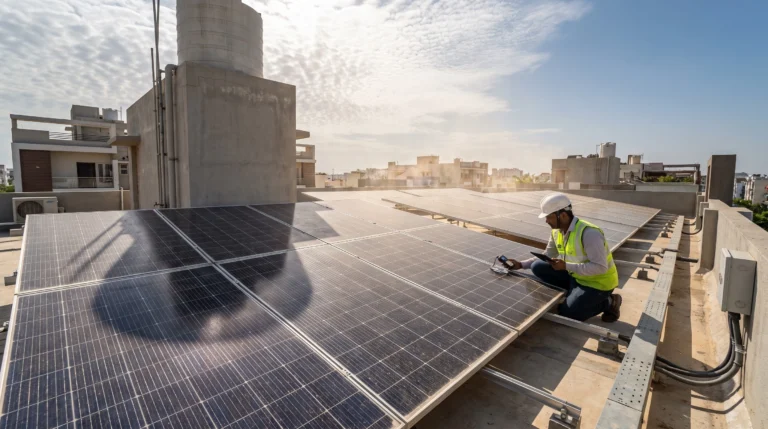
Understanding solar panel electricity generation in Hyderabad requires more than looking at the wattage printed on a solar panel.
A 550 W panel, for example, has a rated capacity of 0.55 kW. Under the illustrative assumptions used in this guide, it could generate approximately 2.2 units per day, but actual production can vary significantly with sunlight, weather, temperature, shading, dust, orientation, tilt and system losses.
For this reason, homeowners should use generation formulas as a planning tool, not as a guarantee. The most reliable approach is to assess the complete rooftop system, compare expected generation with household electricity consumption, and monitor actual production after installation.
Roof Rays Solar Solutions provides electricity bill analysis, site assessment, solar generation estimation, customized system design, professional installation and ongoing support for residential and commercial customers across Hyderabad and Telangana.
Book Your Free Site Survey Today
© 2025 Roof Rays Solar Solutions. All Rights Reserved. | Designed by MANI
Check whether your property qualifies for rooftop solar subsidy support.
