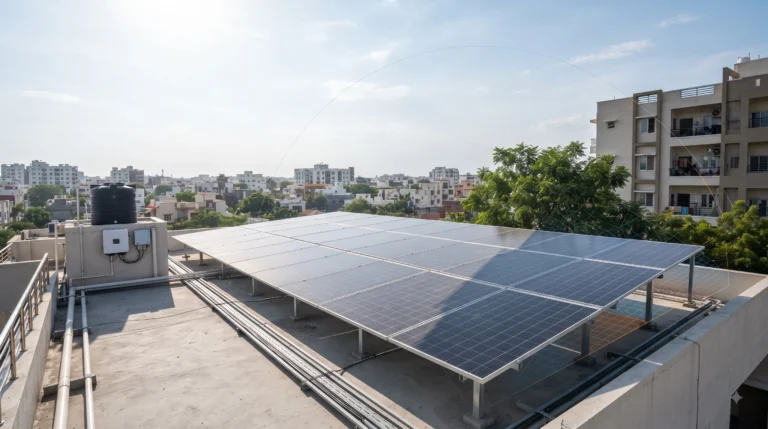
Solar panels need sunlight to generate electricity, so shading is one of the most important factors to evaluate before installing a rooftop solar system. A property may have plenty of roof area, but not every part of that roof is necessarily suitable for solar panels.
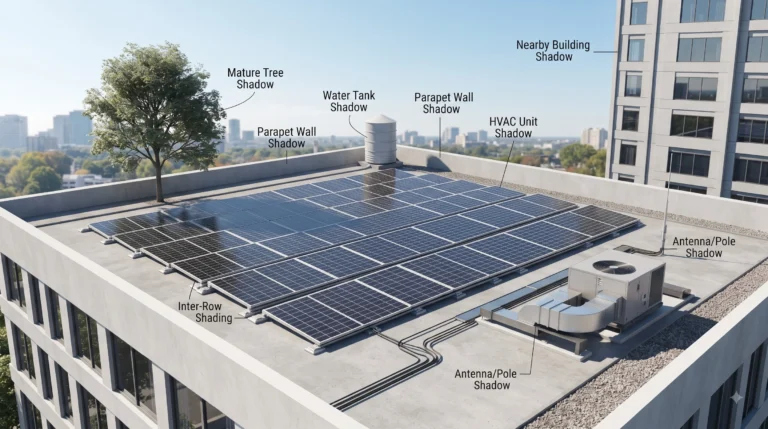
Shadows can come from nearby buildings, trees, water tanks, parapet walls, antennas, HVAC equipment and other rooftop structures. On flat roofs, solar panels can even cast shadows on other panels if the rows are positioned too closely.
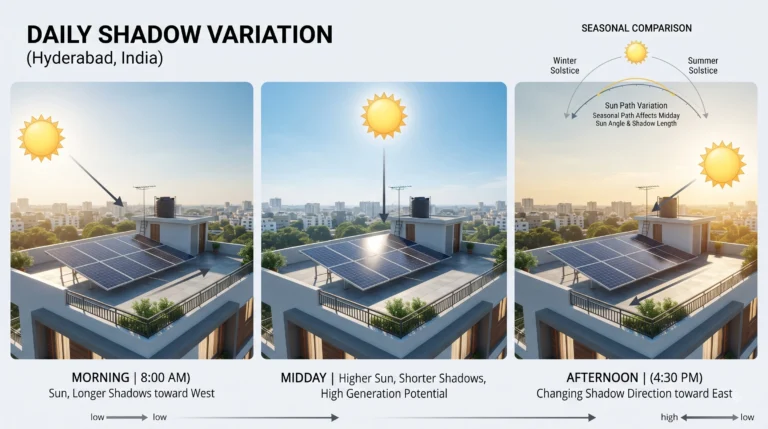
The challenge is that shadows do not remain in one location throughout the day. An area that looks completely clear at noon may be shaded in the morning or afternoon. Shadow patterns can also change with the seasons as the sun’s position changes.
This is why solar panel shadow analysis should be carried out before the final panel layout is approved. It helps identify potential shading sources, understand when shadows may affect the array, and design the rooftop around the most useful available solar area.
For homeowners and businesses in Hyderabad, this assessment is particularly useful in urban locations where neighboring buildings, trees and rooftop structures can be close to the proposed solar installation.
Solar panel shadow analysis is the process of identifying where and when shadows fall on a proposed solar array and assessing how those shadows may affect solar generation.
The assessment can consider:
The purpose is not simply to find out whether a roof is shaded. It is to understand which areas are shaded, when they are shaded, how the shadow changes, and how the panel layout can be designed accordingly.
A professional analysis can help determine where panels should be positioned and how rows should be arranged before installation.
Why Is It Important?
Because total roof area and usable solar area are not always the same.
A smaller area with good solar exposure may be more useful than filling the entire roof with panels without considering recurring shadows.
Key Takeaways
Solar panels convert sunlight into electricity through photovoltaic cells. When an obstacle blocks sunlight from reaching part of the array, the affected modules may produce less electricity.
The effect of shading is not necessarily identical in every installation.
It can depend on:
For this reason, it would be misleading to claim that a particular amount of shading always produces an identical percentage reduction in system output.
The important principle is simple:
Repeated or significant shading should be identified and considered during system design rather than ignored.
Common Sources of Solar Panel Shadows
Neighboring houses, apartments and commercial buildings can cast shadows onto a rooftop.
This can be particularly relevant in densely developed urban areas where buildings are located close to one another.
The impact can change depending on:
Trees are a common source of rooftop shading.
Unlike fixed structures, trees can change over time.
Branches and leaves may expand into areas that currently receive good sunlight. Therefore, a solar assessment should consider not only the tree’s current size but also its potential future growth where relevant.
Water tanks are common rooftop structures in residential properties.
Depending on their height and location, they can cast shadows onto nearby solar panels.
The panel layout should therefore be designed around existing tanks rather than simply treating the entire roof as available installation space.
Parapet walls can create shadows, particularly when the sun is at a lower angle.
Their effect depends on:
This is one reason why panel placement on a flat roof requires more than simply measuring the available square footage.
Commercial and office rooftops may contain:
These structures can create localized shadows and also limit where panels can safely be installed.
A commercial solar layout should account for these existing systems while maintaining appropriate maintenance access.
Antennas, poles, pipes and other small structures can also create localized shadows.
Although an individual obstacle may appear insignificant, its position relative to a panel can determine whether it creates recurring shading during particular periods.
This is an important consideration on flat roofs.
If solar panel rows are positioned too close together, one row can cast a shadow onto another.
For example:
Front row → casts shadow → rear row
The solution isn’t necessarily to use less solar capacity. Instead, the layout should balance panel count, tilt, row spacing, roof area and generation requirements.
Why Shadow Analysis Must Consider Time
A rooftop does not have one fixed shading condition.
The same location can experience different conditions throughout the day.
Morning
The sun is positioned toward the east, so buildings and other obstacles can cast shadows in particular directions.
Midday
The sun is higher in the sky, and shadows may become shorter depending on the season.
Afternoon
West-side obstacles may become more relevant as the sun moves toward the west.
This means that simply visiting a rooftop at noon and observing clear sunlight is not enough to establish that the entire roof is shade-free.
A proper assessment should consider the movement of the sun and the resulting shadow patterns.
Seasonal Shadow Changes
Shadow patterns can also change during the year.
The sun’s apparent position changes with the seasons, affecting:
For example, an obstacle that produces limited shading during one period may cast a longer shadow during another period.
Therefore, effective solar panel shadow analysis should consider relevant seasonal conditions rather than relying on a single observation.
How Shadow Analysis Helps Solar Design
A professional shading assessment can influence several parts of the solar layout.
Panel Placement
Panels can be positioned in areas with better solar exposure where practical.
Direction
The available roof sections can be evaluated to determine practical panel orientation.
Tilt
The panel angle can be selected while considering shading and the overall mounting design.
Row Spacing
Flat-roof installations can be designed to reduce avoidable shading between rows.
System Layout
Panel count, roof utilization, generation potential and maintenance access can be considered together.
Future Risks
Potential future shading sources, such as growing trees or planned rooftop structures, can also be considered during design.
Shadow Analysis for Flat Roofs
Flat roofs require particular attention because solar panels are generally installed using mounting structures that raise the modules above the roof.
The panels themselves can then create shadows.
If rows are installed too closely together:
Front-row panels → cast shadows → rear-row panels
Increasing row spacing can help reduce this effect, but it also requires more roof area.
Therefore, flat-roof design involves balancing:
The goal is not simply to fit the maximum number of panels onto the roof.
Shadow Analysis for Sloped Roofs
Sloped roofs have a different set of considerations because the roof itself already provides an angle and direction.
The assessment should consider:
Panels can then be positioned in suitable areas while considering shading, structural safety and maintenance access.
Solar Panel Shadow Analysis in Hyderabad
Urban rooftops in Hyderabad can encounter several potential shading sources, including:
Although Hyderabad has strong solar potential, that does not mean every rooftop receives the same usable sunlight.
A property surrounded by tall buildings, trees or other structures can have a very different solar profile from an open rooftop.
Therefore, local solar potential should be treated as a starting point. The actual roof must be assessed individually before finalizing the solar system.
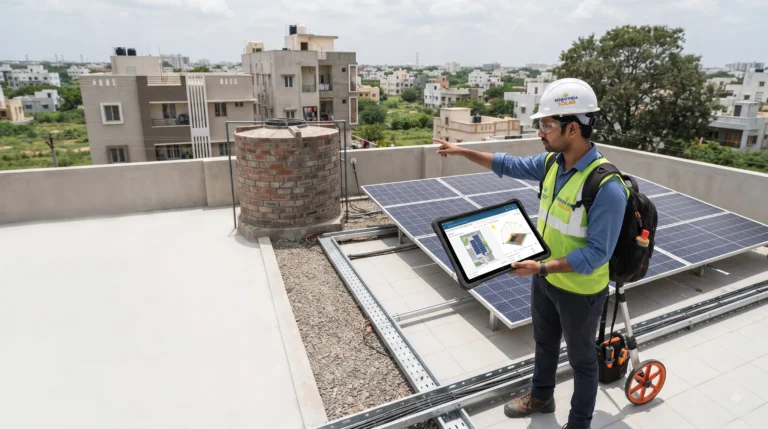
How Professionals Perform Shadow Analysis
A professional assessment can generally involve:
Depending on the project, professional solar designers may use dedicated solar design and shading-analysis software to model the rooftop.
Can Solar Panels Be Installed on a Partially Shaded Roof?
Yes, a partially shaded roof may still be suitable for solar, but the shading should be understood before finalizing the system.
A site assessment should identify:
The layout can then prioritize areas with better solar exposure.
Depending on the project, suitable module-level and electrical design approaches may also be considered. The important point is that partial shading does not automatically make a property unsuitable, but ignoring it can lead to unrealistic generation expectations.
Common Solar Shadow Analysis Mistakes
A roof that looks clear at midday may have significant morning or afternoon shading.
Shadow length and direction can change as the sun’s position changes throughout the year.
A tree that causes little shading today may become a much bigger obstruction later.
Rooftop tanks can create recurring localized shadows.
Fitting more panels onto the roof isn’t necessarily better if some areas have poor solar exposure.
Panels installed too close together can shade the rows behind them.
A layout should leave practical access for cleaning, inspection and maintenance.
Even a relatively small structure can create recurring shadows depending on its height and location.
A single site visit cannot always show how shadows move throughout the day and year.
When reviewing a solar proposal, ask what shading assumptions were used to calculate expected generation.
Solar Installation Process
Shadow analysis should form part of the complete solar installation process.
Understand current electricity consumption and future requirements.
Measure the roof and identify obstacles.
Evaluate potential shading throughout the day and relevant seasons.
Determine practical panel orientation and mounting arrangement.
Select an appropriate solar capacity.
Position panels while balancing generation, roof usage and access.
Review equipment, generation estimates, pricing and project scope.
Install the mounting structure, panels, inverter and electrical components.
Verify system operation.
Track generation and provide ongoing technical assistance.
What Affects Solar Installation Cost?
Shadow analysis itself is only one part of overall solar project planning.
Project cost can be influenced by:
A shaded or complex rooftop may require a more carefully optimized layout, but cost should be evaluated together with the expected generation and overall project requirements.
A site survey is recommended before receiving a final quotation.
Government Subsidy & Net Metering
Eligible residential consumers may qualify for applicable government rooftop solar financial assistance. Current eligibility, subsidy requirements and documentation should be verified before installation.
For grid-connected rooftop solar, surplus electricity may be eligible for net metering or another applicable export arrangement depending on the current utility rules and the property’s electricity connection.
Important: Government subsidy amounts and utility procedures can change. Verify the latest applicable requirements before calculating project economics.
Expert Tips for Solar Panel Shadow Analysis
At-a-Glance Shadow Checklist
Factor | Why It Matters |
Trees | Can create changing and future shadows |
Buildings | May produce long-duration shadows |
Water Tanks | Common rooftop obstruction |
Parapet Walls | Can affect sunlight at lower angles |
HVAC Equipment | Important on commercial rooftops |
Panel Rows | Can create inter-row shading |
Morning Shadows | Can affect early solar production |
Afternoon Shadows | Can affect later production |
Seasonal Shadows | Shadow patterns change throughout the year |
Roof Layout | Determines the truly usable solar area |
Illustrative Hyderabad Rooftop Scenario
Consider a Hyderabad home with a flat roof large enough for the proposed solar system. The rooftop also contains a water tank, a high parapet wall and a nearby tree.
Simply filling the entire roof with panels may not provide the best result.
Instead, a site assessment considers:
The final design can then prioritize areas with better solar exposure and avoid or minimize problematic shaded locations where practical.
Key Lesson
The total physical roof area is not necessarily the same as the usable solar area.
Good rooftop solar design balances panel capacity with sunlight availability, shading, roof conditions and long-term maintenance.
It is the process of identifying potential shadows on a proposed solar array and evaluating when and where those shadows may affect solar generation.
Shading reduces the sunlight reaching affected photovoltaic modules and can reduce their electricity production. The overall impact depends on the extent, duration, location and system design.
Observe potential obstacles throughout the day and consider seasonal changes. For a more reliable assessment, use a professional site survey and appropriate solar-design analysis.
Yes. Trees can cast shadows over panels, and their growth can change the shading situation over time.
Yes. A rooftop water tank can create shadows depending on its height, position, panel location and the sun’s position.
Not necessarily. The impact depends on which modules are shaded, the duration and extent of shading, and the electrical configuration of the system.
Often, yes. The roof should first be assessed to identify usable areas and understand the extent and timing of shading.
On flat roofs, panels installed at an angle can cast shadows onto rows behind them. Appropriate row spacing can help reduce avoidable inter-row shading.
Yes. The sun’s position changes throughout the year, which can change shadow direction, length and duration.
Roof Rays can assess your rooftop, identify potential shading sources, evaluate the available solar area and incorporate those conditions into the proposed solar layout.
Roof Rays Solar Solutions helps homeowners and businesses across Hyderabad and Telangana evaluate rooftop solar based on actual property and electricity requirements.
Why Customers Choose Roof Rays
The focus is on understanding the rooftop first and designing a solar system that balances solar exposure, generation potential, safety, usable space and maintenance access.
Our experts design customized solar solutions based on your electricity consumption, roof space, and future energy goals—helping you maximize savings and achieve the best possible return on investment.
Phone
Address
📍 HUDA Complex, Tellapur, Hyderabad
Contact our solar experts today for a free consultation and personalized solar savings estimate.
Solar panel shadow analysis is an important part of planning a reliable rooftop solar installation. A roof may appear large and suitable for solar, but its actual usable area depends on sunlight availability, surrounding structures and how shadows move throughout the day and across seasons.
Buildings, trees, water tanks, parapet walls, HVAC equipment and even other solar-panel rows can create shading. Ignoring these factors can make a generation estimate less representative of actual site conditions.
The objective is not simply to install the maximum possible number of panels. A better approach is to identify usable solar areas, understand shading patterns, optimize panel placement and maintain practical access for the life of the system.
For Hyderabad homeowners and businesses, Roof Rays Solar Solutions can assess the rooftop, electricity requirements and shading conditions before developing a customized solar installation plan.
A properly assessed roof leads to a better-informed solar investment.
Book Your Free Site Survey Today
© 2025 Roof Rays Solar Solutions. All Rights Reserved. | Designed by MANI
Check whether your property qualifies for rooftop solar subsidy support.