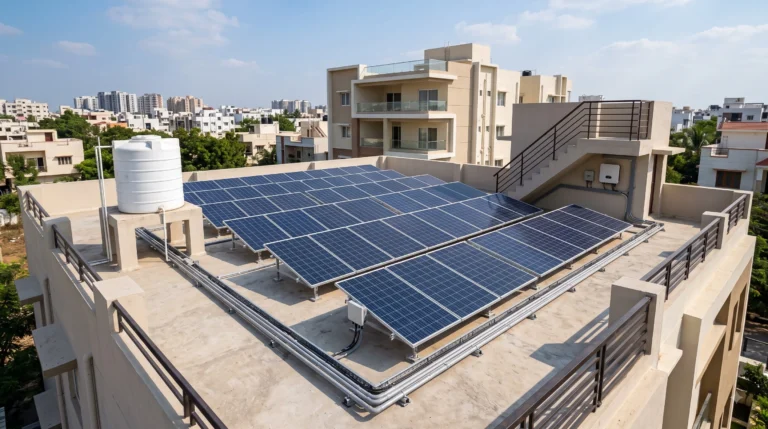
RCC, or reinforced cement concrete, is one of the most common roof types found in Indian homes, villas, apartments, offices and commercial buildings. Its relatively flat and usable surface often makes it suitable for rooftop solar installations.
However, installing solar panels on an RCC roof is not simply a matter of placing panels on the terrace and connecting them to an inverter.
A proper installation should consider the existing roof condition, structural capacity, mounting method, wind exposure, waterproofing, drainage, shading, panel orientation, access and electrical safety.
This becomes particularly important when the rooftop already contains water tanks, staircase rooms, parapet walls, solar water heaters, AC equipment or other structures.
The good news is that RCC roofs can often accommodate rooftop solar successfully when the system is appropriately designed and installed.
For Hyderabad homeowners and businesses, a professional site survey is therefore an important first step before deciding the system capacity or final panel layout.
Yes. Solar panels can commonly be installed on RCC roofs, provided the roof and mounting arrangement are suitable for the proposed system.
Before installation, the installer should assess:
The mounting approach should also be selected according to the specific roof and project.
An RCC roof should not automatically be assumed to be structurally suitable just because it is concrete.
Where there is uncertainty about structural capacity or roof condition, appropriate structural assessment should be obtained before proceeding.
Key Takeaways
RCC stands for Reinforced Cement Concrete.
An RCC roof uses concrete reinforced with steel reinforcement to provide structural strength.
RCC roofs are common in:
Because many RCC roofs provide relatively open terrace space, they can be suitable for rooftop solar.
However, the roof’s age, construction, condition, structural design and existing loads still need to be considered.
Why RCC Roofs Are Suitable for Rooftop Solar
An RCC terrace can provide several practical advantages for solar installation.
Relatively Open Surface
Many RCC roofs provide usable flat areas for arranging solar panels.
Flexible Panel Layout
Panels can generally be positioned using suitable mounting structures according to the roof’s orientation and available space.
Easy Access
A well-designed RCC terrace can provide access for:
Multiple Mounting Possibilities
Depending on the project, mounting structures can be designed to suit the roof and desired panel orientation.
But these advantages do not remove the need for structural and waterproofing assessment.
Structural Safety: The Most Important Consideration
The first question should not be:
“How many solar panels can fit on the roof?”
It should be:
“Is the roof suitable for the proposed solar installation and its additional loads?”
The installer should consider:
If the roof’s structural capacity is uncertain, a qualified structural professional should assess it.
Important
Do not drill, anchor or load an RCC roof without understanding the structural and waterproofing implications.
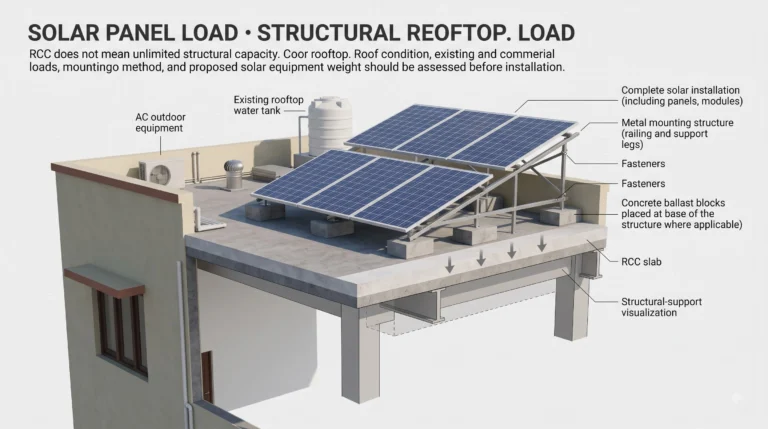
How Much Load Does Solar Add to an RCC Roof?
The total added load depends on the complete installation.
It can include:
The actual load varies by panel, mounting system and installation method.
Therefore, there is no single weight figure that should be applied to every RCC rooftop solar project.
A professional design should determine the actual equipment and mounting arrangement before assessing the additional load.
RCC Roof Mounting Methods
There are different approaches to mounting solar panels on an RCC roof.
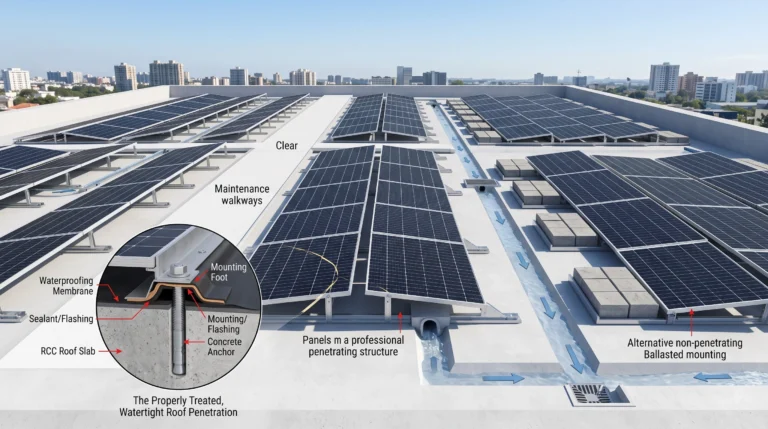
Mounting structures can be mechanically fixed to the roof where appropriate.
This approach requires careful consideration of:
The roof should not be penetrated casually.
Some rooftop systems can use ballast to hold the mounting structure in place rather than relying primarily on roof penetrations.
However, ballast adds additional weight.
Therefore, the structural capacity of the roof must be assessed before using a ballasted arrangement.
Some RCC rooftops require customized structures because of:
The appropriate mounting solution should be selected after surveying the property.
Waterproofing: A Critical RCC Roof Consideration
One of the biggest concerns with rooftop solar installation is waterproofing.
An RCC terrace may already have a waterproofing system designed to prevent rainwater from entering the building.
If mounting structures require roof penetrations, poor workmanship can potentially create leakage points.
Therefore:
Important
A solar installation should protect the roof as well as support the solar panels.
Can Solar Installation Cause Roof Leakage?
A properly designed and professionally executed installation should account for waterproofing.
However, roof penetrations, poorly sealed anchors, damaged waterproofing or blocked drainage can create potential leakage risks.
Before installation, homeowners should ask:
These questions are especially important on older RCC roofs.
Roof Drainage Must Remain Clear
RCC terraces need proper drainage to prevent standing water.
Solar structures should not obstruct:
Panels and mounting structures should be positioned so that normal rainwater drainage remains functional.
This is particularly relevant during Hyderabad’s monsoon periods.
Never maximize panel coverage at the expense of essential roof drainage.
Solar Panels on RCC Roof: Shading Considerations
RCC roofs commonly contain several structures that can cast shadows.
Potential sources include:
Shadows change throughout the day and can vary seasonally.
A professional solar panel shadow analysis can help identify areas that may experience recurring shading.
This can influence:
Panel Direction & Tilt on an RCC Roof
A flat RCC roof provides flexibility because the mounting structure can establish the desired panel angle.
However, the final direction and tilt should be determined from the actual property.
Consider:
For Hyderabad, south-facing orientation can be a strong starting point for annual solar exposure, but the final design should not ignore site-specific conditions.
A shade-free east- or west-facing section can sometimes be more practical than a theoretically ideal direction that is heavily obstructed.
Solar Panels Around Water Tanks on RCC Roofs
Water tanks are common on RCC terraces.
They don’t necessarily need to be removed before installing solar panels.
The installer can evaluate:
Panels can often be arranged around the tank when the roof provides sufficient suitable space.
The key is to maintain:
Solar exposure + access + safety + practical layout
rather than simply trying to cover every open section of the roof.
How to Protect Rooftop Access
Solar panels should not make essential rooftop equipment inaccessible.
Maintain practical access to:
This is important because solar systems are designed for long-term operation and will require periodic inspection and maintenance.
A layout that maximizes panel count but makes equipment difficult to reach may create unnecessary problems later.
RCC Roof Condition: What Should Be Checked?
Before installation, inspect for:
Cracks
Visible cracks may require evaluation before additional rooftop equipment is installed.
Water Seepage
Existing leakage should be addressed rather than concealed beneath a solar structure.
Surface Damage
Damaged roof areas may need repair.
Waterproofing Condition
Existing waterproofing should be understood before mounting work.
Drainage
Drain outlets should be identified and kept accessible.
Existing Loads
Water tanks and other permanent equipment should be considered as part of the rooftop’s existing condition.
Age of the Building
Older buildings may require more detailed structural evaluation.
Common Mistakes When Installing Solar on RCC Roofs
A roof should be assessed before the final design.
RCC construction does not mean unlimited additional load capacity.
Existing rooftop loads should be considered.
Unplanned penetrations can affect structural and waterproofing performance.
Solar structures should not obstruct water-flow paths.
Roof obstacles can reduce expected generation.
More panels aren’t automatically better if the layout compromises access or roof functionality.
Mounting structures should be appropriately designed for site conditions.
Cables should be routed safely and protected appropriately.
Access should be considered before installation, not after the roof is filled with panels.
RCC Roof Safety Checklist
Before installing solar panels on an RCC roof, check the following:
If there is uncertainty about the roof’s structural capacity, obtain an assessment from a qualified structural professional before installation.
Structural Assessment: When Is It Important?
Not every rooftop solar project requires the same level of structural investigation.
A more detailed assessment may be appropriate when:
The purpose is to make sure the proposed solar installation is compatible with the existing structure.
Never assume that an RCC roof can accept any solar structure simply because it is made from reinforced concrete.
Installation & Waterproofing Precautions
For an RCC rooftop, installation quality matters as much as equipment selection.
Where roof penetrations are required:
Where a non-penetrating mounting arrangement is appropriate, the structural implications of the added ballast must also be evaluated.
The correct mounting method depends on the individual roof.
Solar Installation Process on an RCC Roof
A typical project can follow these stages:
Review current consumption and future electricity requirements.
Measure the terrace and assess its condition.
Determine whether the proposed mounting arrangement is suitable.
Identify shadows from tanks, buildings, trees and other obstacles.
Design the panel position, orientation, tilt and row spacing.
Choose a suitable mounting approach for the roof.
Select panels, inverter and required electrical protection.
Install the mounting structure and solar modules.
Complete DC and AC connections, protection and cable routing.
Verify system operation and safety.
Track generation after commissioning.
Maintain panels, electrical equipment and access areas as required.
RCC Roof Solar Cost Factors
There is no single installation price for every RCC rooftop.
Project cost can vary based on:
A customized quotation should therefore follow a site survey rather than being based only on the number of panels.
Government Subsidy & Net Metering
Eligible residential consumers may qualify for applicable government rooftop-solar financial assistance.
For grid-connected rooftop solar in Telangana, current subsidy, net-metering and utility requirements should be verified before installation because rules and procedures can change.
The rooftop’s RCC construction does not itself determine subsidy eligibility. Applicable government and electricity-distribution requirements determine whether the consumer qualifies.
For commercial and industrial properties, the applicable regulatory and financial arrangements can differ from residential installations.
RCC Roof Solar Maintenance
A well-designed solar installation should allow practical access for ongoing maintenance.
Panels
Keep modules reasonably free from excessive dust and soiling.
Mounting Structure
Inspect for visible issues, corrosion or loose components where applicable.
Electrical Equipment
Check inverter alerts and electrical equipment through qualified personnel.
Drainage
Ensure roof drains remain clear.
Waterproofing
Inspect areas around any roof penetrations periodically for signs of water ingress.
Shading
Check whether new trees or nearby structures are creating additional shade.
Generation
Monitor production and investigate unusual changes.
Expert Tips
Don’t finalize the panel count before understanding the RCC roof.
Prioritize suitable placement, sunlight and safe access.
Don’t wait for leakage to become a problem.
Ask whether the structure is anchored, ballasted or another type and why it is suitable for your roof.
Water tanks and other permanent rooftop equipment should be considered.
Never allow solar structures to interfere with essential rainwater drainage.
The inverter, tank, panels and other serviceable equipment should remain accessible.
Mounting structures should be appropriately designed for the site’s environmental conditions.
A structurally suitable roof can still have poor solar exposure.
Compare panel specifications, inverter, mounting structure, warranties, generation estimate and installation scope—not just the final price.
At-a-Glance RCC Solar Checklist
Factor | What to Check |
Roof condition | Cracks, damage and deterioration |
Structural capacity | Suitability for proposed additional loads |
Waterproofing | Existing system and penetration protection |
Drainage | Drains and water-flow paths remain clear |
Water tanks | Location, load, access and shading |
Shading | Trees, buildings and rooftop structures |
Mounting | Anchored, ballasted or suitable alternative |
Wind | Appropriate structural design |
Access | Maintenance and equipment servicing |
Electrical safety | Proper equipment, protection and installation |
Yes, many RCC roofs can accommodate rooftop solar, provided the roof and proposed mounting system are suitable.
The panels themselves do not inherently damage an RCC roof. However, poor mounting, inappropriate drilling, damaged waterproofing or improper installation can create structural or leakage concerns.
Yes. Solar modules, mounting structures and other associated equipment add load. The actual additional load depends on the system design.
The need for a detailed structural assessment depends on the building, roof condition, existing loads and proposed installation. Where structural suitability is uncertain, qualified professional assessment is appropriate.
Some mounting arrangements can avoid direct roof penetration, but they may use ballast or other methods. The suitability of the approach depends on the specific roof and structural requirements.
Poorly executed roof penetrations or damaged waterproofing can create leakage risks. Proper mounting, sealing and waterproofing practices are therefore important.
Yes. Solar panels can often be arranged around existing water tanks while maintaining suitable access and minimizing shading.
Potentially. The roof’s actual condition should be assessed before installation, particularly where there are cracks, leakage, deterioration or uncertainty about structural capacity.
No. Rooftop solar mounting structures can accommodate different roof conditions, but the specific design depends on roof geometry and installation requirements.
Roof Rays can conduct a site assessment covering roof area, obstacles, shading, proposed panel layout, installation requirements and other factors relevant to the solar project.
Roof Rays Solar Solutions helps homeowners and businesses across Hyderabad and Telangana plan rooftop solar around their actual electricity requirements and property conditions.
Roof Rays Can Help With:
The objective is to develop a solar installation that balances generation, structural suitability, waterproofing, safety, accessibility and long-term usability.
Our experts design customized solar solutions based on your electricity consumption, roof space, and future energy goals—helping you maximize savings and achieve the best possible return on investment.
Phone
Address
📍 HUDA Complex, Tellapur, Hyderabad
Contact our solar experts today for a free consultation and personalized solar savings estimate.
Solar panels on an RCC roof can be a practical long-term solution when the installation is properly planned. The fact that a building has an RCC terrace does not automatically guarantee structural suitability, but it can provide a useful foundation for a rooftop solar system when the roof, mounting arrangement and existing loads are appropriately assessed.
The most important considerations are structural suitability, waterproofing, drainage, shading, mounting method, wind exposure and maintenance access.
Homeowners should avoid treating solar installation as simply placing panels on an empty concrete surface. Water tanks, staircase rooms, parapet walls, AC equipment and other rooftop structures all influence the final design.
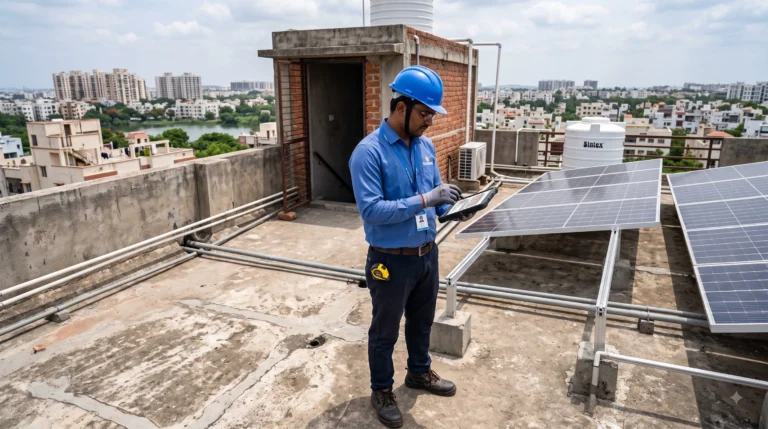
A professional site survey can identify these factors before installation, allowing the panel layout and mounting system to be designed around the actual property.
For Hyderabad homes and businesses, Roof Rays Solar Solutions can help evaluate the rooftop, electricity requirements and installation conditions before recommending a suitable solar solution.
A good rooftop solar installation should protect the roof, work with the building and generate electricity for years to come.
Book Your Free Site Survey Today
© 2025 Roof Rays Solar Solutions. All Rights Reserved. | Designed by MANI
Check whether your property qualifies for rooftop solar subsidy support.